Crypto at the World Cup - just not on equal footing
England opened their 2026 World Cup campaign on Wednesday with a 4-2 win over Croatia. Harry Kane scored twice - including a penalty in the 12th minute and a second goal in the 42nd - tying Gary Lineker as England's all-time top World Cup scorer. Jude Bellingham and Marcus Rashford rounded out the scoring. It was a high-quality opening match that drew attention for the football.
But there is a quieter story playing out at this tournament, and it has nothing to do with the pitch.
The 2026 World Cup is the first in history to feature crypto companies in its official partnership structure. Kraken, Avalanche, Chiliz, and Chainlink all have a role. Yet if you are looking for any of them among FIFA's seven global partners or eight official 2026 sponsors, you won't find them. None of them are there.
This matters because the reason they aren't is structural - and it says something about where the financial establishment wants crypto to sit in the public square.
The crypto tier
FIFA 2026 created what is essentially a crypto-specific sponsorship category. Kraken is the "Official Crypto Exchange Supporter". That's a real title, and it carries activations across North America and Europe for the tournament's seven-week run. Chiliz provides fan tokens (tradable digital tokens tied to clubs and national teams, which let supporters vote on minor club decisions and earn rewards). Avalanche hosts FIFA's official blockchain infrastructure. Chainlink supplies the oracle plumbing - the data bridges that connect real-world outcomes to on-chain contracts - for what FIFA is calling the first official prediction market at a World Cup, run by partner ADI Predictstreet.
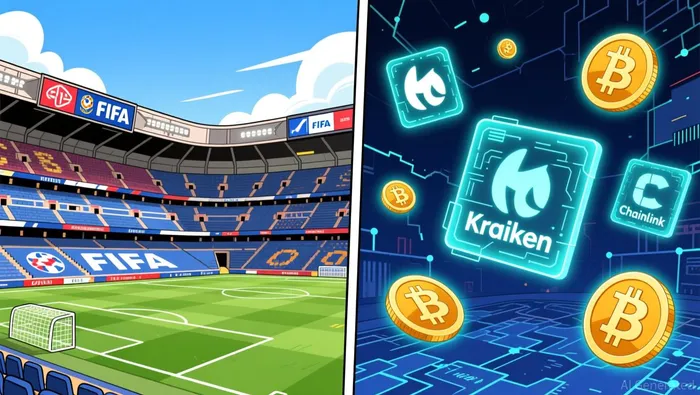
What you get when you read through these roles is a crypto ecosystem at a major global event, each piece doing what it does: the exchange does exchange, the fan-token platform does fan tokens, the oracle does data, the blockchain does hosting. It feels like marketing. And in some ways, it is.
But the architecture of it tells a different story. FIFA did not fold crypto into its existing global-partner tiers. It built a separate lane. That is a deliberate choice, not an oversight. You don't have a Visa and a Mastercard as global partners and then put a crypto exchange on the same shelf - not when those relationships are worth hundreds of millions and built on decades of negotiation.
So instead, FIFA created a category that isolates crypto from the traditional financial sponsors. The signal is clear: we will take the money and the attention, but we will not blur the line with the incumbents.
The national teams are not playing by the same rules
The segregation at FIFA level contrasts sharply with what's happening at the national-team level. There, the action is unfettered. Argentina, the defending champion, has six crypto partners for this tournament, including LBank, Nexo, BTCC, Deepcoin, and Bybit. Individual associations are free to build whatever relationships they want, because their sponsors don't compete with FIFA's global tiers in the same way.
This two-track system - segregated at the top, open at the national level - is not unique to crypto. FIFA has always managed category exclusivity carefully. But it is revealing to see it applied to digital assets specifically, because it shows the sport's governing body navigating a political economy that traditional finance sponsors don't face.
Banks and card networks are settled institutions. Their regulatory posture is known, their customer bases are domestic and compliant, and their brand associations carry no controversy in conservative sporting cultures. Crypto firms, even the regulated ones, still carry questions about investor protection, jurisdictional arbitrage, and political sensitivity in countries where digital assets remain restricted.
The crypto tier is FIFA's way of collecting both audiences without having to take a position on which one wins.
What this is - and what it isn't
I should be clear about what this isn't. This isn't a headline about mass crypto adoption through football. Fan tokens are not wallets being funded for the first time. Prediction markets are not a breakthrough in decentralized finance. Most of the people watching England beat Croatia on Wednesday have never opened a crypto exchange.
What this is, though, is a statement about legitimacy and access. FIFA is testing whether crypto sponsorship can exist at the world's largest sporting event without disrupting its traditional financial architecture. The experiment's design - a separate tier - means the answer is already partly baked in. Crypto gets a seat, but not an equal one.
That may change. If the tournament goes well, if the crypto partners deliver measurable engagement, and if regulatory clarity improves in key markets, the pressure to elevate those relationships could build. Alternatively, if a high-profile crypto scandal coincides with the tournament, the tier might become more of a quarantine than a bridge.
The national-team deals - with their lower barriers and fewer constraints - might end up teaching us more about real crypto-fan engagement than FIFA's carefully managed structure ever could. Argentina's six crypto partners are already running the kind of promotions that a risk-averse global tier never would.
So as the 104 matches of this World Cup unfold, the on-pitch story is worth watching. But the off-pitch one - about who gets to sit at which table, and what that says about the future of finance in the world's most visible cultural space - is the one that will outlast the tournament.