Buy the Dip Again as Warsh Is Not That Scary and the AI Trade Remains Resilient With Bullish Technicals Intact
The stock market pulled back after the June 17 FOMC meeting as new Fed Chair Kevin Warsh tried to deliver a more hawkish message around inflation and price stability. However, the decline should still be viewed more as a short-term sentiment reset than the beginning of a major trend reversal. The core market driver remains unchanged. Investors continue to return to the AI trade whenever macro pressure fades, and the bullish technical structure in major indexes remains intact, though there are still key levels to watch.
From a price action perspective, the sell-off after the Fed meeting was not surprising. The market had been hovering near record highs after digesting the U.S.-Iran peace deal, while Warsh's first press conference became the core uncertainty. Recent bets on rate hikes have increased due to oil-driven inflation, even though Warsh is Trump's pick and the recent oil decline has not yet flowed through to inflation data. Investors still have little clarity on how to deal with the new Fed, and the hawkish message briefly froze sentiment, triggering another round of selling.
However, the important point is that the Fed did not actually deliver a policy shock. Rates were left unchanged at 3.5% to 3.75%, and although Warsh emphasized price stability, he did not commit to an immediate rate hike cycle. His tone was clearly hawkish, but his actual policy stance still appears closer to wait and see. That distinction matters. Markets can absorb hawkish language when liquidity conditions remain broadly stable and growth leadership remains strong. What would be far more dangerous is a clear signal that the Fed is preparing to restart aggressive tightening. That has not happened yet.
In fact, Warsh may be trying to rebuild inflation credibility without forcing the market to price in a near-term rate hike, which is another form of forward guidance. Inflation remains uncomfortable, especially with energy and geopolitical risks still present, so the new chair cannot sound dovish too early. But sounding hawkish is different from being forced into action. His reluctance to give a stronger tightening signal suggests that the Fed wants optionality rather than a preannounced policy path. For investors, that means rate hike risk deserves monitoring, but it should not yet become the dominant bearish thesis.
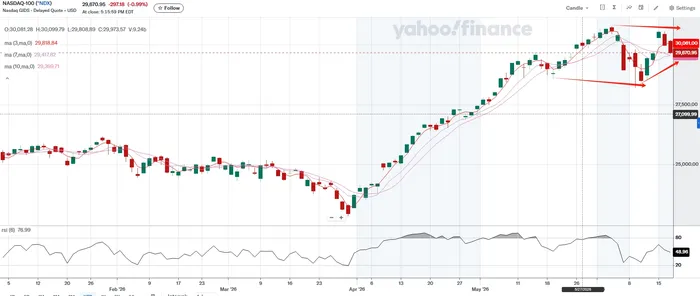
Technically, the bullish structure also remains intact. Despite the two-day sell-off, the tech-led Nasdaq 100 is still trading with MA3 above MA7 and MA10, while creating a potential higher-low pattern. However, investors should also watch whether a double-top or lower-high structure begins to form near key resistance. As long as the Nasdaq 100 trades above 28500, the key support level, there is little reason to panic. If the upward trend is reinforced and the index breaks 30000, or even reaches a new high, then a fully bullish setup would return.
This is why the latest dip may again become attractive if attention shifts back toward AI. The semiconductor complex has already shown signs of resilience, with several AI infrastructure and memory names rebounding even as broader indexes weakened. The market continues to reward companies tied to data center expansion, memory demand, networking, CPUs, GPUs, and power infrastructure.
Every time macro headlines create pressure, capital quickly rotates back into AI-related leaders once the immediate fear fades. This does not mean the trade is risk-free. Positioning is crowded, valuations are elevated, and market breadth remains narrow. But crowded leadership can persist for much longer when the earnings narrative continues improving. As long as hyperscalers keep spending aggressively and semiconductor demand remains supported by real orders, the market is unlikely to abandon the AI trade simply because the Fed chair sounded tough for one afternoon.
The bigger risk is not that the rally immediately collapses, but that it becomes too narrow again. If only a small group of AI and semiconductor stocks carry the entire index higher while the advance-decline line weakens, the market becomes more vulnerable to sudden air pockets. That remains the key warning signal. The sell-off in recent sessions was mainly driven by the Mag 7, which dragged the broader market lower, while buy-the-dip demand for AI leaders remains intact. Healthy bull markets can survive short-term overbought conditions, but they become more fragile when leadership narrows too much. Investors should therefore watch whether the next rebound broadens beyond chips and mega-cap technology, or whether it once again depends on the same crowded names.
Still, the macro backdrop is not bearish enough to invalidate the buy-the-dip strategy. Warsh's hawkish communication may keep rate-cut expectations limited, but the absence of an immediate hike threat reduces the risk of a major valuation reset. Meanwhile, AI demand continues to provide a strong growth anchor for the market. As long as earnings revisions remain positive across the AI supply chain, the path of least resistance may still be higher after short-term volatility fades.
In conclusion, the market's latest pullback looks more like a sentiment adjustment than a structural breakdown. Warsh is not as scary as the first reaction suggested, because the Fed kept policy unchanged and avoided committing to a new tightening cycle. The real focus should remain on whether AI leadership can regain momentum and whether Nasdaq 100 can hold above 28500 before attempting another move toward 30000. If support remains intact and AI stocks recover, the dip should be treated as another entry opportunity rather than a warning to exit. The key risk is narrow leadership, not a broken bull market. Investors should stay bold but selective, focus on AI names with real demand support, and use volatility as a chance to buy quality rather than chase fear.