Double-Top Warning Emerges as Crowd Trade Unwinds and Too Much Good News Is Priced In, Key Levels to Watch
The stock market is entering a more difficult phase after an extraordinary AI-driven rally failed to deliver a clean breakout. Too much good news may already be reflected in prices. Meanwhile, the usual crowd trade remains concentrated in a small group of semiconductor names, market breadth is lacking, and speculation surrounding SpaceX's blank-check style valuation adds another layer of concern. All of this suggests the current bull market has become more fragile. While it is too early to call a bottom or rush into buying the dip, investors should closely watch whether the narrative is beginning to pause for a while.
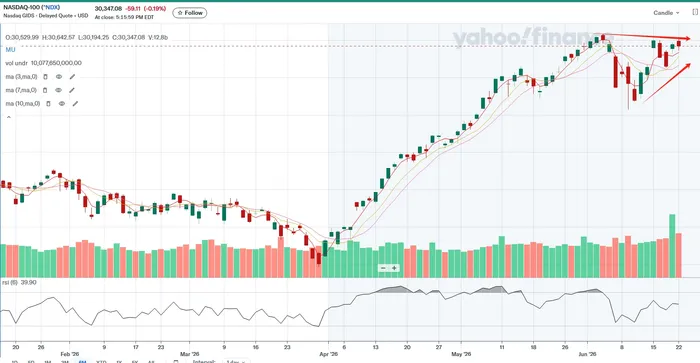
Put simply, a double-top structure is forming. It is not yet a confirmed bearish reversal, but it is a warning signal investors should take seriously. When an index fails near a major high after a powerful rally, it often suggests buyers are becoming less aggressive while profit-taking starts to increase. As we cautioned before, market breadth is narrowing, with semiconductors serving as the primary force behind the advance. That narrow leadership can become the market's "killer" if the same group that drove the rally begins to lose momentum.
Again, AI demand remains strong, hyperscalers are still spending heavily, and semiconductor earnings expectations continue to be supported by data-center investment. Investors are always eager to buy the dip. However, Monday's market action showed how uneven this rally has become. Micron, Intel, Sandisk, and AMD continued to outperform, while other mega-cap names such as Google, Microsoft, and Amazon became victims of rotation. This is not a broad advance. Instead, chip companies appear to be absorbing flows away from mega-cap stocks, making their valuations even richer as investors crowd into the same trade. Under such unhealthy conditions, a correction becomes increasingly obvious. The only question is timing, and it may be starting now.
The too-good macro backdrop could also become the perfect cash-out opportunity. Investors have long priced in the peace deal between the U.S. and Iran despite recent volatility, but as the agreement finally begins to take effect, a sell-on-the-fact reaction could emerge. Even though oil prices have dropped sharply, the impact on inflation will take time to show up, keeping the rate path uncertain. We still believe a rate hike is not the baseline scenario under new Fed Chair Warsh, but the uncertainty itself can make investors uncomfortable and become a trigger for selling pressure.
SpaceX is another example of how irrational this market has become. We previously covered the IPO, and even at a $2 trillion valuation, the company would trade at roughly 71 times sales using a projected $28 billion in annual revenue, which already assumes around 50% year-over-year growth despite only 15% expansion in the first quarter. By comparison, trillion-dollar companies such as Nvidia and Broadcom, among the richest valued mega-cap names, trade closer to 20 times sales while delivering gross margins above 70%. The difference is that investors are buying a blank check tied to the Musk-backed SpaceX story. If reality begins to challenge that optimism, it could strengthen the broader market's downward spiral until the sell-off becomes overdone.
The market is therefore facing a different type of risk from an event-driven crash. A geopolitical shock, extreme sentiment, or sudden policy surprise can spark a sharp sell-off, but those moves often recover quickly once fear fades. The more difficult corrections are normalizations. They happen when valuations become stretched without one obvious warning indicator, leadership narrows, and investors gradually realize that future returns may not justify the prices already paid.
These corrections can be slower and more frustrating because there is no single headline to blame. The market simply begins to lose momentum. Every rebound becomes weaker. Investors keep buying the dip because the long-term story still sounds attractive, but the index struggles to make sustained new highs. Over time, the leaders that pushed the market higher can become the same names that drag it lower as confidence fades.
From a technical perspective, the first cautious signal to watch is whether the Nasdaq 100's MA(3), MA(7), and MA(10) continue moving downward (MA3<MA7<MA10), which would suggest bearish momentum is beginning to form alongside the double-top pattern. The key support level remains 28,500. As long as the index holds above this zone, the current weakness can still be treated as a normal correction within a broader bullish trend. A successful defense of 28,500, followed by a recovery toward 30,000, would show that buyers remain willing to support the AI-led market.
However, a decisive break below 28,500 would be more concerning. It would confirm that the market is no longer simply pausing near the highs, but beginning to lose its higher-low structure. In that case, the bearish scenario would become more credible, and the sell-off could extend as investors start to panic.
The bearish case is not that AI is over. Demand remains real, and the long-term investment cycle around data centers, semiconductors, power infrastructure, networking, and enterprise software is still intact. The more immediate risk is that the market has moved too far ahead of itself. Even great companies can correct sharply when expectations become excessive.
To conclude, investors may now be better served by shifting into wait-and-see mode. There is no need to panic, but execution matters more than ever. Too much good news is already embedded in the AI trade, concentration risk is elevated, and the Fed is no longer offering the same comfort around future easing. That uncertainty could become the real risk. If an oversold move eventually develops, it may create another attractive entry point. For now, rationality is how investors win the game.