Cerebras Doubled Revenue, but Its Margin Guide Sank the Stock
Cerebras shares plummeted as soaring revenue growth was overshadowed by a sharp cut in gross margin guidance, highlighting the heavy cost of expanding AI infrastructure.
Cerebras shares closed Wednesday at $182.26, down 19.6% from Tuesday, after the AI-infrastructure company delivered its first earnings report since a May listing. The selloff moved the debate away from demand alone and toward the cost of supplying it.
Core revenue rose 92% to $191.3 million, yet second-quarter core gross-margin guidance fell to 36% to 38% from 47% in the first quarter. Reuters reported that the annual margin outlook was below the first-quarter level. Rapid growth survived the report; the assumption that growth would quickly absorb capacity costs did not.
Revenue growth is arriving before cost absorption
GAAP revenue reached $193.4 million, up 94% year over year. Cloud and other services revenue grew 178% to $82.8 million, faster than the 59% increase in hardware revenue to $110.6 million. GAAP net loss narrowed to $14.0 million from $23.9 million.
Those results showed commercial traction, but guidance set a different earnings bar. Q2 core revenue is expected near $194 million, up 88% year over year, while the midpoint of the gross-margin range is 10 percentage points below Q1.
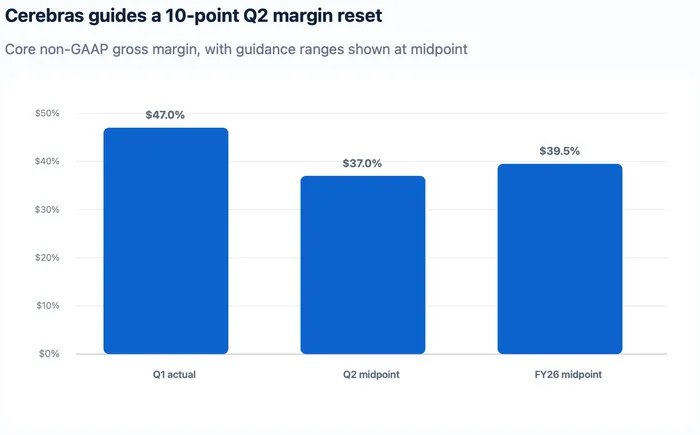
Source Cerebras earnings release filed June 23, 2026. Provider Cerebras Systems. Symbol CBRS. Date range Q1 2026 actual through fiscal 2026 guidance. Interval fiscal quarter and fiscal year. Basis core non-GAAP gross margin with guidance ranges shown at midpoint.
Core operating margin is guided to negative 30% to negative 32% in Q2. Revenue can still expand at a high rate while the income statement absorbs a much larger deployment bill.
OpenAI capacity turns demand into a near-term cost burden
Cerebras gave the mechanism in its quarterly filing. Pass-through data-center costs and startup spending to expedite cloud capacity are expected to reduce near-term gross margin; customer-warrant amortization also lowers reported revenue.
Capacity spending is already visible. Construction in progress rose to $294.7 million at March 31 from $163.5 million at year-end, while total depreciation expense increased to $18.2 million from $3.9 million a year earlier. Those costs arrive before new facilities reach steady workload levels.
Demand is not hypothetical. Cerebras announced a multi-year OpenAI agreement for 750 megawatts valued at more than $20 billion. AWS is also pairing Trainium 3 for prefill with Cerebras CS-3 systems for decode, creating a distribution path beyond a single anchor customer.
Q1 core cloud and other services gross margin was 53%, above the 42% core hardware margin. That spread offers the counterpoint to the selloff. Better utilization could restore unit economics, but capacity must fill quickly enough to outrun depreciation and startup expense.
The balance sheet buys time but not automatic returns
Funding pressure is lower than it was before the listing. Cerebras said it raised $6.4 billion in gross IPO proceeds, following a $1 billion Series H financing and a $1 billion OpenAI working-capital loan. An up-to-$850 million revolving facility adds more room for data-center acquisitions.
Cash does not settle the return question. Every new facility can lift future revenue, but it also adds fixed costs and execution exposure before customer workloads arrive. The selloff reflects that timing gap more than a collapse in reported demand.
Customer dependence raises the stakes. Three customers represented 86% of accounts receivable at March 31. Large counterparties can accelerate adoption, yet a delayed deployment or adverse development with one of them can move quarterly results sharply.
Q2 needs utilization to outrun capacity startup costs
Cerebras expects Q2 core revenue of about $194 million, core gross margin of 36% to 38% and core operating margin of negative 30% to negative 32%. Meeting the revenue number without holding the margin range would reinforce the view that expansion is consuming economics faster than it creates them.
Full-year guidance keeps the growth case alive. Core revenue is expected at $855 million to $865 million, up 69% at the midpoint, with core gross margin of 38% to 41%. A Q2 result near the top of the margin range, slower growth in construction in progress and a broader customer mix would show capacity economics improving.
More depreciation, another step-up in unfinished facilities or gross margin below 36% would point the other way. Cerebras has already established that customers want faster inference. The next disclosure must show that revenue from those workloads can rise faster than the infrastructure built to serve them.