Oil Drop Signals Fed Pivot as Hatfield Sees Rate Cuts and $50 Crude
Infrastructure Capital Advisors CEO Jay Hatfield predicts oil will fall to $50, driving disinflation and forcing the Federal Reserve toward rate cuts over the next two years.
Oil prices and interest rates are headed lower, not higher, according to Infrastructure Capital Advisors CEO Jay Hatfield, who said “we’re clearly moving into a disinflationary phase driven by energy,” as falling oil prices begin to reshape the inflation outlook and push the Federal Reserve toward rate cuts over the next two years. In an interview with AInvest's Capital and Power, Hatfield said that oil’s decline is being driven by rising global supply and a fading Iran war risk premium, setting up a more dovish policy path than markets currently expect.
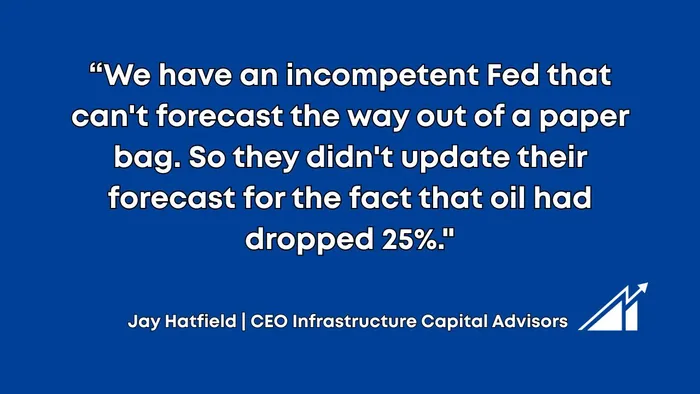
“We have an incompetent Fed that can't forecast the way out of a paper bag. So they didn't update their forecast for the fact that oil had dropped 25%," he said.
His call lands at a moment when energy markets have been easing from earlier Iran war driven spikes, with crude benchmarks recently retreating from highs as supply expectations improve and risk premiums unwind. At the same time, interest rate futures, according to Hatfield, have increasingly priced in a slower growth and disinflationary path rather than renewed tightening, reflecting a market consensus that inflation pressures are cooling even if central bank messaging remains cautious. Against that backdrop, Hatfield’s view places him at the more aggressive end of the disinflation camp.
Hatfield pointed to supply dynamics as the dominant force in crude markets. He said OPEC is positioned to raise output beyond its typical 29 million barrels per day toward as much as 32 million barrels, while Iran is also expected to push production higher now that exports can flow more freely. In his view, this combination leaves the market structurally oversupplied and reinforces downside pressure on prices.
He added that while developments around the Strait of Hormuz continue to generate headline risk, they do not meaningfully change the underlying trajectory. Even with periodic risk premiums, Hatfield said the direction of prices remains lower, with crude potentially settling into a $50–$60 per barrel range if supply conditions persist.
A key part of his argument is that oil does not move in a smooth, linear fashion. Instead, he said, once prices begin to fall, momentum tends to reinforce the decline as traders reposition and inventory dynamics adjust. That feedback loop, he suggested, makes earlier expectations of sustained $80–$90 oil increasingly difficult to justify.
From Lower Oil to a More Dovish Fed Path
Hatfield tied the energy outlook directly to inflation and monetary policy. He argued that the recent drop in oil prices has not yet fully worked its way through official inflation readings because of the way consumer price indices are constructed and lagged. Over the coming months, he expects that transmission to become more visible, with lower energy costs pulling headline inflation down and easing pressure on core measures as well.
On that basis, he rejected the case for further tightening by the Federal Reserve. “There’s definitely not going to be any rate increases,” he said, arguing that inflation will soften as energy, shelter, and tariff related effects roll through the data. He added that the more likely path is a series of policy cuts, potentially totaling three reductions by mid-2027, as disinflation becomes more firmly established.
Hatfield also questioned the reliability of market based expectations tied to Fed funds pricing, suggesting that longer dated Treasury yields offer a more stable signal of macro direction. In his view, bond markets are already beginning to reflect slower inflation and a higher probability of easing rather than tightening.
He also noted that infrastructure adjustments, such as expanded pipeline capacity and alternative shipping routes, are gradually reducing the vulnerability of global oil supply chains to chokepoints like the Strait of Hormuz. That development, he said, further supports a lower long term price environment by smoothing supply disruptions that historically drove spikes.
Hatfield’s conclusion is that the macro regime is shifting from inflation risk to deflation risk, driven primarily by energy. In that framework, both oil prices and interest rates are moving in the same direction, downward, over a multi-year horizon.

Register 👉 https://www.yotta-event.com/2026-passes/?utm_source=ainvest&utm_medium=partner&utm_campaign=yotta2026