Comcast's NBCUniversal Split Sent Shares Up 17%, Then Most of It Faded
Comcast shares surged 17% on its NBCUniversal spinoff plan, but gains faded as investors await critical debt allocation details to validate the breakup premium.
Comcast said on June 29 that it will spin NBCUniversal and Sky into a second public company, and CMCSA initially reacted as if a long-running conglomerate discount were about to disappear. The stock opened at $27.05 and reached $27.10, 16.96% above the prior close, before finishing at $24.22 for a gain of only 4.53%.
That reversal left a more useful verdict than the morning spike. Shareholders are due to own both companies after a tax-free separation expected in about a year, but the plan still lacks the debt allocation, standalone financials and long-term capital-return policies needed to value either piece with confidence.
Most of the breakup premium disappeared before the close
CMCSA surrendered nearly three quarters of its peak percentage gain during the regular session. The stock still rose, so the close did not reject the strategy. It reduced the premium attached to an outline whose most consequential numbers will arrive later.
Peer moves showed that the announcement reached beyond Comcast. Reuters reported Charter Communications up 11.2% during the session while Verizon, AT&T and T-Mobile fell between 3.9% and 5.8%. Charter offered a cable-focused comparison, whereas the wireless carriers reflected a different concern that a standalone Comcast could direct more management attention and capital toward its converged broadband and mobile offers. One day of price dispersion does not establish future market share.
Connectivity carries the reported earnings base
Latest operating data explain the initial enthusiasm. First-quarter results put Connectivity & Platforms revenue at $19.962 billion and adjusted EBITDA at $7.910 billion, with a 39.6% margin. Content & Experiences generated $11.940 billion of revenue but only $331 million of adjusted EBITDA. On those existing reported segments, connectivity supplied about 23.9 times as much adjusted EBITDA.
Those earnings still come with a customer-mix problem. Domestic residential broadband lost 65,000 customers in the quarter, although that was 117,000 fewer losses than a year earlier. Record wireless additions of 435,000 lifted total lines to 9.7 million. A focused valuation still needs narrower broadband losses and stronger wireless economics to offset network spending and the reported 4.3% decline in segment profit on an adjusted EBITDA basis.
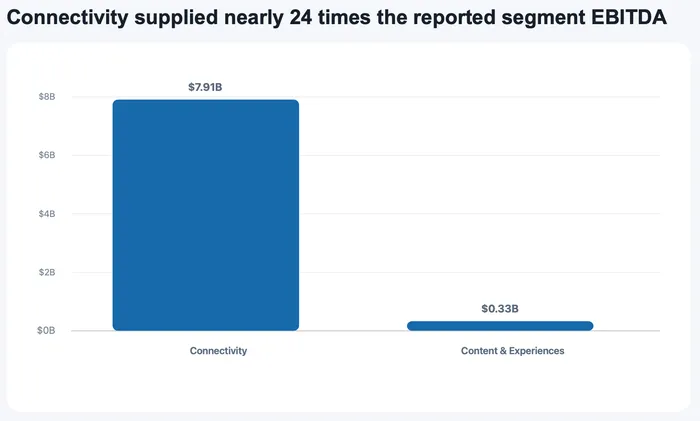
Source note Comcast first-quarter 2026 results. Symbol CMCSA. Period quarter ended March 31, 2026. Interval fiscal quarter. Basis company-reported adjusted EBITDA, a non-GAAP measure. Reported segments are shown before the announced post-spin Sky allocation and are not standalone pro forma results. Company results and separation perimeter.
NBCUniversal gets the growth assets and the heavier spending cycle
NBCUniversal will combine NBC, Peacock, Bravo, Universal's studios and theme parks with Sky. That collection has growth assets, but its earnings arrive on different calendars. Media posted a $426 million adjusted EBITDA loss in the first quarter, while Studios earned $555 million and Theme Parks earned $551 million. Parks EBITDA rose 33%, and Studios more than doubled its result from a year earlier.
Streaming and sports keep the spending burden visible. Comcast reported $2.1 billion of Peacock revenue and a $432 million adjusted EBITDA loss, including amounts tied to the Olympics and Super Bowl. Those events also make the quarter unusually noisy. Standalone NBCUniversal needs Peacock's scale and media distribution to join parks and studios as recurring profit sources rather than depend on a favorable release slate or attendance cycle.
Debt allocation will decide whether the split creates durable value
Capital structure is where the strategic narrative meets equity value. Comcast says both businesses will start with strong investment-grade balance sheets, yet management deferred the detailed debt, dividend and financing policies and paused share repurchases through the separation. Reuters put Comcast's debt at more than $90 billion, making its placement across the two companies more than an accounting footnote.
A retained NBCUniversal stake offers one offset. The company presentation allows Comcast to keep as much as 19.9% for up to a year after closing and monetize it to support deleveraging. Existing shareholders also keep exposure to both sides, so the breakup does not force an immediate choice between network cash flow and entertainment growth.
The June 29 close says separation alone is not enough. A stronger case would emerge if the Form 10 shows manageable debt at both companies, connectivity steadies broadband margins, Peacock narrows its loss after the sports-heavy quarter, and dividend capacity survives the split. Weak standalone cash generation or a prolonged buyback pause would leave the morning's 17% surge looking more like price discovery than durable value creation.