5 Bullish Setups as Chip Expansion, Space Catalysts, and Momentum Broaden Beyond Crowded Leaders
As Samsung and SK Hynix move forward with an ambitious $520 billion chip expansion plan, and with more capacity likely needed to address the ongoing chip shortage, semiconductor equipment stocks are regaining leadership. At the same time, momentum is broadening into smaller-cap space names and even defensive cash-flow stocks, giving investors new opportunities beyond the most crowded trades. This week's basket combines higher-beta growth names, small-cap space exposure, and defensive plays, while keeping the focus on bullish technical setups and strong short-term reversal signals. All five names are new to the column this week, ranging from small to large caps, with meaningful upside potential, diversification benefits, and key levels to watch.
Applied Materials (AMAT)
Strength: key equipment supplier to Samsung, SK Hynix, and Intel. The company has introduced new systems for DRAM and advanced packaging, targeting the 3D architectures behind next-generation AI chips. Management also expects semiconductor equipment growth of more than 30% in calendar 2026, supported by leading-edge logic, HBM, and advanced packaging demand.
Technical: The setup has accelerated into a clean MA3 > MA7 > MA10 structure, and the stock closed at new highs. Momentum remains strong, although the sharp move argues for disciplined position sizing rather than chasing an extended open.
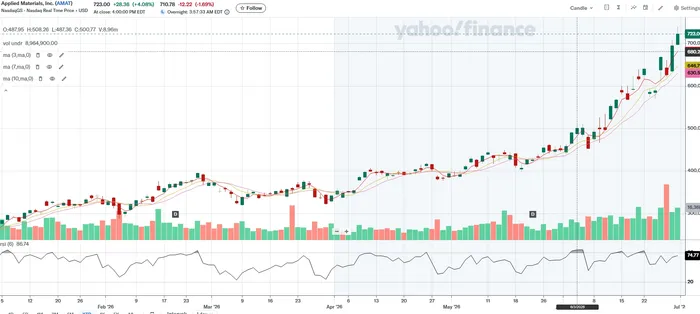
Short-term target: $750, or roughly 4% upside. If the frenzy continues, momentum could push shares toward $780.
Stop loss: Close below $620, which would suggest the trend is broken, or a renewed MA3 crossover below MA7.
Merck (MRK)
Strength: Merck offers defensive exposure while regaining momentum as its oncology franchise adds fresh regulatory catalysts. The FDA recently approved KEYTRUDA and KEYTRUDA QLEX, each in combination with Trodelvy, for first-line treatment of certain patients with advanced triple-negative breast cancer. Additional approvals and late-stage pipeline progress give investors multiple catalysts beyond the existing KEYTRUDA base.
Technical: The stock recently broke out and maintains a solid MA3 > MA7 > MA10 structure. The close at $128.50 sits just below MA3 after a fast multi-day advance, suggesting consolidation rather than a confirmed breakdown. Holding the $126 to $128 area would keep the breakout structure intact.
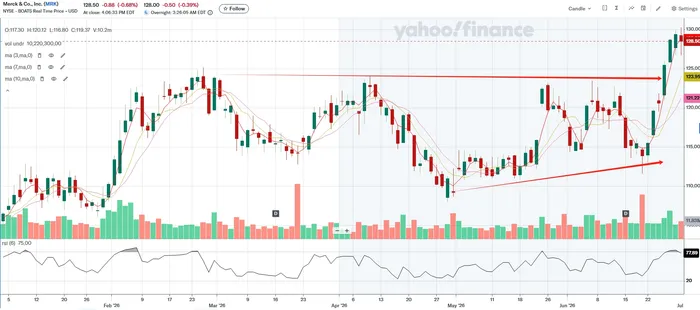
Short-term target: $135, or roughly 5% upside. If momentum continues, the next breakout scenario could point to $141.
Stop loss: Close below $120, which would erase the recent breakout.
NextEra Energy (NEE)
Strength: NextEra is a defensive play with upside from soaring U.S. electricity demand driven by the AI boom. The market has largely digested the proposed combination with Dominion Energy, and the outcome could still be positive whether the merger is approved or not. The company also has a substantial pipeline of large-load opportunities tied to data centers and advanced manufacturing. The setup blends utility stability with an infrastructure-growth catalyst.
Technical: MA3 remains above MA7 and MA10, with the moving averages trending upward. A recovery through the recent resistance zone would confirm renewed upside momentum. The pattern is less explosive than semiconductor names but offers a cleaner defensive profile.
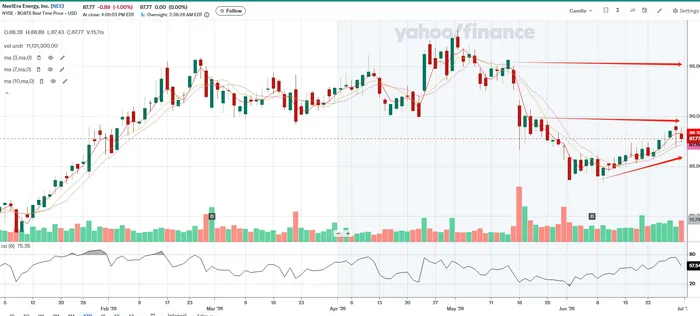
Short-term target: $90, or roughly 3% upside. A stronger move could push shares back toward $95, the level before the announcement, representing roughly 8% upside.
Stop loss: Close below $86, or MA7 crossing below MA10.
Chevron (CVX)
Strength: Chevron offers stable cash flow as the second-largest oil and gas producer in the U.S. The stock could still benefit from volatile oil prices and renewed Middle East tensions, making it a defensive energy name with short-term rebound potential.
Technical: The stock has returned to its January low, well before the U.S.-Iran conflict escalated. RSI is now near 16, the lowest level since last April, when shares saw huge volatility the following week. The current setup looks more like an oversold bounce than a long-term breakout, but the risk-reward could still appeal to short-term traders.
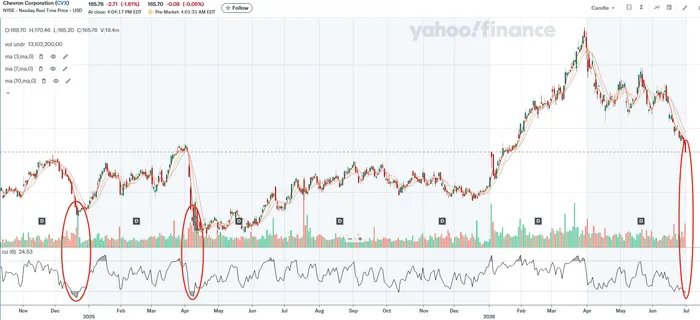
Short-term target: $170, or roughly 3% upside from current levels. This is more of a tactical rebound trade and could behave like a dead-cat bounce if broader momentum fails.
Stop loss: If RSI normalizes above 20 without meaningful price improvement, the bounce case weakens. Extreme RSI readings often create short-term return opportunities, but follow-through remains critical.
Planet Labs (PL)
Strength: Planet Labs operates one of the largest fleets of Earth-imaging satellites and is gaining attention after Rocket Lab's $8 billion agreement to acquire Iridium, a move that highlights rising strategic premiums across the space sector. As an important space stock, Planet could benefit from the broader revaluation of satellite and data infrastructure names. The company recently reported record revenue, up 42% year over year to $94 million, while backlog rose 72% to more than $906 million. Its acquisition of Bedrock Research could also accelerate AI-enabled geospatial solutions.
Technical: This is the strongest small-cap momentum setup in the basket. MA3 remains above MA7 and MA10, creating a clean bullish stack after two strong sessions. The next key test is the $34 to $34.50 resistance zone. A decisive breakout could extend the move toward $38 and potentially back to the previous high near $52.
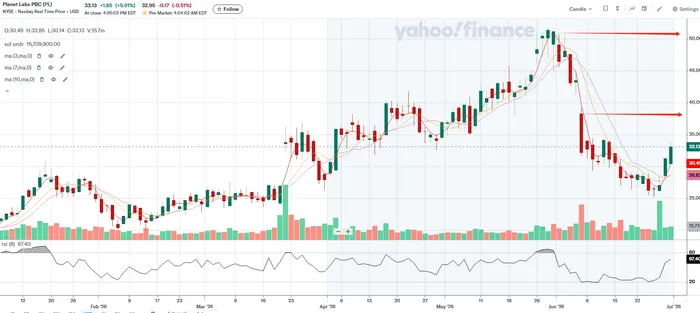
Short-term target: $38, or roughly 15% upside. In a bullish scenario, shares could eventually retest $52 and potentially challenge new highs.
Stop loss: Close below $29, or MA3 crossing back below MA7.