The Bid That Wasn't (But Is Now Again)
Bain Capital and LY Corporation cancelled their bid to buy Kakaku.com last month. Then they didn't really.
Or more precisely, Bloomberg is reporting on June 29 that the two are likely to submit a formal bid next week. So what happened? They put a bid on the table, pulled it back, and are now walking it back in. In M&A this is not the rarest maneuver in the world, but the sequence is worth looking at because the plumbing explains more than the price.
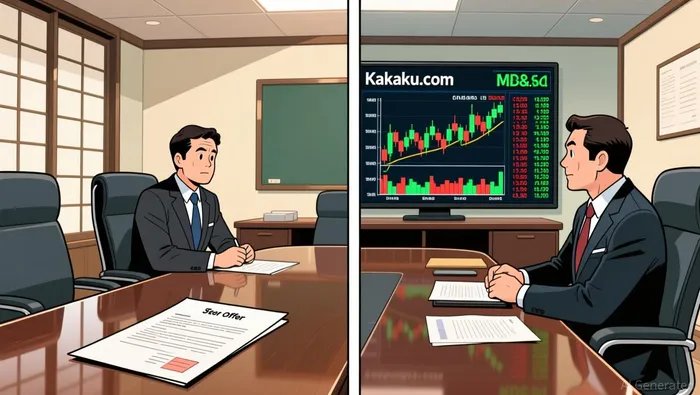
Let's establish the timeline, because the Japanese tender offer rules make the order of moves important. EQT, the Swedish private equity firm, launched a formal tender offer on May 13 for ¥3,000 per share in Kakaku.com, a price-comparison and classifieds platform. That values Kakaku at roughly ¥590–600 billion, or about $3.9 billion. On the same day, the Kakaku board announced it backed EQT's offer. Board endorsement matters in Japanese takeovers because it signals shareholder support and shapes the regulatory review.
Bain and LY had entered the picture earlier. LY - a SoftBank affiliate that runs Yahoo Japan - and Bain initially proposed to acquire Kakaku for about ¥640 billion on May 7. That's already a step above EQT's opening number. Then on May 13, the same day EQT's tender went live, they sweetened their offer to ¥3,232 per share, which comes to roughly $4 billion. So you had two bidders, a board that had picked a side, and a rival offer that was technically higher but not yet formal.
Then on June 5, LY and Bain announced they were cancelling their acquisition proposal. The cancellation removed what the market was treating as a near-term price catalyst. The deal was done, or at least it was going away. EQT's tender stood alone.
Three weeks later, Bloomberg says Bain and LY are preparing a new formal bid. Shares of Kakaku rose on the report.
The odd thing is not that there's a bidding war. The odd thing is the cancel-and-return, and what it tells you about how Japanese tender offers work.
In Japan, once a formal tender offer is underway, the rules around rival bids get complicated. If a new bidder wants to intervene, they need to file their own tender offer and meet certain procedural requirements. There are timing constraints around when you can launch, how long the offer has to stay open, and what happens if two tenders overlap. If Bain and LY were working out financing terms, structuring the LY partnership piece (LY isn't a pure private equity shop; it's a tech platform operator that also does investments), or negotiating with existing shareholders, the cleanest procedural move may have been to pull the formal proposal, sort out the mechanics, and file a fresh one.
Or the cancellation was a way to reset the negotiating position. By stepping away, Bain and LY may have forced the Kakaku board and EQT to think about what actually happens if the rival bid disappears and then comes back stronger. There's a sort of option value in saying "we're out" and then showing up again, because it signals that you can afford the delay and that your offer is genuinely competitive. EQT, meanwhile, is locked into its tender timeline and can't easily walk away from the ¥3,000 price point without looking weak.
The simplest model is this: Kakaku is a Japanese internet business worth somewhere between ¥590 billion and ¥640 billion depending on who's buying it. The ¥53 billion gap between the two bids is maybe 9% of the deal size - not enormous in M&A terms, but enough to matter when you're arguing over board loyalty, shareholder votes, and regulatory approval. The question isn't really whether Kakaku is worth more than EQT is offering. It's whether Bain and LY can close a higher bid before EQT's tender absorbs enough shares to become irreversible.
There's another layer worth noting. LY Corporation has a structural reason to be interested in Kakaku that a pure financial sponsor doesn't have. LY runs Yahoo Japan, one of the country's dominant search and portal properties. Kakaku.com is a price-comparison engine. That's not a random acquisition; it's an adjacency play. LY already owns a traffic platform. Adding Kakaku gives it a deeper grip on Japanese consumer commerce data and comparison shopping. Bain brings the capital and the operating playbook. So the Bain-LY bid has a strategic buyer's premium built into it, even if the formal bidder is structured as a private equity joint venture.
What happens next depends on what the formal bid looks like and whether the Kakaku board can credibly stick with EQT after a higher rival resurfaces. In Japanese M&A, boards have some independence but they also face shareholder and regulatory pressure not to throw away a premium. If Bain and LY file a tender at or above ¥3,232 per share, the board's position becomes awkward. If they file something lower, EQT's existing tender becomes the practical floor and the bidding war may end by exhaustion rather than by declaration.
This is basically a story about who can sit still longer. EQT is already in a formal tender, which means it has committed capital and disclosed its price to the market. Bain and LY cancelled, regrouped, and are coming back. They get the benefit of flexibility: they can adjust their price, restructure the deal terms, or time the filing to squeeze EQT's timeline. The Kakaku board, which publicly backed EQT, has the least flexibility of all. That's usually the position of the party that everyone is talking about but nobody is writing a check.
The compressed structural judgment: in a Japanese tender war, the bidders with the most procedural maneuverability tend to win. The board that commits first is the one that has to justify it afterward.