Robotaxis Are Just the Warmup: Why Humanoid AI Could Be 10x Bigger
Robotaxis showed autonomy can monetize; humanoids may broaden it
Robotaxis have already shown that autonomy can move from demo to revenue. The robotaxi market is still small at USD 0.61 billion in 2025, but the forecast to USD 96.31 billion by 2034 suggests self-driving technology is commercializing rather than merely attracting attention. If that core intelligence can be reused beyond one vertical, the next step could be much larger.
Humanoids are the more general-purpose bet because they are designed for a world already built for people. Most automation handles one job in a controlled setup. A humanoid, by contrast, can operate in spaces built for humans, use human-designed tools, and move between tasks without rebuilding the environment.
Why the humanoid shape matters commercially
Adaptability is the sell, not imitation
Buyers are increasingly focused on whether a robot can show up in an existing building and do useful work. That is why the humanoid form factor matters: it can operate in human environments and adapt to diverse tasks without forcing companies to redesign facilities from scratch. Stairs, door handles, aisles, workbenches, and standard tools are already in place; the commercial case improves if the machine can use them.
That is also why industrial and service deployments are likely to precede household adoption. For now, the strongest use cases are likely factories, warehouses, logistics operations, and other labor-tight workflows where a robot can handle multiple steps in a process and move between stations without a custom automation project for every new task.
Market size points higher, but buyers still want proof
The humanoid robot market was USD 4.89 billion in 2025 and is projected to reach USD 165.13 billion by 2034, above the robotaxi end-state estimate. But projected market size is not the same as near-term certainty. Enterprises are still being selective, and the companies that ultimately win will need to prove repeatable productivity, not just impressive movement.
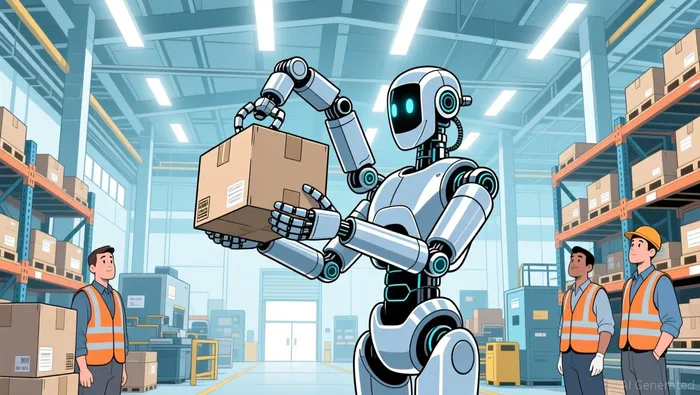
Humanoid developers are now being judged on commercial deployment scale, hardware maturity, and whether their software is moving beyond teleoperation toward more autonomous, vision-language-action model-driven operation. In practical terms, buyers want a robot that can do a shift, not just win a video.
Pilots are getting more credible
The category still sits in the early-commercial phase, but the evidence is improving. Figure AI's Helix-02 ran for 81 hours and handled 101,391 packages with zero failures. Agility's Digit has already accumulated 65,000 hours in real-world operations with customers such as Toyota and GXO. Those signals do not prove mass adoption, but they do show progress from concept validation toward usable reliability.
Capital is also concentrating in companies that look closer to execution. The humanoid robotics space was $2.9 billion global market in 2025, and Apptronik's $935 million Series A at roughly a $5.3 billion valuation underscores investor appetite for teams that pair robotics talent with commercial pilots.
What investors should watch next: - More pre-orders and paid deployments, not just livestreams. - Evidence that robots can handle variable, non-belt tasks in real sites. - Supply-chain milestones such as component wins and multi-year actuator orders.
If those signals keep showing up, the form factor starts to look less like a science project and more like a new category of industrial equipment.
The bigger economic case is versatility across workplaces
A humanoid can operate in spaces built for humans and adapt to different tasks without forcing a company to redesign floors, aisles, or tooling. That makes the opportunity look less like one route in one vertical and more like a general-purpose worker that can touch many workflows over time.
That is also why the market math matters. The humanoid robot market is projected to grow from USD 6.24 billion in 2026 to USD 165.13 billion by 2034 at a 50.60% CAGR. A curve like that usually suggests the technology can plug into more than one narrow use case. Asia Pacific accounted for 42.60% of market share in 2025, and broader commercialization pathways are tied to China's capacity growth strategy, which could help manufacturing scale and supply depth if the category matures.
The parts cascade may capture value first
The first reliable upside may sit less with the final robot brand and more with suppliers providing the muscle, senses, and controls. Hardware currently represents the majority of value capture because of actuator complexity, battery density requirements, and precision control systems. The ecosystem already spans actuator manufacturers, sensor suppliers, AI software developers, semiconductor providers, and system integrators.
Schaeffler committed to deploying up to 1,000 to 2,000 robots by 2032 and signed a five-year actuator supply agreement covering seven-digit joint actuators through 2031. That is a cleaner signal than a standalone demo because it links deployment intent with real component demand.
Public-market exposure is still narrow and catalyst-driven
Public-market exposure remains narrow, with only a small number of humanoid robot companies directly accessible to public-market investors, while many of the most commercial-looking names are still private or pre-IPO. That means near-term pricing can swing on headlines, so the theme is better approached as a proof chain rather than an earnings story.
That proof chain is improving. Figure's run included autonomous sorting in a sustained livestream, and Schaeffler paired deployment intent with a five-year actuator supply agreement. At the same time, buyers are still selective, with enterprises prioritizing measurable productivity gains over experimental deployments. That filters out noise and helps separate companies that can earn a rerating from those still living on demo value.
The story weakens if humanoids still cannot show full-shift workflows at competitive cost, or if buyers keep choosing conventional automation over general-purpose machines. For now, though, the direction of travel is clear: autonomy is moving from one domain into the broader physical economy.