Robotaxis Are the Setup: Why Humanoids Are the Real 10x AI Trade
Robotaxis proved the AI brain; humanoids may be the broader platform
Robotaxis showed that AI can handle real-world complexity on the road. Humanoids, by contrast, could extend that capability into physical work more broadly. The distinction matters because robotaxis are one vertical, while embodied AI could function as a wider platform for automation.
The market math helps explain the urgency. Embodied AI is projected to grow from $3.22 billion in 2025 to $7.24 billion by 2030, while the humanoid robot market could reach $200 billion in less than a decade, with some investors envisioning an even larger outcome over 10 years. That is what makes this more than a single-use-case story.
Why the window matters now
Public-market access is still narrow. A small number of humanoid robot companies are directly accessible to public investors, even as well-funded private companies move closer to IPOs. That scarcity may not last long once private deals start listing.
Tesla is also sending a clear signal about its priorities. Elon Musk said Model S and Model X trims will be phased out in favor of Optimus robot production, which underscores how seriously the company is treating the category even while commercialization remains early.
Why embodied AI is different from standard automation
This is not just another automation upgrade. The key difference is adaptability.
Automation repeats; embodied AI adapts
Traditional automation excels at repeating one programmed motion in a controlled setting. Embodied AI has to operate in messy, human-built environments, relying on capabilities such as adaptive learning in physical environments and real-time environmental perception. That is the real leap.
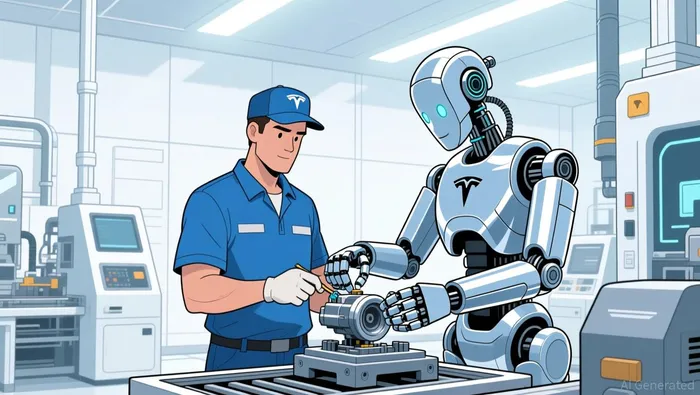
You can see the stack coming together at Tesla. Its Cortex 2.0 Phase 1 confirmed online April 2026 gives Optimus an AI training backbone, while Gen 3 hands beginning 24/7 deployment in Q2 2026 moves the system from lab demos into sustained factory work. Tesla is still the clearest public-market bridge because the same perception-and-decision technology behind advanced autonomy is being applied to a general-purpose body, and Tesla's vision-based autonomy has been reported to outperform emerging Chinese brands in some ADAS testing.
Why the humanoid shape matters economically
A humanoid form factor may lower integration costs in facilities already designed for people. Stairs, door handles, control panels, and shelving heights were built around human ergonomics, so a humanoid robot could use more of the existing workspace without expensive redesign.
That helps explain why embodied AI is spreading across manufacturing, logistics, healthcare, and consumer automation. The shape is not cosmetic; it may make deployment easier in environments already optimized for human movement and tools.
Where the revenue model could shift
The more interesting business question is not just hardware sales, but whether the system can improve through deployment. Tesla is still in a learning phase, and the next explicit milestone is first commercial customers signed. If that happens, the monetization story can start shifting from demos and unit shipments toward recurring software, fleet management, and deployment services.
Execution still has to keep moving. But with only a small number of humanoid robot companies directly accessible publicly, waiting could mean missing the transition from prototype narrative to recurring-revenue platform.
Tesla remains the clearest public proxy, but the burden of proof is clearer
Tesla is still the cleanest listed exposure, but the debate has changed. The stock is no longer being valued on EVs alone; it also carries substantial option value tied to Optimus, FSD, and robotaxis while trading at roughly 200× 2026 earnings. That means bulls do not need every long-term claim to be right. They need to show that the next deployment and commercialization gates are real.
