Robotaxis Hit a Wall. That's Why Embodied AI Is the Next $250B Leap
Robotaxis proved AI can operate in the physical world - and also showed how hard that is
The market is split for a reason.
Bulls argue robotaxis proved AI can leave the cloud and interact with physical reality. That is hard to dispute. Bears argue that if the category leader still needs to pause service in bad weather and construction, the technology is still more science project than mass-market product. Both views capture part of the truth. Robotaxis are a proof of concept, but they are also a stress test that exposed how unforgiving deployment in the real world can be.
Waymo showed that commercial rollout is still conditional
Waymo is the clearest example. It paused operations across Atlanta, Dallas, Houston, and San Antonio because heavy rain and flooded roads revealed gaps in knowing when not to drive at all, then extended those pauses to Austin and Nashville. In the same week, it also halted freeway service in San Francisco, Los Angeles, Phoenix, and Miami while improving construction-zone performance. That is not proof that robotaxis will not work. It is proof that commercial rollout is still conditional.
Why the opportunity is broadening beyond robotaxis
That helps explain why attention is widening from robotaxis to embodied AI. The winning stack is not just self-driving software. It is the full loop: models that understand the physical world, edge-case data flowing back from real deployments, and manufacturing scale that can push unit costs down. Europe is becoming another key testbed, with robotaxis expected to become far more visible across the region over the next two years, while 2026 and 2027 are being framed as an inflection point for the category.
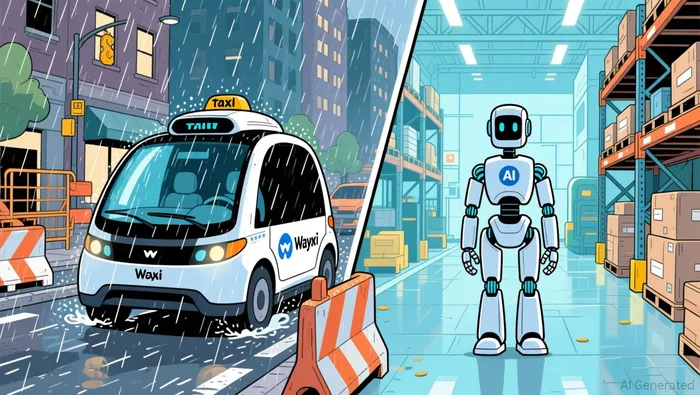
Robotaxis tested the frontier. Embodied AI is where the broader moat may get built.
Humanoids target a much wider labor-substitution market
Autonomous driving automates one job: getting a vehicle from A to B. Humanoids are aiming higher: they are trying to operate in environments that were built for humans in the first place. That is why the opportunity is not just larger. It could be a different order of magnitude.
Market forecasts are still early, but they point to hundreds of billions
The starting base remains small, but the projected trajectory is what matters. Barclays sees humanoid robotics scaling from roughly $2–3 billion today to $200 billion by 2035. Another forecast values the market at USD 4.87 Billion in 2025, rising to USD 251.40 billion by 2035. The key investor question is not whether today's demos look polished. It is whether the category is moving from prototypes toward real procurement.
One body, many environments
The appeal is structural. A robot that can move, balance, grip, and manipulate objects in human-shaped environments can enter spaces that already exist. Factories, warehouses, care facilities, and service spaces were designed around human ergonomics, tools, stairs, doors, and workflows. Humanoids do not require society to be rebuilt from scratch. That makes the addressable market much broader than any single application, including driving.
Bears are right that this versatility is still mostly theoretical. But the bull case is more than demo excitement: if one platform can span manufacturing, logistics, healthcare support, and broader service tasks, each deployment is not limited to one lane.
The economics are finally becoming easier to justify
The stack is also becoming more economic. The global robotics market reached $38B in 2026, a 34% year-over-year increase and the fastest growth the sector has seen in a decade. Humanoid robot installations surpassed 45,000 units in 2025, and twelve commercial humanoid platforms are already available for purchase or lease.
That is the real watchpoint: whether hardware, data collection, and foundation models can start compounding together well enough to support repeatable deployments.
China has an early deployment and iteration lead
China is not necessarily winning the final race, but it is leading the race that matters most at this stage: real-world exposure.
China's advantage is velocity, not optics
Chinese firms appear ahead because they have more units in the field, faster iteration cycles, and a hardware base already shaped by scale. Unitree shipped roughly 36 times more units last year than U.S. rivals Figure and Tesla, and analysts say China's broader hardware supply chain-much of it built through the EV sector-lets companies iterate faster than Western competitors. That is the real edge today: not flashier demos, but quicker learning loops.
Bulls and bears still disagree on what that means. The cautious read is important: it remains unclear how many of those units represent commercial sales versus demo or pilot deployments, so the headline alone should not be overread. Even with that caveat, though, the broader signal is still meaningful. In a category this early, the company with the most real-world exposure has the best chance to collect edge cases, refine policies, and widen its lead.
Public-market exposure is still limited
That matters for investors because the clearest winners are not obviously available yet. Only a small number of humanoid robot companies are directly accessible to public-market investors, while a larger group of well-funded private companies are still outside public markets. That creates opportunity, but it also limits choice.
The economics also help explain the current stage of the race. The source notes that twelve commercial humanoid platforms are available for purchase or lease, which is why pilots can start before full ownership economics are settled. That makes the near-term battleground less about which robot looks coolest and more about which company can prove repeatable utility, gather scalable data, and convert pilots into paid deployments.
What will separate real platforms from demo companies
The next 12 to 24 months matter more than the marketing. The key signal is no longer whether a robot works in a controlled demonstration. It is who can collect data, train a policy, and redeploy it repeatedly, economically, at scale. Robotaxis still matter in that framework because arrival doesn't guarantee permanence, and 2026 and 2027 are being treated as an important deployment window, especially in Europe.
The main scenarios
- Bull case: A few companies show that deployments can stick long enough to become repeatable labor or mobility infrastructure. If that happens, the sector starts to look more like a platform than a demo trade.
- Bear case: The category remains pilot-heavy and fragmented, with commercial conversion slower than the market wants.
What to watch
- Paid deployments that last longer than a trial period
- Evidence that real-world data is improving reliability outside controlled settings
- Broader rollout in Europe and other regulated markets
- Whether the pool of investable public-market names expands as the category matures