The $50 Billion Data Center That's Also a $9.5 Billion Loan
Switch - the Las Vegas data center builder founded by Rob Roy - is in talks to raise billions of dollars at a valuation of at least $50 billion, with Brookfield and KKR among the interested investors. The round would set the company up for an IPO as early as next year, according to The Information.
That is not a startup valuation. That is a private-equity exit play wearing a tech-adjacent hat. And the funniest part of this story, once you look at the plumbing, is that Switch is not just worth $50 billion to its new buyers. It is also borrowing $9.5 billion to build the thing they are buying into.
The basic point is that data centers in 2026 have become the closest thing to income-producing real estate you can buy. They are not speculative. They are preleased. Hyperscalers sign decade-long contracts before the concrete cures. The tenant has already committed to the power and the space. The risk is not whether someone will show up. The risk is whether the power grid and the building permit will let you show up in time.
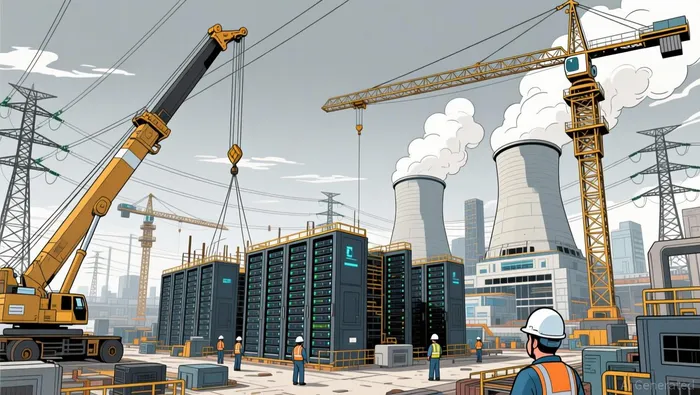
So when a company like Switch can go to Brookfield and KKR and say "here are the contracts, here are the campuses, here is the AI capex pipeline," the buyers are not buying a growth story. They are buying a toll road that someone else is paying to build. That is a very specific kind of asset. It is sort of commercial real estate with a longer lease and a bigger check.
This is not the first time Switch has done this dance with ownership. In 2022, DigitalBridge and IFM Investors took Switch private for approximately $11 billion. At the time, the deal valued the company at roughly $34 per share. DigitalBridge, IFM Investors, and management held stakes in the company after the take-private.
Now, four years later, those same owners are shopping the business at nearly five times the purchase price. The $50 billion round, if it closes at that number, would not just be an exit for the early investors. It would be a bridge to the public markets, where the valuation can - in theory - go higher, and where the original buyers can monetize without triggering a full sale.
But here is where the plumbing gets interesting. Just as Switch is talking to investors about a $50 billion equity value, the company increased its revolving credit facility to $9.5 billion in June 2026. That is not pocket change. That is nearly 20 percent of the equity valuation in debt.
The typical private-equity playbook for infrastructure assets goes like this: you buy the thing, you leverage the cash flows with debt, you raise the equity value through the operating story, you bring in a new tranche of private capital at a higher multiple, and then you go public. At each step, the equity multiple stretches while the debt layer quietly absorbs the capex risk. The new private-money investors get to ride the pre-IPO appreciation. The debt holders get first claim on the cash flows. The original buyers get an exit at a number that, in 2022, would have looked like a fantasy.
It's not a scam. It's just how you turn a $11 billion acquisition into a $50 billion public company. You add debt, you add a story, and you add time. The story here - AI infrastructure demand, power-constrained supply, hyperscaler capex that keeps expanding - is real enough that the market might buy it at $50 billion. Or $60 billion. The question is not whether Switch is building things people need. The question is what slice of the $50 billion is earnings and what slice is narrative, and who bears the downside if the narrative curdles before the IPO.
The answer to that question is the people who step into this round at $50 billion. If Brookfield and KKR are writing checks here, they know the numbers. They've done this movie before. They know which contracts are signed, which campuses are permitted, and which power interconnections are still in the queue. But there is always the gap between what the company tells private money and what a public prospectus has to disclose. And in the period between now and the IPO, when the equity is still private, that gap is where the original owners have all the information advantage.
The odd thing is not that Switch is expensive. The odd thing is that it's expensive and heavily indebted and still attracting major financial sponsors who are supposed to be in the business of finding bargains, not buying into a pre-IPO momentum story. But in a world where data centers have become the closest thing to a government-backed infrastructure play you can buy, $50 billion for Switch might not look like a stretch. It might look like a discount to the next multiple.
The simplest model is: Switch earns enough on its current contracted capacity to service $9.5 billion in debt and still throw off equity cash flow. If that math works at a $50 billion price, the new investors are fine. If the AI capex cycle slows, or power permits dry up, or hyperscalers start building their own capacity, the debt is still $9.5 billion and the equity multiple is the first number that comes down. The debt holders do not care about the IPO. They have a lien.
That is the structure. The rest is a question of timing.