CATL's Mining Push Highlights the Wrong Bottleneck for the West
CATL is investing US$4.4bn in mining, signaling that the world's largest battery maker sees raw-material extraction as a critical constraint. But for the West, that framing is backwards.
The problem is the claim only makes sense if you're CATL, which already dominates the refining side.
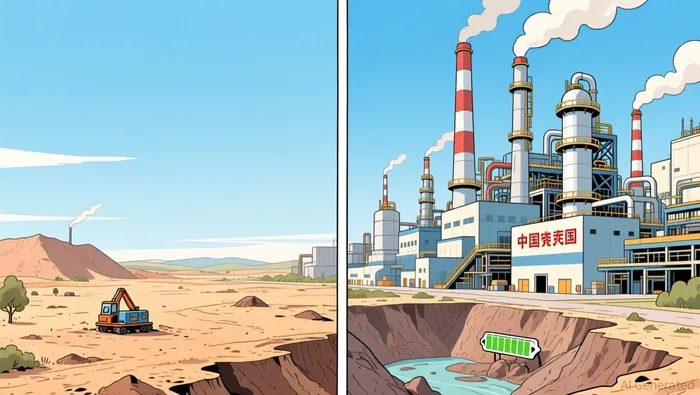
The chokepoint is processing, not digging.
Here's the actual number:
The US has less than 1 percent of global processing capacity for lithium. Less than 3% for other battery minerals.
China controls more than 95% of global graphite processing.
You can mine lithium all day in Nevada, but if you can't turn it into battery-grade lithium carbonate or hydroxide without shipping it to a Chinese refinery, you haven't solved the supply chain problem.
You've just moved the ore to a port.
Why CATL gets to say mining is the bottleneck
CATL is the world's largest battery manufacturer with 38% of the global EV battery market. They already control the refining and processing layer. Their recycling is at 99.6% for Nickel and Cobalt.
For CATL, the constraint has shifted upstream. They've locked down what happens after the ore comes out of the ground. Now they need to secure the ground itself.
That's why the $4.4 billion mining push makes total sense - for them.
It also explains why CATL halted operations at a major mine in China and lithium prices jumped sharply. One battery maker controlling mine operations is enough to move commodity prices.
But framing mining as the bottleneck is like saying the bottleneck in semiconductor manufacturing is sand.
True, but not useful.
The Western blind spot
The US and EU have been treating mining permits and raw extraction as the priority in their battery supply chain push.
Meanwhile the gap between Western investment and Chinese capacity is absurd.
The EU allocated roughly €300 million to raw materials and battery allocation. One CATL subsidiary committed $4.4 billion. That's a 13:1 ratio.
And even when Western projects do get funded, cost competitiveness remains the biggest hurdle. Western battery supply chains are achievable on paper - but cheaper Chinese processing means every new Western refinery needs subsidies just to break even.
The refining layer is where the real chokepoint lives.
It's the bottleneck-within-a-bottleneck. Mining → refining → cell manufacturing → pack integration. Everyone looks at mining because it's visible. Permits are political. Headlines are easy.
But refining is where the concentration actually hurts.
What to look for instead
If the real constraint is Western refining capacity, the investable nodes are companies building or operating non-China processing - not mining.
Battery-grade lithium hydroxide and carbonate refineries outside China. Graphite purification capacity - this is the one where China's >95% control creates the tightest squeeze.
Most Western battery plays are mining companies or cell assemblers. The pure-play refining exposure is thin. That means whoever gets there first - with actual operational capacity, not just announced projects - could capture the same kind of pricing power China already holds in processing.
I don't have a specific ticker mapped that cleanly yet. The sector is dominated by large diversified miners or Chinese integrated players. That absence itself is part of the thesis: if the refining gap is real, there should be smaller, focused operators trying to fill it that haven't caught institutional attention.
TLDR
CATL says mining is the bottleneck because they already own refining. For the West, refining is the bottleneck because they barely have any. The chokepoint isn't digging up ore. It's turning ore into battery-grade material without shipping it to China.