Tesla Delivered 480,126 Vehicles, Then Its Stock Fell 7.5%
Tesla delivered 480,126 vehicles in the second quarter, beating its own company-compiled consensus of 406,024 by 74,102. TSLA nevertheless closed Thursday down 7.5%. The split moved the debate from whether vehicle demand could rebound to whether that volume carried enough price, margin and cash-flow quality.
The operating change was real. Tesla produced 408,386 vehicles and delivered 358,023 in the first quarter, then produced 451,758 and delivered 480,126 in the second. Yet the July 2 release contained no automotive revenue, average selling price, gross margin or free cash flow. Tesla scheduled those financial results for July 22.
A 74,102-vehicle beat could not hold the stock
The delivery count exceeded the published consensus by 18.3%, a surprise large enough to reject the weakest near-term demand scenarios. Reuters reported that recovering European demand offset subdued North American demand and intense competition from Chinese automakers. That regional mix matters because growth did not have to come from every market to produce the global total.
Shares still fell. The reaction does not establish that the delivery report caused the entire decline. Technology shares were already under pressure during the session, and Tesla carries expectations beyond vehicle sales. A 7.5% loss beside a 74,102-vehicle beat shows that the operating surprise did not settle the equity argument.
Q2 reversed the production gap, not the earnings equation
Q1 production exceeded deliveries by 50,363 vehicles. Q2 flipped that relationship, with deliveries running 28,368 above production. The reversal is consistent with stronger customer handoffs and some reduction in completed-vehicle stock after the first-quarter build.
Quarterly production minus deliveries is not a precise inventory calculation. Vehicles in transit, regional shipping and the timing of customer handoffs also change the spread. The direction still matters because it shows Tesla did not need to build 480,126 new vehicles during the quarter to deliver that many.
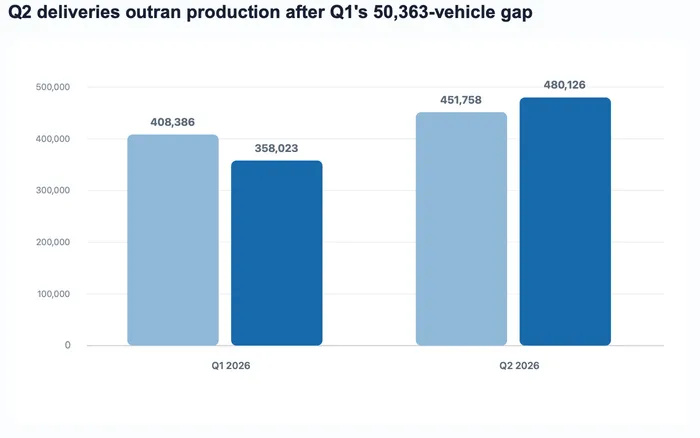
Sources Tesla Q1 and Q2 releases, stitched from two official quarterly reports. Symbol TSLA. Date range Q1 to Q2 2026. Interval fiscal quarter. Basis is company-reported global vehicle production and deliveries. Tesla Q1 release and Tesla Q2 release.
Tesla's own caveat puts price and cost ahead of vehicle count
Tesla explicitly warned against treating the update as an earnings proxy. The company said deliveries and storage deployments should not be relied on as an indicator of quarterly financial resultsbecause average selling price, cost of sales, foreign exchange and other factors also determine the result.
Higher volume can raise automotive revenue and spread factory costs across more units. Discounts, a cheaper product mix or higher unit costs can absorb that benefit before it reaches gross profit. Tesla's Q1 filing reported a 21.1% total automotive gross margin, but that is only a starting point. It does not establish Q2 pricing or profitability.
Energy storage also strengthened, rising from 8.8 GWh in Q1 to 13.5 GWh in Q2. That adds operating breadth to the release, but Tesla gave the same caution for storage deployments. Revenue and margin still decide how much value the additional volume created.
July 22 must connect record volume to margin and cash
Tesla will report full second-quarter results after the close on July 22. Automotive revenue divided by deliveries will give a rough price-and-mix signal, while automotive gross margin will show whether higher volume improved factory economics. Regulatory-credit revenue should remain separate because it can move reported margin without reflecting vehicle pricing.
Vehicle inventory and free cash flow will complete the operating bridge. A lower inventory balance alongside stronger operating cash would support the view that Q2 cleared the first-quarter production gap without sacrificing economics. If average selling price or margin weakens materially, the delivery record will look more like a volume achievement than an earnings reset.