Top Rated Stocks: Beyond the Memory Bubble, Four New Opportunities
Storage and memory stocks have surged so far and so fast that bubble concerns are rising. Instead of chasing crowded hardware momentum, investors may want to look at less stretched opportunities tied to AI software adoption, defensive consumer demand, healthcare logistics and premium travel.
Microsoft Corp (MSFT): AI Adoption Is Moving From Hype to Workflow
Microsoft is the cleanest alternative to chasing overheated memory and storage stocks because its AI story is becoming more usage-driven.
The strongest recent proof came from Microsoft’s June 24 AI in Education Report, which showed that AI is already embedded in school workflows rather than sitting at the experimental stage. Microsoft said 92% of students and education leaders and 88% of educators have used AI for school-related purposes, while 58% of education leaders said their schools are already implementing or scaling AI. Source: Microsoft.

AI Adoption Snapshot
The second catalyst is product depth. On June 25, Microsoft expanded Copilot in Excel for finance professionals, adding repeatable workflow skills, financial data connectors, traceability and planning features. That matters because finance teams are demanding AI that can show its work, connect to trusted data and support reviewable decisions. Source: Microsoft 365 Blog.
A third catalyst is investor sentiment. TheStreet reported that Michael Burry disclosed a long-dated bullish options position in Microsoft, arguing the market had thrown away a high-quality software franchise too aggressively. Source: TheStreet.
The risk is that AI capex still pressures free cash flow. But Microsoft has something storage stocks often lack after a vertical rally: visible adoption, enterprise distribution and software monetization.
Coca-Cola Co (KO): Defensive Brand Power and a New Global Hotel Partnership
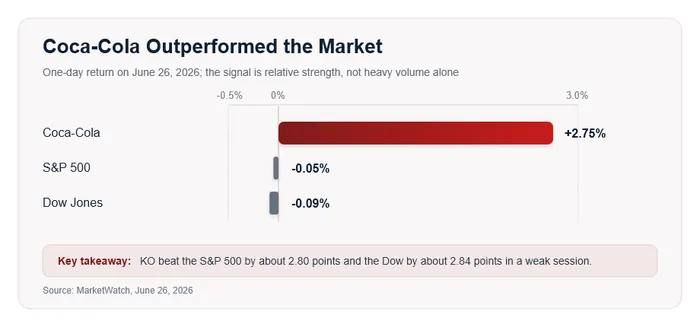
Coca-Cola’s latest catalyst is market outperformance. On June 26, the stock rose 2.75% while the S&P 500 fell 0.05% and the Dow fell 0.09%. Volume was elevated, but that alone is not the investment signal. The real point is that the stock clearly outperformed the market on a weak tape, showing defensive demand when investors were rotating away from crowded momentum areas.
The second catalyst arrived on July 1, when Coca-Cola and Marriott announced a global beverage agreement. Coca-Cola becomes Marriott’s global beverage partner across carbonated soft drinks, hydration, functional beverages and other categories, with a phased rollout across guestrooms, restaurants, lounges, meetings and events. This creates a high-visibility distribution win across Marriott’s global hotel portfolio. Source: PR Newswire.
The third catalyst is positioning. In a market worried about storage-stock excess, Coca-Cola offers the opposite profile: global brands, recurring consumption, pricing power and a dividend-oriented shareholder base. Its beta is low, and the stock trading close to its 52-week high around the same period.
Risks include valuation and slower consumer spending. Still, the combination of market outperformance, a fresh Marriott partnership and defensive cash-flow appeal makes Coca-Cola a useful alternative when speculative AI hardware trades look crowded.
United Parcel Service Inc (UPS): Healthcare Cold Chain Adds a Higher-Value Growth Lane
UPS is trying to move its story away from ordinary package volume and toward specialized logistics.
The most important recent catalyst came on June 22, when the company announced a $48 million investment in 27 temperature-controlled freight cross-dock facilities across the U.S., Europe, Asia and the Americas. These sites are designed for advanced therapies and other temperature-sensitive medicines, with tighter chain-of-custody controls between air and ground transportation. Source: UPS.
UPS cited projected 8.3% compound annual growth in temperature-sensitive biologics through 2033, reaching an estimated $39.1 billion. It also noted that biologics, cell and gene therapies, mRNA products and GLP-1 injectables are making healthcare supply chains more complex. That is exactly where an integrated logistics provider can earn a premium over standard parcel delivery.
The second catalyst is stock behavior. On July 1, UPS rose 1.90% while the S&P 500 fell 0.22% and the Dow slipped 0.03%, snapping a three-day losing streak.
UPS still faces risks: weak parcel volume, labor costs, Amazon-related pressure and dividend-sustainability questions. But healthcare cold chain gives the company a clearer growth lane with better margins and higher service complexity. If investors are rotating away from crowded storage names, UPS offers a more grounded cash-flow recovery setup tied to medical logistics demand.
Delta Air Lines Inc (DAL): Dividend Growth and Premium Travel Momentum
Delta’s strongest recent catalyst is shareholder confidence. On June 18, the company raised its quarterly dividend to $0.215 per share, about 15% above the prior level, payable July 30 to shareholders of record on July 9. For a cyclical airline, a dividend increase is meaningful because it suggests management sees enough cash-flow durability to return more capital. Source: Delta.
The second catalyst is price momentum. On June 25, Delta rose 1.61% to $92.11, marking its fifth consecutive gain, while the S&P 500 slipped slightly. MarketWatch also reported that the stock reached a new 52-week high during that move.
The third catalyst is loyalty economics. Delta and American Express expanded SkyMiles card benefits on June 4 without increasing annual fees, including a complimentary second checked bag for eligible cardholders and rideshare credits for certain Gold card members. These perks deepen customer engagement and support Delta’s premium travel ecosystem. Source: Delta.
The broader airline backdrop is also improving. MarketWatch reported on June 30 that U.S. airline stocks were benefiting from lower jet-fuel prices and resilient travel demand, with Delta and United moving toward fresh records. Source: MarketWatch.
Risks include fuel volatility, labor costs and travel cyclicality. But Delta’s dividend hike, loyalty upgrades and premium-demand exposure make it a credible non-hardware opportunity after the storage-stock surge.