NVDA Stock Near ATH: Google's TPU Push and the Flow of AI Chip Demand
NVIDIA closed at $202.06 on April 20, just 10.13 points below its 52-week high of $212.19. The stock has rallied 17% over the past 20 days, a strong move that has brought it near its all-time peak. This surge reflects intense market enthusiasm for AI chip demand, but the recent price action shows signs of consolidation.
Trading volume was notably light, with 118.5 million shares changing hands, well below the 20-day average of 175.3 million shares. This lower volume suggests the stock is pausing after its run, with buyers and sellers finding a temporary equilibrium near the highs. The market is digesting the momentum.
Valuation now reflects these elevated expectations, with a forward P/E of 41.15. This multiple prices in exceptional growth, leaving little room for error. Any stumble in the AI demand narrative could quickly pressure this rich valuation, making the current price level a critical inflection point.
The Competitive Flow: Google's TPU Infiltration
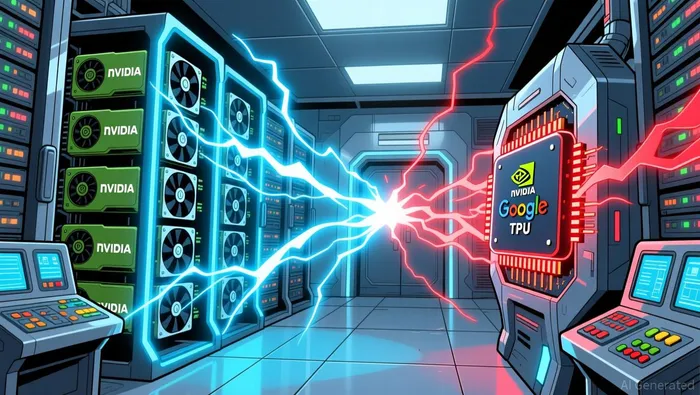
Google is executing a deliberate, multi-pronged strategy to shift AI chip demand away from NVIDIA. The company is investing heavily to expand its TPU ecosystem, including a reported $100 million investment with Fluidstack to widen access. This move directly targets NVIDIA's dominance by offering an alternative hardware stack, aiming to reduce the industry's dependence on its GPUs.
The strategic focus is on inference, the next frontier of AI workloads. Google is developing new TPU designs specifically for inference tasks, where its chips demonstrate substantial efficiency advantages. This specialization is a direct challenge to NVIDIA's training-centric model, as the market increasingly values cost-effective, real-time processing. Major customers like Meta and Anthropic are already securing access, signaling early commercial traction.
The market is recognizing this threat. In response, prediction-market odds for NVIDIA's market-cap leadership have fallen to 86.5%. This shift in sentiment, coupled with NVIDIA's stock dip, shows that capital is flowing to assess the competitive risk. While NVIDIA's software lock-in remains a formidable barrier, Google's push is creating tangible pressure on the narrative of unquestioned dominance.
The Demand Flow: Efficiency Gains vs. Volume Growth
Google's latest research introduces a powerful conflicting signal for chip demand. Its new TurboQuant compression method could reduce the memory needed to run large language models by six times. This efficiency breakthrough directly threatens the narrative of ever-increasing memory chip requirements, sparking a sharp sell-off in memory stocks like SK Hynix and Micron.
Yet analysts argue this efficiency could ultimately fuel more advanced AI, increasing total chip demand. The compression targets a key performance bottleneck, which will likely lead to more powerful models. As one analyst noted, "When the model becomes more powerful, you require better hardware to support it." This suggests the initial reduction in per-model memory needs may be offset by a surge in overall AI complexity and deployment.
The broader market provides a massive base for this dynamic. The global AI data center market is projected to grow exponentially from $215 billion in 2025. Even if efficiency gains slow the growth rate for specific components like memory, the sheer scale of the expansion creates ample room for all players, including NVIDIA and its competitors, to scale. The flow of demand is being reshaped, not reduced.