Main Street's Secured Bet on UBM Hinges on Proven Logistics Synergy and 90%+ On-Time Delivery Execution
Main Street Capital made a clear, focused bet this week. On April 21, 2026, it announced a $15.6 million follow-on investment in its portfolio company, UBM ParentCo, LLC. The money is a first-lien, senior secured debt position, directly supporting UBM's strategic acquisition of Mystic Logistics. This move is a direct continuation of a plan Main Street laid out just months ago.
The core transaction is straightforward. In January 2026, Main Street had already invested $50.8 million to facilitate UBM's merger with Mystic Logistics Holdings, LLC. That initial deal allowed Main Street to exit its own debt and equity stakes in Mystic, realizing a $23.8 million gain on the equity portion. Now, with the merger complete and Mystic integrated as a wholly owned subsidiary, Main Street is stepping in again to provide the necessary capital to make the combined entity work.
So, what exactly did Main Street buy? It bought a secured debt position in a company that just expanded its footprint. UBM, a leading provider of marketing mail services, now owns Mystic Logistics, a national provider of palletized mail consolidation, freight brokerage, and warehousing. The integration is designed to drive scale and efficiency across UBM's operations. The real test, as always, is whether this makes UBM's core mail service more valuable and sticky for its clients. Main Street is betting that a stronger logistics backbone will improve speed, visibility, and cost efficiency for large-scale mailers, which is the heart of UBM's business. The move is a classic "buy the tape" play on operational synergy.
The Real-World Utility: Does This Make UBM's Core Service Better?
The real test of this deal is whether it makes UBM's core mail service better for its customers. The numbers tell a story of scale and integration. UBM, the largest independent provider of Standard Commingle Services, already sorts over 2.5 billion Standard Class letter mail pieces per year using 39 high-speed sorters. Mystic Logistics brings a different kind of scale to the transport side, hitting over 230 USPS facilities multiple times each week with over 90% on-time delivery.
Viewed together, the combined capability is a classic operational upgrade. UBM's strength is in the sorting and barcoding that unlocks postage discounts. Mystic's strength is in moving that sorted mail reliably and quickly. The integration could offer customers faster, more predictable delivery and potentially larger discounts by consolidating mail volume across a broader network. In practice, this means a mailer's piece gets barcoded and sorted at UBM's Chicago facility, then shipped via Mystic's national truck network to a local post office, all with better tracking and fewer delays.
The key metric here is the 2.5 billion letters. That's a massive volume that needs to move. By adding Mystic's transport backbone, UBM isn't just moving more mail; it's making the entire journey more efficient. The goal is to improve the "on-time every time" promise for customers who rely on in-home delivery schedules. If the combined operation can maintain or improve that 90%+ on-time performance while handling more volume, it directly strengthens UBM's value proposition. It turns a great sorting service into a more complete logistics solution.
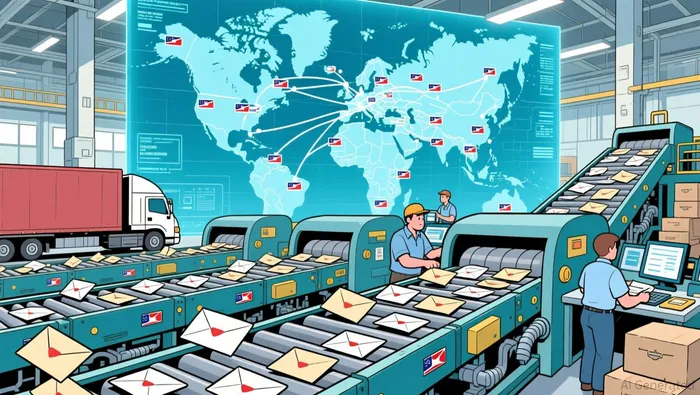
The bottom line is about real-world utility. For a large-scale mailer, the difference between a 24-hour turn and a 48-hour turn can be critical. The combined operation aims to shrink that window. It's a simple, common-sense play: better sorting plus better transport equals a better product. If UBM can execute this integration smoothly, it should make its core service more sticky and valuable.
Financial Impact and Risk: The Simple Math
The numbers here are straightforward, but the outcome depends entirely on execution. Main Street is playing a classic debt-financed growth game. It first invested $50.8 million in January to pull off the Mystic merger, and in that deal, it realized a $23.8 million gain by exiting its prior equity and debt stakes in Mystic. That's a clean profit on the initial bet. Now, with the merger complete and Mystic operating as a wholly owned subsidiary, Main Street is stepping in again with a $15.6 million follow-on investment to fund the next phase.
This second move is a secured bet. The new money is a first-lien, senior secured debt position, meaning Main Street has a priority claim on UBM's assets if things go wrong. That's the safety net. The return, however, hinges on UBM's ability to leverage Mystic's transport scale to make its core sorting business more valuable. The goal is to increase volume and pricing power in the commingling market by offering a more complete logistics solution.
The financial math is simple: UBM sorts over 2.5 billion letters a year. Mystic moves them reliably. If the combined operation can improve delivery speed and reliability, it should make UBM's service more sticky for large clients. That stickiness is the engine for future cash flow. Main Street's secured debt position gives it a steady interest stream, but the ultimate payoff depends on that cash flow being strong enough to service the debt and support the equity owners.
The risk is operational. Integrating two companies, even with no planned changes to Mystic's day-to-day, is never seamless. The success of the investment is a direct function of UBM's ability to execute this integration and convert the promised scale into real-world utility for its customers. If the combined mail stream gets delayed or the promised on-time performance slips, the value proposition weakens. For Main Street, the secured position mitigates downside, but the upside is capped by the debt's fixed return. It's a bet on UBM's operational execution, not a bet on market timing.
What to Watch: The Kick-the-Tires Test
The investment thesis here is simple: better logistics should make UBM's core sorting service more valuable. To see if that's working, you need to kick the tires on the real-world numbers. The key metrics to watch are the ones that define the business-volume, reach, and reliability.
First, monitor UBM's customer growth and retention. The expanded logistics offering is meant to be a bigger, stickier product. If UBM starts winning new large mailers or retaining existing ones at higher rates, that's a direct signal the integration is working. Look for public announcements or data on increased mail volume processed through the combined UBM/Mystic network. The headline figure is over 2.5 billion Standard Class letter mail pieces per year sorted by UBM. Any acceleration in that volume, especially from new customers attracted by the logistics package, would be a strong positive.
Second, track the promised operational performance. Mystic Logistics brings a national transport backbone, hitting over 230 USPS facilities multiple times each week with an over 90% on-time performance. After integration, UBM's reported on-time delivery performance and customer satisfaction scores are the ultimate test. If the combined operation can maintain or improve that 90%+ on-time promise while handling more volume, it proves the synergy is real. A slip in delivery speed or reliability would contradict the thesis.
The bottom line is about observable utility. For a large-scale mailer, the difference between a 24-hour turn and a 48-hour turn can be critical. The combined operation aims to shrink that window. If the promised scale translates into faster, more predictable delivery for customers, it strengthens UBM's value proposition. Keep an eye on those three numbers: the 2.5 billion letters, the 230+ USPS facilities, and the 90%+ on-time delivery. They are the concrete signs that will confirm whether Main Street's $15.6 million bet is paying off.