$1.5 Million Heir Must Rethink 3% Advisor Fee—Fee Drag Compounds Into a Stealth Wealth Erosion Risk
The central issue for any value-minded investor is whether the service being paid for creates durable, compounding value. When an advisor charges a 3% annual fee on a $1.5 million portfolio, the annual cost is $45,000. That is an exceptionally high price to pay. The industry average for such services typically ranges between 0.5% and 1.5% of assets under management annually. In this light, a 3% fee sits well outside the norm, demanding a justification that goes beyond standard portfolio management.
The true test of any fee is its long-term impact on compounding. A 1% difference in annual costs can silently drain nearly a quarter of potential retirement savings over decades. For a portfolio of this size, that gap is not a rounding error-it is a material erosion of principal. This is the core principle of value investing: protecting capital and ensuring every dollar works as hard as possible for the owner. A fee structure that consumes such a large portion of potential returns is the opposite of a moat; it is a structural headwind.
Therefore, the prudent step is not to accept the fee as a given, but to conduct a rigorous review. Does the advisor's holistic planning, tax strategies, and behavioral coaching generate a net benefit that consistently exceeds the 1.5% premium over the industry average? If the answer is not a clear, demonstrable "yes," then the fee itself becomes the primary risk to the portfolio's long-term growth. For a $1.5 million inheritance, the math suggests that a review or replacement is not just a financial adjustment, but a necessary act of stewardship.
Assessing the Advisor's "Economic Moat"
The advisor's 3% fee demands a wide economic moat-a durable competitive advantage that justifies the premium. The foundation of modern advisory compensation is the Assets Under Management (AUM) model, which aligns the advisor's financial success with the growth of your portfolio. Research confirms this is the industry standard, with 86% of advisory firms relying on AUM fees as their primary method. This structure is designed to create a shared interest, where the advisor benefits when your assets grow.
For a fee of this magnitude, the value proposition must extend far beyond basic portfolio management. The high cost should be covered by three key drivers: holistic financial planning, sophisticated tax strategies, and effective behavioral coaching. These services aim to create a comprehensive, personalized roadmap for your wealth, optimize after-tax returns, and help you navigate market volatility without making emotional decisions. In theory, the net benefit from these integrated services should consistently exceed the 1.5% premium over the typical AUM fee, which is roughly 1.02% for a $1 million portfolio.
An alternative compensation model is the performance fee, where the advisor earns a percentage of investment gains above a benchmark. This structure explicitly aligns incentives with client returns and is common in hedge funds and high-net-worth portfolios. However, it is less typical for standard advisory services and introduces a trade-off. As noted, performance fees can encourage greater risk-taking because the advisor is rewarded for results, potentially leading to more aggressive strategies. For a $1.5 million inheritance, the goal is steady, compounding growth, not speculative bets. Therefore, a performance fee might not be the right fit and could undermine the long-term stability the inheritance requires.
The bottom line is that a 3% fee is a bet on the advisor's ability to deliver exceptional, multi-faceted value. If the holistic planning, tax optimization, and behavioral guidance are truly world-class and demonstrably superior to what you could achieve independently or with a lower-cost advisor, the fee may be justified. But if these services are merely standard, the fee becomes a significant drag on compounding. The advisor's moat must be wide enough to generate a net return that consistently outpaces the cost of admission.
The Estate Planning Imperative: A Foundational, Fee-Independent Need
For an inheritance of this size, the immediate priority is not the advisor's fee, but the foundational task of estate planning. This is a non-negotiable requirement that must be addressed regardless of the advisory compensation model. The threshold where simple wills give way to complex, trust-based strategies is precisely around the $1 million mark, which a $1.5 million estate easily exceeds. As one wealth manager notes, for more complicated estates-as those that exceed $1 million often are-a will may not be the only solution to consider. The goal is to ensure the estate is structured to maximize what heirs receive and to follow the original owner's wishes efficiently.
The Rowland family's tragic experience serves as a stark, real-world cautionary tale of what happens when planning is merely "good enough." After the death of his wife in 2016, Billy Rowland's estate filed a tax return that failed to specify the value of each individual asset. While the total estate value was reported, that seemingly minor oversight had catastrophic consequences. When Billy passed away in 2018, the IRS determined he could not access his late wife's unused estate tax exclusion. The result was a $1.5 million tax bill for his children-an amount they never should have had to pay. The error was not discovered until 2021, three years after Billy's passing, by which time correction was impossible.
This case underscores that effective estate planning is not a one-time document dump. It requires a dynamic system supported by professional expertise to navigate intricate requirements like estate tax filings and to ensure every detail is correct. For a $1.5 million estate, the components of a comprehensive plan include regular reviews, the use of a revocable trust to avoid public probate and potential multi-state complications, and meticulous titling of assets. The Rowland family's story is a powerful reminder that the cost of poor planning can far outweigh any advisory fee, making the initial investment in robust, professional estate planning a critical first step in stewarding the inheritance.
Catalysts and Risks: What to Watch Next
The path forward for this $1.5 million inheritance hinges on a few clear catalysts and a significant, accelerating risk. The primary catalyst is a formal, no-holds-barred review of the advisor's services against the steep 3% fee. This is not a routine check-up; it is a fundamental reassessment of value. The benchmark is clear: the industry average for AUM fees is between 0.5% and 1.5%. The advisor's charge sits at the extreme high end of that spectrum, demanding a justification that goes far beyond standard portfolio management. The investor must compare the advisor's "holistic" offerings-tax strategies, behavioral coaching, and life planning-to what is available through lower-cost alternatives, including self-directed investing or a fee-only planner charging a fraction of the fee. The goal is to determine if the net benefit consistently exceeds the 1.5% premium.
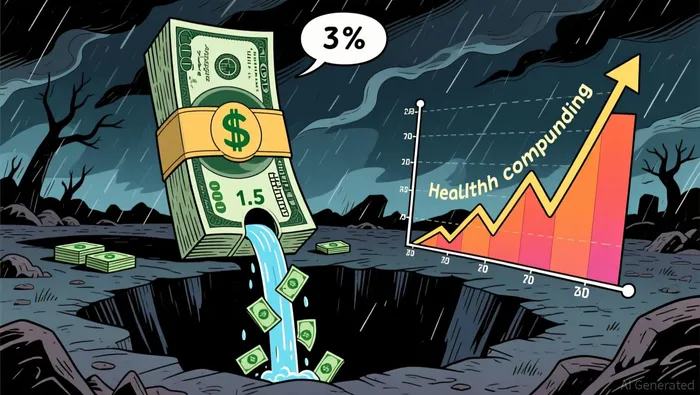
The key risk, however, is the insidious "fee drag" that accelerates over time. This is not a one-time cost but a compounding erosion of principal. As research shows, a 0.50% difference in expense ratios can cost a client the equivalent of several years of retirement income over 30 years. For a 3% fee, the math is stark. The cost of that high fee does not grow linearly; it compounds on itself and on every dollar of growth. The wealth gap created by the fee widens dramatically in the later decades of a long holding period. In other words, the longer the money is invested, the more the high fee structure works against the goal of compounding. This is the silent, structural headwind that the initial 3% fee represents.
Finally, the investor must assess the true, unique value of the advisor's "holistic" services. These include emotional well-being and life satisfaction planning, which aim to align financial decisions with personal values. The question is whether these services are uniquely valuable or simply replicable. If the advisor's personalized attention and behavioral guidance are world-class and demonstrably superior to what the investor could achieve independently or with a lower-cost advisor, then the fee may be justified. But if these services are merely standard, the fee becomes a significant drag on long-term wealth. The bottom line is that the investor must treat this as a capital allocation decision. The high fee is a bet on the advisor's ability to generate a net return that consistently outpaces the cost of admission. If the review shows the bet is not paying off, the optimal course is to reallocate capital to a lower-cost provider or a disciplined self-directed strategy, ensuring the inheritance's compounding engine runs as efficiently as possible.