Trump's Iran Ultimatum: Deal or Destruction?
The crisis has crystallized into a binary event defined by a single deadline: 8 p.m. ET Tuesday. That's the moment when the Trump administration says diplomacy ends and total escalation begins. The objectives laid out from day one are non-negotiable: reopen the Strait of Hormuz, dismantle Iran's ballistic missile arsenal, annihilate its navy, and ensure the regime never acquires a nuclear weapon. These aren't bargaining chips-they're presented as existential imperatives.
The stated goals are explicit. From the first day of Operation Epic Fury, the White House has articulated four clear objectives: obliterate Iran's missiles and production capability, annihilate its navy, sever its support for terrorist proxies, and ensure the world's leading state sponsor of terrorism never obtains a nuclear weapon. Vice President JD Vance has been equally direct, stating that regime change is incidental to the primary objective-preventing a nuclear bomb. Secretary of State Marco Rubio framed it as eliminating the threat from Iran's short-range ballistic missiles and navy. These are the terms. There is no ambiguity in what the U.S. demands.
What makes this a binary event is the deadline mechanics. Trump has warned that missing the 8 p.m. ET Tuesday cutoff triggers a dramatic escalation-targeting Iran's energy infrastructure, including power plants, oil wells, Kharg Island, and potentially desalination plants that supply drinking water. The threat extends beyond military targets to what amounts to civilian infrastructure. "I don't want that to happen, but it probably will," Trump said Tuesday morning, calling the deadline "one of the most important moments in the long and complex history of the world." The implication is clear: either a deal emerges before the clock runs out, or the U.S. broadens the war to dismantle Iran's economic backbone.
Iran's position adds complexity to the deadline calculus. Tehran denies engaging in direct negotiations with the U.S., yet acknowledges backchannel talks facilitated by Pakistan. But the Iranian parliament speaker, Mohammad Bagher Qalibaf-a former Revolutionary Guard commander who has publicly taunted the U.S.-dismissed those talks as a cover for American troop deployments. Iran rejected a U.S. ceasefire draft on Monday and submitted a counterproposal, which Trump dismissed as "not good enough." Meanwhile, the IRGC has threatened to "deprive the United States and its allies of oil and gas in the region for years" if Trump follows through on infrastructure threats.
The strategic tension is stark: the U.S. is demanding complete compliance on multiple fronts within hours, while Iran shows no sign of yielding and has signaled it will retaliate against attacks on civilian facilities. The 8 p.m. deadline isn't just a timing mechanism-it's the pivot point between a negotiated settlement and a war that could reshape the entire Middle East.
The Deal Probability: What's Actually Being Negotiated
The core question facing markets is whether the claimed "deep negotiations" have genuine substance or are performative theater designed to create an illusion of progress while preparation for escalation continues. The evidence suggests a troubling gap between rhetoric and reality.
Trump asserted in an Axios interview that Iran "called this morning" and "would like to work a deal," claiming his envoys Steve Witkoff and Jared Kushner are holding intense negotiations that hit a roadblock related to nuclear issues. However, Reuters could not verify the claim that Iran initiated contact. The mediators themselves-Pakistan, Egypt, and Turkey-are working to the last minute but are less optimistic that a deal is close. Over the last ten days, these mediators have facilitated indirect talks with no significant progress on reaching a ceasefire deal.
The nuclear issue remains the hard roadblock. Trump has been unequivocal: "Iran will not have a nuclear weapon" and he will not come to any agreement that allows Tehran to have one. This absolute position eliminates the one area where flexibility typically enables deals. Iran rejected a U.S. ceasefire draft on Monday and submitted a counterproposal, which Trump dismissed as "not good enough". The substance of that counterproposal remains unclear, but the rejection signals Iran is not yielding on core demands.
Trump has extended deadlines before-this one is a 24-hour extension from his original Tuesday warning-but insists this one is final. The market must price the risk of miscalculation: either side could interpret the deadline mechanics differently, or Trump could follow through on threats despite the stated diplomatic track. With mediators pessimistic and the nuclear issue unresolved, the probability of a last-minute deal appears low. The setup favors pricing in escalation risk, not diplomatic resolution.
Market Implications: Oil, Oil, and Regional Exposure
The financial markets are now pricing in a binary outcome: a deal before 8 p.m. ET Tuesday, or a dramatic escalation that threatens the global oil supply chain. The immediate risk is quantifiable, and it's already moving markets.
Oil prices have surged on Trump's threats to target Iran's energy infrastructure. A full breakdown could push Brent crude above $100 per barrel. The Strait of Hormuz carries roughly 20% of the world's oil supply in peacetime, and Iran has vowed to block it indefinitely until Tehran is paid for war damages. That threat is no longer theoretical-U.S. forces have already struck Kharg Island twice, the second time hitting military infrastructure on Iran's key oil terminal according to a White House official. This signals a clear willingness to escalate against economic targets.
Insurance rates for Gulf transit are spiking as the war zone expands. Ships rerouting around Africa add weeks to delivery times and millions to shipping costs. The IRGC has warned it will "deprive the United States and its allies of oil and gas in the region for years" if Trump follows through on infrastructure threats. That's not just rhetoric-trading houses are already hedging against a prolonged supply shock.
But the financial risk extends beyond oil. If Trump follows through on destroying desalination plants and power infrastructure, the humanitarian fallout could trigger UN Security Council intervention. Iran's UN representative has already labeled the threats "incitement to war crimes and potentially genocide", and 14 million Iranians have volunteered to fight. The combination of civilian casualties, refugee flows, and potential regional retaliation creates a tail risk that no insurer wants to underwrite.
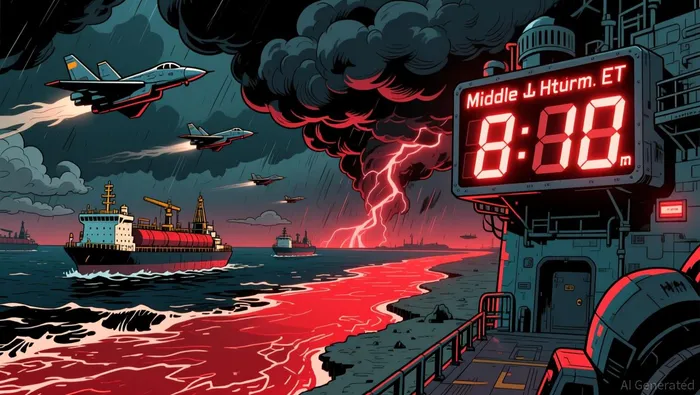
The market's message is clear: the 8 p.m. deadline is a binary option with asymmetric payoffs. A deal keeps oil in the $80-90 range and avoids a humanitarian crisis. Missing it opens a portfolio of tail risks-supply disruption, insurance spikes, and potential UN involvement-that could persist for years.
Catalysts and Scenarios: What to Watch Next 48 Hours
The next 48 hours contain three specific triggers that will determine whether this ends in a deal or total escalation. Watch them in order.
First, the 1 p.m. ET news conference on the F-15 airman rescue. This is the earliest potential off-ramp. The rescue operation succeeded-satellite images show multiple craters along roads in the extraction zone where the airman was extracted. If Trump frames this as a humanitarian win and couples it with a diplomatic opening, both sides gain face-saving cover. Iran can claim it allowed a prisoner exchange; Trump can claim he secured an American life without further bloodshed. The counter-risk: if the administration uses the news conference to double down on threats, it eliminates that off-ramp.
Second, Iran's formal response to the 8 p.m. deadline. Tehran has already signaled it will not yield. The Iranian parliament speaker called negotiations "a cover for American troop deployments" and dismissed the talks. The IRGC has threatened to block the Strait indefinitely until Tehran is paid for war damages. But the critical question is whether Iran issues a formal acceptance of U.S. terms, a counterproposal, or simply lets the deadline pass. The latter two options trigger the escalation pathway.
Third, any announced extension or sudden diplomatic breakthrough. Trump has extended deadlines before-but insists this one is final. Pakistan's prime minister has urged a two-week extension to allow diplomacy to advance, and mediators from Egypt and Turkey are still working. If an extension appears, it signals the administration itself doubts the deadline will produce results. If a breakthrough emerges at the last minute, it would require Iran to accept terms it has thus far rejected-including reopening the Strait and dismantling missile capabilities.
The rhetoric on both sides has reached a fever pitch that increases miscalculation risk. Trump's threat that a "whole civilization will die tonight" if no deal is reached crosses into language that legal scholars say could constitute incitement to war crimes. Iran's president has said 14 million people, including himself, have volunteered to fight despite the threats. This kind of language closes off moderate pathways and makes escalation more likely if the deadline passes without agreement.
The binary setup means markets should price in the escalation scenario unless one of these three catalysts moves in the deal direction. The 1 p.m. ET conference is the first test.