JPMorgan's SRI Bet on European Defense Signals High-Conviction, Geopolitical-Grade Trade Setup
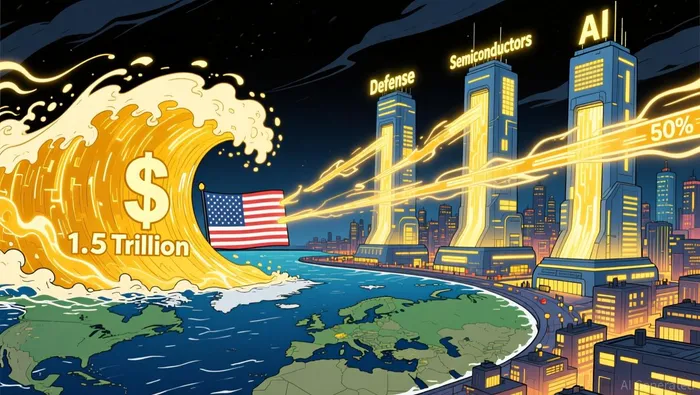
JPMorgan Chase is making a monumental capital allocation decision with its $1.5 trillion, 10-year Security and Resiliency Initiative (SRI). This is not a modest sideline bet but a core strategic thesis, framing the bank's future growth around the global shift toward economic and national security. The scale itself is a statement of conviction, aiming to increase its facilitation and financing activities in critical industries by up to $500 billion-a 50% leap from its prior decade-long plan.
The direct equity and venture capital component, capped at up to $10 billion and primarily focused on U.S. companies, is the most visible signal of this strategic pivot. It represents a direct bet on innovation and manufacturing in sectors like defense, advanced materials, and frontier technologies. This move is backed by a dedicated leadership structure, including the appointment of a head of SRI for defense and aerospace, signaling that national security is now a core banking vertical.
The recent expansion into Europe is a deliberate geographic extension of this thesis. It builds on the U.S. momentum to reinforce commitment to strengthening critical supply chains, economic resilience and shared security across trading partners. For institutional investors, this is a key signal: JPMorgan is positioning itself as the premier financial partner for the industrial and technological realignment underway in the West. The appointment of a former U.K. Defence Staff chief to its advisory council underscores the depth of this commitment.
Viewed through a portfolio lens, this is a multi-year, high-conviction allocation. The bank is committing vast resources to sectors that are likely to see sustained government and corporate spending, aiming to capture fees, deposits, and equity upside. The European push ensures its capital is positioned across the entire Atlantic alliance, not just the U.S. market. This is a structural bet on a new era of industrial policy, and JPMorgan is deploying its balance sheet to lead it.
Sector Exposure and Portfolio Construction Implications
The $1.5 trillion initiative is not a broad bet but a targeted capital allocation across four distinct, high-conviction sectors. These are semiconductors, defense, energy, artificial intelligence and critical infrastructure, which JPMorgan is structuring around the pillars of Supply Chain & Advanced Manufacturing, Defense & Aerospace, Energy Independence & Resilience, and Frontier & Strategic Technologies. This creates a clear portfolio construction framework: a concentrated, multi-year allocation to industries defined by structural demand and government support.
The European defense sector stands out for its compelling risk-adjusted profile. Morgan Stanley analysts note the sector's strong growth potential and that sector multiples are not yet stretched relative to earnings growth prospects. This is a critical distinction for institutional investors. The setup is driven by a concrete, multi-year spending cycle, not a cyclical spike. As highlighted, European rearmament is perhaps the standout story, with nations like Germany and Poland dramatically scaling procurement. This structural shift has already propelled European defense names to multi-year highs, with top picks delivering +118 percentage points of outperformance since 2021.
This transition is key. Defense stocks are moving from a niche holding to mainstream consideration, a shift validated by the bank's own leadership moves. The appointment of a head of SRI for defense and aerospace is a tangible signal of strategic focus, aligning JPMorgan's capital deployment with a macro environment of record defense budgets and long-term contract visibility. For a portfolio, this represents a quality factor play: exposure to large contractors with massive order backlogs and predictable revenue streams from both U.S. and European programs.
From a portfolio construction standpoint, this initiative offers a path to diversify away from traditional tech and into sectors with durable, policy-backed growth. The energy and advanced manufacturing components provide a hedge against supply chain volatility, while the frontier tech focus captures innovation upside. The bottom line is that JPMorgan is building a sector-weighted portfolio around a new global paradigm, one where national security and economic resilience are the primary drivers of capital allocation.
Financial Impact and Risk-Adjusted Return Assessment
The direct equity and venture capital component of the initiative, capped at up to $10 billion, is a concentrated, high-conviction allocation. For JPMorgan, this represents a direct capital commitment to sectors with durable, policy-backed growth, aiming for both fee income and potential equity upside. The recent performance of European defense stocks provides a strong signal of the market's conviction in this thesis. Morgan Stanley analysts highlight the sector's strong growth potential, noting that its top picks have delivered +118 percentage points of outperformance against the broader European market since 2021. This track record suggests that the risk premium for exposure to these strategic industries is being adequately rewarded, at least in the near term.
From a portfolio construction perspective, this is a quality factor play. The bank is allocating capital to large, established contractors with massive order backlogs and predictable revenue streams from both U.S. and European programs. This contrasts with the volatility of pure-play tech or cyclical sectors, offering a path to diversify away from traditional equity benchmarks. The European defense sector's recent outperformance, including a +16.7 percentage points of outperformance in the last 12 months, validates the shift of these names from niche holdings to mainstream consideration. For JPMorgan, financing this expansion is a natural extension of its role as a premier corporate bank, capturing fees on the very deals it is helping to structure.
Yet this strategic opportunity is not without material execution risk. The geopolitical landscape introduces a significant friction point: the EU-NATO divergence over defense industrial policy. While European nations are ramping up procurement, Brussels's "Buy European" approach faces skepticism from NATO allies, particularly the United States. This tension creates a complex operating environment for the bank's financing role. JPMorgan must navigate potential trade-offs between supporting EU-led industrial policy and facilitating U.S. defense exports, which could complicate cross-border deals and introduce regulatory uncertainty.
The bottom line is a trade-off between a compelling risk-adjusted opportunity and a new layer of geopolitical friction. The bank's capital allocation is positioned to capture the structural growth in defense and critical infrastructure, a trend underscored by the sector's stellar recent returns. However, the EU-NATO dynamic introduces execution risk that could slow deal flow or increase the cost of capital for certain projects. For institutional investors, the key is assessing whether the expected risk premium-evidenced by the sector's outperformance-adequately compensates for this new geopolitical overhang. The bank's leadership appointments suggest it is betting that the strategic tailwinds outweigh the friction.
Catalysts, Scenarios, and What to Watch
For institutional investors, the $1.5 trillion Security and Resiliency Initiative moves from announcement to execution. The coming quarters will be defined by a set of forward-looking events that will validate the bank's strategic thesis or expose its vulnerabilities. The framework for monitoring progress hinges on three key areas: capital deployment, market penetration, and the resolution of fundamental sector drivers.
First, the allocation and returns of the up to $10 billion direct equity and venture capital component will serve as the most direct proxy for the initiative's investment success. This concentrated capital is the bank's high-conviction bet on innovation and manufacturing in its four priority sectors. Investors should watch for the pace and focus of these investments-whether they flow into early-stage startups or later-stage, scaling companies-and the subsequent financial performance of those holdings. Strong, early returns here would signal that JPMorgan's internal deal flow and due diligence are effectively capturing the structural growth it has identified.
Second, specific European financing deals announced under the expanded SRI will signal the bank's market penetration and its ability to capitalize on the region's industrial realignment. The recent expansion into Europe is a deliberate geographic extension of the U.S. thesis, aimed at strengthening critical supply chains and supporting industries critical to innovation and growth. Look for high-visibility deals in defense, advanced manufacturing, and energy resilience. The volume, size, and complexity of these transactions will demonstrate whether JPMorgan's leadership appointments and regional talent investments are translating into tangible business. A steady stream of such announcements would confirm the bank's role as the premier financial partner for this strategic shift.
Finally, the fundamental drivers of the European defense sector-the core growth engine for the initiative-must be monitored. The sector's stellar performance, with top picks delivering +118 percentage points of outperformance since 2021, is built on the concrete reality of European rearmament. The key catalysts here are the actual European defense budget commitments and the resolution of the EU-NATO policy tensions. If European nations follow through on pledges to boost defense spending, the growth trajectory is secure. Conversely, if the "Buy European" friction leads to trade barriers or delays in cross-border procurement, it could slow the very spending the bank is financing. This geopolitical overhang remains the most significant external risk to the sector's long-term outlook.
The bottom line is that the initiative's success will be measured in real capital deployed, real deals closed, and real policy outcomes. Institutional investors should track these three vectors to assess whether the strategic tailwinds are materializing as planned or if execution frictions are emerging.