One Geely Strategy: How Geely Auto's Global Expansion Plan Targets 6.5M Vehicles by 2030
The core investment question is straightforward: Can Geely Auto scale from a strong Chinese player into a top-five global automaker, and at what pace? The answer lies in the "One Geely" strategy-a coordinated platform designed to capture market share across distinct customer segments worldwide while leveraging shared technology to drive down costs.
Geely's ambition is quantified in a single target: 6.5 million annual vehicles by 2030 from 3.02 million in 2025. Hitting this requires a sustained 16%+ compound annual growth rate-a demanding but achievable trajectory given current momentum. The company is already outpacing its domestic market, with export sales surging 121% year-on-year in January 2026 to 60,506 units while NEV exports jumped 76% month-on-month. This export acceleration is the engine of the growth thesis, signaling that Geely's global localization strategy is moving beyond pilot phases into meaningful scale.
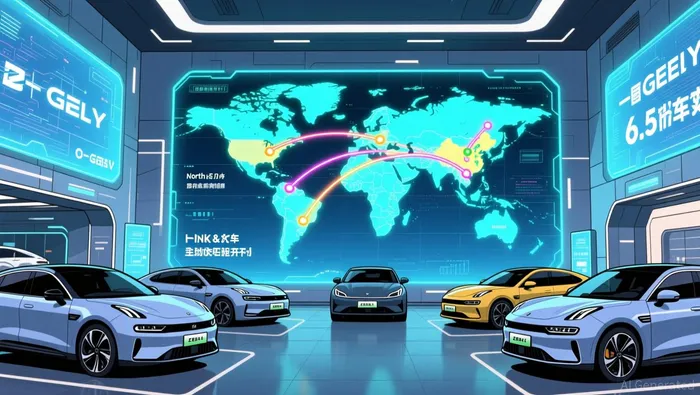
The "One Geely" model works by differentiating brands while sharing underlying platforms. The mainstream Geely brand targets volume with its fuel and new energy lineups, the premium Lynk&Co brand captures the upmarket segment, and ZEEKR competes in the luxury technology space. This segmentation allows Geely to pursue customers at every price point without brand cannibalization. Critically, platform sharing across these brands reduces R&D cost per vehicle-a key scalability factor. The company is backing this with massive investment: 21.8 billion yuan in R&D for 2025, an 8.3% annual increase that strengthens the balance sheet while the rest of the industry races to stack features.
The numbers validate the approach. In 2025, Geely sold 3.02 million vehicles-a 39% year-on-year jump that exceeded its revised annual target with NEV sales reaching 1.69 million units. Lynk&Co surpassed 350,000 units annually, and ZEEKR hit monthly records of over 30,000 units demonstrating each brand's traction. The export mix is shifting faster than domestic sales, with the company targeting one-third of total sales from overseas by 2030 as it aims for the world's top five automakers.
For growth investors, the setup is clear: Geely has the scale foundation, the brand architecture, and the export momentum. The next phase is executing the 6.5 million target while maintaining profitability in a competitive global market. The 16%+ CAGR required is aggressive, but the export trajectory and brand differentiation provide a credible path to capture global market share.
Financial Scalability: Can Profits Keep Pace with Volume Growth?
Volume growth is meaningless without profitability-and in a two-year price war, margins are the first casualty. Geely's 2025 results answer the investor question directly: profits are not only holding, they're accelerating. The core net profit margin rose 0.8 percentage points to 4.2%, outpacing the 25% revenue growth with a 36% surge in core profits. Per-vehicle core net profit climbed to 4,800 yuan in the second half-a clear signal of scaling benefits kicking in.
But the margin story has a twist. Institutional investors pressed Geely on why gross margins haven't improved more dramatically given the volume surge. The CFO's explanation reveals a strategic choice: R&D expenses averaged around 4 billion yuan each quarter, jumping to 5.9 billion yuan in Q4 due to a higher proportion of R&D spending being expensed immediately. This accounting treatment squeezes gross margins in the short term while strengthening the balance sheet long term. While competitors cut features to protect margins, Geely is racing to invest-pouring 21.8 billion yuan into R&D in 2025, an 8.3% annual increase that strengthens the balance sheet.
The premium brand mix is where scalability becomes compelling. Lynk&Co's 350,000-unit year (+23%) now features a 65% NEV mix with an average transaction price exceeding 330,000 yuan-meaning higher-margin vehicles are driving a growing share of volume. ZEEKR's Q4 2025 profitability adds another margin tailwind; the brand sold 224,000 units for the year and contributed to the 0.8 percentage-point margin increase following consolidation. These premium segments are pulling the profit curve upward even as the company discounts aggressively in competitive segments.
The growth investor's concern is whether this holds as Geely pushes toward 6.5 million vehicles. The answer hinges on two factors: continued premium mix shift and whether R&D spending normalizes as a percentage of revenue. Current trajectory suggests yes-per-vehicle profit is rising, premium brands are scaling profitably, and the company is extracting margin despite a 55% NEV penetration rate that would crush less diversified competitors. The risk is execution: maintaining this margin trajectory while scaling 115% faster than the industry requires disciplined pricing and continued brand upmarket movement. But the 2025 numbers show the model works.
Global Infrastructure: Manufacturing Footprint and Market Access
Volume targets and profit margins mean nothing without the physical infrastructure to deliver them. Geely's path to 6.5 million vehicles hinges on a network of strategic assets that enable rapid international scaling without the capital intensity of building from scratch. The company is executing a three-pronged footprint strategy: acquiring instant North American capacity, aligning a global partner network, and localizing production in key emerging markets.
The most strategically significant move is Geely's position as a finalist to acquire a 230,000-unit Nissan-Mercedes plant in Mexico alongside BYD and VinFast. This isn't incremental capacity-it's a strategic shortcut. Winning the bid would give Geely immediate, tariff-advantaged manufacturing presence in the crucial North American market, bypassing years of regulatory friction and capital expenditure. For a company racing against time to capture global share, this is the definition of scalable growth: leveraging existing industrial assets to unlock a massive new market overnight.
While the Mexico deal solidifies advanced-market access, Geely is simultaneously deepening its emerging-market roots through localized production. The launch of the Geely EX2 in Indonesia with commencing local production demonstrates this approach in action-meeting regional demand while navigating import dynamics favorably. This dual-track strategy-securing footholds in both developed and emerging markets-creates the geographic diversification needed to sustain high growth rates as domestic competition intensifies.
The partner network conference in Hangzhou from April 21–23, 2026 ties these physical assets together. Bringing together stakeholders from over 100 countries to align on the global vision ensures that manufacturing capacity translates into actual market penetration. For growth investors, this network is as critical as the factories themselves-it's the distribution muscle that converts production capability into sold vehicles across diverse regulatory and consumer environments.
The implication is clear: Geely is building a global operating system, not just adding factories. The Mexico acquisition would provide instant scale in the world's most valuable automotive market while circumventing tariff headwinds. Combined with localized production in Southeast Asia and a coordinated global partner network, this infrastructure supports the 6.5 million vehicle target without proportionally increasing capital intensity. The risk is execution-securing the Mexico deal and integrating it with existing operations requires disciplined execution. But the setup is compelling: Geely is positioning itself to scale volume while protecting the margin trajectory established in the previous section.
Catalysts and Risks: What Could Accelerate or Derivel Growth
The 6.5 million vehicle target by 2030 is not a forecast-it's a bet on specific events unfolding over the next four years. For growth investors, the question isn't whether Geely can grow, but whether the right catalysts materialize at the right time while risks stay contained.
The most immediate catalyst sits in a decision expected Q2-Q3 2026: Geely's bid to acquire the 230,000-unit Nissan-Mercedes plant in Mexico alongside BYD and VinFast. This isn't incremental capacity-it's a strategic shortcut to North American manufacturing that bypasses years of regulatory friction. Winning the bid would give Geely tariff-advantaged access to the world's most valuable automotive market overnight. The competitive landscape here is telling: BYD is also a finalist. This isn't just a real estate deal-it's a signal of which Chinese automaker has the capital and strategic clarity to seize global scale first.
On the brand front, ZEEKR's December 2025 performance provides a early read on premium execution. The luxury brand hit monthly sales of over 30,000 units the highest in its history-a critical milestone for a brand targeting the high-margin luxury segment. When a premium brand crosses this threshold, it signals product-market fit and operational scalability. Combined with Lynk&Co's 350,000-unit year and the partner network spanning 100+ countries, the infrastructure is in place to convert capacity into global market share.
But the risks are material. Geopolitical tariff headwinds represent the biggest uncertainty-any escalation in US-China trade tensions could directly impact the Mexico deal's viability or impose new costs on exported vehicles. The fact that BYD is also bidding for the same plant highlights the strategic value but also intensifies competitive pressure in the exact markets Geely needs to capture.
Then there's the execution challenge. Hitting 6.5 million vehicles requires sustaining 16%+ annual growth while managing a 55%+ NEV penetration rate in a price-war environment. The 2025 numbers show the model works-3.02 million vehicles sold, 36% profit surge, premium brands scaling profitably-but the margin trajectory depends on continued brand upmarket movement and R&D spending normalizing as a percentage of revenue.
The setup is clear: Geely has the brand momentum, the infrastructure pipeline, and the financial capacity to execute. The catalysts are binary but high-impact-a Mexico win would be transformative, while sustained premium brand growth validates the margin thesis. The risks are real but largely external; the company can't control tariffs, but it can control execution. For growth investors, the bet is on the catalysts outweighing the risks-and the 2025 trajectory suggests they will.