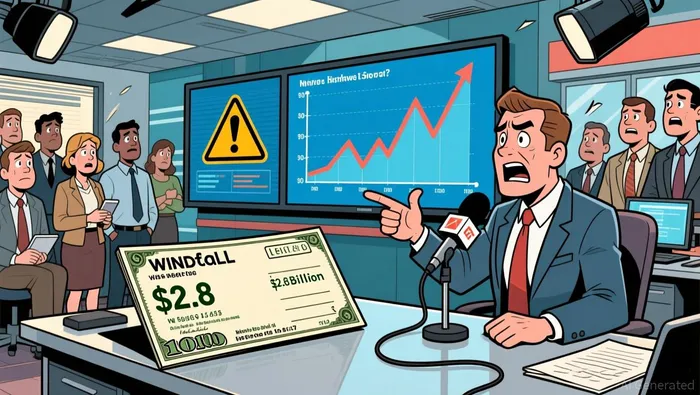
Netflix Stock Dips 9% After One-Time Windfall Clouds Earnings Picture—Is This a Buy Opportunity or Warning Sign?
The immediate event is Netflix's first-quarter 2026 earnings report. The stock's reaction was a classic case of conflicting signals. On the surface, the results were strong: revenue of $12.25 billion beat analyst expectations by a hair, driven by robust underlying growth across all regions. The company also doubled its earnings per share, a figure that included a massive one-time boost.
That boost came from a $2.8 billion payment from Paramount Skydance for the termination of Netflix's proposed acquisition of Warner Bros. Discovery. This non-recurring windfall inflated net income to $5.28 billion for the quarter. Yet, when stripped of that gain, the core earnings story was less impressive. GAAP EPS of $1.23 missed the Street's $1.34 estimate, and the company's own Q2 revenue guidance of $12.57 billion came in 0.6% below expectations.
This sets up the core tactical question. The revenue beat and strong underlying growth suggest the business is firing on all cylinders. But the guidance miss and the sheer size of the one-time fee create near-term risk. The stock fell 9% in extended trading, a sharp move that frames the debate: is this a tactical mispricing of a resilient business, or a warning sign that the guidance caveat is the new normal?
The Mechanics: Pricing Pressure and the Hastings Exit
The stock's sharp decline was driven by two immediate catalysts: operational headwinds and a governance shift. The guidance miss is the clearest signal. While the company reiterated its full-year revenue forecast of $50.7 billion to $51.7 billion, its Q2 projection of 13% growth implies a slowdown from the first quarter's 14% pace. This deceleration is likely linked to recent U.S. price increases. The hike, announced in late March, will hit the books more fully in the current quarter, suggesting subscriber sensitivity is already kicking in. Management's choice to maintain rather than raise guidance reflects a measured, if cautious, response to this new data point.
Separating the noise from the signal is critical. The $2.8 billion one-time fee from Paramount Skydance inflated net income to $5.28 billion, but core GAAP EPS of $1.23 still missed expectations. The company's own full-year forecast, however, implies a clear second-half slowdown, with content amortization growth expected to decelerate to mid-to-high single digits after Q2's peak. This sets up a potential earnings trajectory where the first half is buoyed by timing and the fee, while the second half faces tougher comps and pricing pressure.
On the governance front, the exit of Reed Hastings from the board in June is a notable change. While analysts like Michael Morris of Guggenheim view it as the completion of a long-planned succession, the timing adds a layer of uncertainty. Hastings has been a central figure for over two decades, and his departure, even after stepping down as co-CEO in 2023, can be interpreted as a symbolic signal about the company's next phase. It introduces a governance catalyst that investors will watch for any shifts in strategic tone or board dynamics.
Valuation and the Setup: Assessing the Risk/Reward
The price action tells the story. After the earnings report, the stock fell 9% in extended trading and is now down roughly 10.8% from its close on the day of the report. It trades at $94.83, a level that is well below its 52-week high of $134.12. More importantly, it sits about 12% below the 52-week average of $108.44. This move toward the historical mean creates a clear tactical setup: the stock is pricing in near-term execution risk, but it has also pulled back from a significant premium.
The core business growth remains robust, with Q1 revenue up 16.2% year-over-year. That underlying strength is the counterweight to the guidance caveat. The risk is that the recent U.S. price increase and the resulting guidance miss signal a near-term slowdown in subscriber growth momentum, which could pressure the second-half trajectory. The stock's sharp decline suggests the market is discounting that near-term risk more aggressively than the long-term growth story.
The bottom line is a classic event-driven mispricing opportunity. The valuation has compressed on a specific catalyst-the guidance miss and the timing of the price hike-but the fundamental growth engine is still accelerating. For a tactical investor, this creates a potential asymmetry: the downside from here may be limited by the strong underlying business, while the upside is tied to a resolution of the near-term pricing pressure and a return to the previously guided growth path. The setup hinges on whether the guidance miss is a temporary blip or the start of a more sustained deceleration.
Actionable Takeaways: Price Levels and Watchpoints
The tactical setup is now clear. The stock is trading at $94.83, which is roughly 14% below its 52-week average of $108.44. This level often attracts value buyers when the underlying business remains intact, which it does. The key near-term catalyst is the July earnings report for the second quarter. That release will show the full impact of the U.S. price increase and provide the first concrete data point on whether subscriber growth momentum has indeed slowed as the guidance miss suggests. Investors should watch for any updates on engagement metrics or ad-tier adoption, which could signal resilience in the face of pricing pressure.
The longer-term watchpoint is governance stability. Reed Hastings's exit from the board in June completes a multi-year succession plan, but it is a symbolic shift. The market will be watching for any changes in strategic tone or board dynamics that could signal a pivot in the company's approach to growth and competition. For now, the stock's pullback creates a potential asymmetry: the downside from here may be limited by the strong underlying growth, while the upside hinges on a resolution of the near-term pricing pressure and a return to the guided path.