Google Cloud Next 2026 Preview: Can New TPUs, Gemini, and Agentic AI Sustain Alphabet's Growth?
Google Cloud Next 2026 unveils advanced TPUs and Gemini 3.2 to drive enterprise adoption and sustain Alphabet's long-term growth trajectory.
Google Cloud Next 2026 officially begins on April 22 at Mandalay Bay in Las Vegas, marking a pivotal moment for Alphabet Inc. as the company transitions from foundational AI research to large-scale enterprise execution. The official previews clearly establish Gemini 3.x, Agentic AI, and sweeping AI infrastructure upgrades as the core focus for this year's event.
Silicon Ambitions: The Hardware Battleground and TPU Evolution
To understand the financial implications of Google's hardware announcements, investors must look at the company’s internal silicon trajectory. According to Ainvest analysis, charting the evolution of Google's custom chips reveals a relentless pursuit of computational efficiency. The progression from the 28nm TPU v1 in 2016, which offered a mere 92 TOPS primarily for search ad inference, to the 2023 TPU v5p delivering 459 TFLOPS, illustrates massive internal scaling.
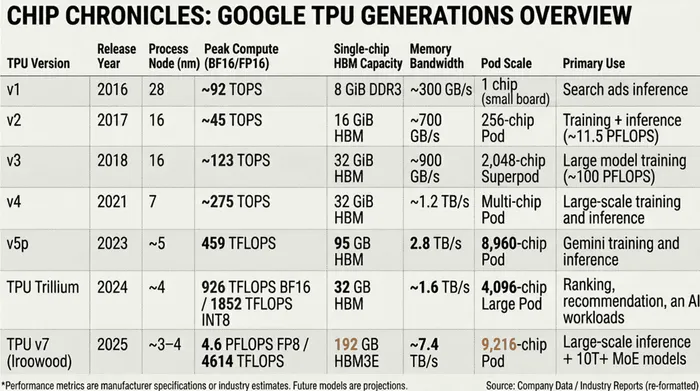
At Cloud Next 2026, the spotlight will aggressively shift to the TPU v7 (codenamed Iroowood). Fabricated on a 3-4nm process node, the v7 architecture reportedly achieves 4.6 PFLOPS of FP8 compute and features 192 GB of HBM3E memory. Crucially, these chips are deployed in massive 9,216-chip pods, delivering the 7.4 TB/s memory bandwidth required to process 10-trillion parameter Mixture of Experts (MoE) models. This internal hardware superiority is already translating to commercial victories. A recent Bloomberg report highlighted that leading AI developers, including Anthropic, have signed expansive agreements to utilize up to 1 million TPUs. Furthermore, Meta Platforms secured a multi-year, multi-billion-dollar contract for Google Cloud TPU capacity. While the v7 dominates the immediate agenda, supply chain analysts at Morgan Stanley suggest that Google may also tease preliminary specifications for a next-generation TPU v8 to reassure investors of its long-term roadmap against Nvidia's relentless product cycle.
The Brain of the Operation: Anticipating Gemini 3.2
The underlying models powering Google's enterprise software suite are due for a significant refresh. Retrospectively, Google Cloud Next 2025 established a high baseline by launching the Gemini 2.5 Pro and Flash variants. Those iterations successfully embedded native multimodal inputs—enabling the seamless processing of text, images, audio, and code—directly into Vertex AI, AI Studio, and the consumer-facing Gemini App. The 2025 updates heavily emphasized stronger logical reasoning and coding proficiency.
For Next 2026, the market anticipates the formal introduction of the Gemini 3.2 architecture. Market analysts expect this iteration to push the boundaries of enterprise data ingestion, likely expanding the contextual window significantly beyond the previous 1-million-token limit. This expansion is critical for enterprise clients who require the model to ingest entire corporate repositories or massive codebases simultaneously. Furthermore, Gemini 3.2 is expected to feature optimized parameter counts specifically tailored to reduce inference latency and lower the compute cost per query. By making the models lighter and faster without sacrificing reasoning capabilities, Google aims to improve the profit margins of its cloud AI services, addressing a key concern among Wall Street tech analysts regarding the high capital expenditures associated with generative AI.
The Agentic Shift: From Passive Models to Active Employees
Perhaps the most profound structural shift to be showcased in Las Vegas is the transition from "Generative AI" to "Agentic AI." Enterprises are moving past chatbots that merely answer questions; they demand autonomous agents capable of executing complex, multi-step workflows across disparate software environments. Google's Workspace Studio, a no-code platform allowing users to build and deploy personalized AI agents, acts as the primary vehicle for this transition.
The recent rollout of the dedicated Mac Gemini application serves as a strong preliminary signal of this strategic pivot. By integrating deeply into the desktop environment, Google is positioning its agents to observe, learn, and automate routine operational tasks directly at the endpoint. During the conference, expect robust demonstrations of Agentspace deployments where Gemini-powered entities autonomously schedule logistics, process procurement orders, and resolve tier-one customer service inquiries. If Google can successfully demonstrate that these agents reduce corporate operating expenses, it will justify higher subscription pricing for its premium Workspace tiers, subsequently driving reliable, recurring revenue growth.
Beyond the Headlines: Hidden Catalysts for Institutional Portfolios
While chips and models dominate retail headlines, institutional investors will be closely monitoring several specialized "hidden" verticals that dictate enterprise adoption rates.
Foremost among these, security and compliance remain the absolute prerequisites for corporate AI deployment. Following the Next 2025 launch of the Google Unified Security brand, the 2026 agenda will likely detail advanced agent security governance. As AI agents gain access to sensitive corporate databases, Chief Information Security Officers require granular, zero-trust control planes. Google's ability to integrate threat intelligence and secure enterprise browsing natively into its AI ecosystem will be a major selling point against fragmented vendor stacks.
On a structural level, the underlying architecture of Google Cloud is undergoing a quiet revolution. Cloud engineers note a paradigm shift toward a "continuous execution" control plane. Instead of traditional short-lived batch processing, the network and storage layers are being fundamentally re-architected to support AI agents that run persistently. This systemic upgrade positions Google Cloud as an operating system for AI, rather than just a passive compute pool.
In the realm of digital transactions, the Universal Commerce Protocol (UCP) warrants close attention. Anticipated to be a shared infrastructure layer, UCP enables autonomous agents to interact with online retailer databases, compare pricing, and execute transactions without human intervention. This infrastructure for agentic commerce could open entirely new monetization avenues in digital retail.
Ultimately, sustainability metrics will be scrutinized. With the explosive energy demands of AI data centers, ESG compliance is a material risk for mega-cap tech valuations. Google is expected to provide concrete updates on its commitment to 24/7 carbon-free energy by 2030, showcasing high-efficiency liquid cooling and dynamic workload scheduling to offset the power consumption of its expanding TPU clusters.