Crypto "Earn" Products: A $19B Liquidity Risk Without FDIC Backing
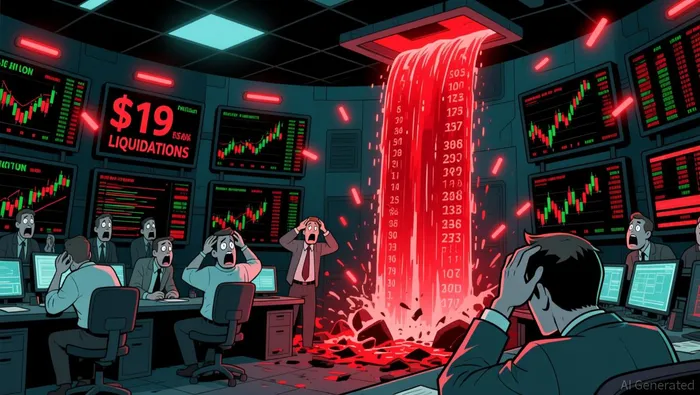
The core thesis is stark: crypto "earn" products are unsecured loans to poorly regulated intermediaries, not safe deposits. The Bank for International Settlements (BIS) provides the clearest proof, pointing to a $19 billion liquidation cascade in October 2025 as evidence of systemic leverage amplification. This wasn't a minor hiccup; it was a forced unwinding of over 1.6 million leveraged positions in a single day, triggered by a macro shock and sweeping through dominant exchange venues.
Major exchanges are the conduits for this risk. The BIS labels them "multi-functional intermediaries," combining the roles of banks, brokerages, and exchanges without traditional safeguards. They operate as lightly regulated "shadow banks," turning user deposits into unsecured loans and recycling them into risky activities like margin lending and proprietary trading. In this model, customers become unsecured creditors of opaque trading operations, directly exposed to platform solvency risk if things go wrong.
This structural flaw was on full display with the collapses of Celsius Network and FTX. The BIS report notes these were cautionary examples where users were left with only general creditor claims after customer funds were mixed with proprietary bets. The model's danger is that it pools assets into risky activities while promising deposit-like stability and easy withdrawals, a setup that the BIS warns could be significant for the broader crypto ecosystem and potentially spill over into traditional finance.
The Liquidity and Risk Flow: A Systemic Vulnerability
The dangerous flow begins with user deposits, which are treated as unsecured loans to the platform. These "earn" products pool customer assets into risky activities like margin lending and proprietary trading, creating a direct exposure to the platform's solvency. The BIS explicitly warns that leverage, opacity and deposit-like promises without protection leave users directly exposed to repayment risk, a vulnerability starkly demonstrated by the collapses of Celsius and FTX.
This model amplifies systemic risk through a cycle of leverage and recycling. Exchanges act as "shadow banks," turning user deposits into unsecured loans that are then reused to fund more leverage across the ecosystem. The BIS cites a $19 billion liquidation cascade in October 2025 as evidence of how this amplifies losses during a shock, sweeping through interconnected trading venues. The risk isn't theoretical; it's a documented mechanism for forced unwinding.
A critical metric reveals the pool's composition: illicit actors captured 2.7% of available crypto liquidity in 2025. While this is a small fraction of raw volume, it represents a significant portion of deployable capital. This high-risk segment flows into the same liquidity channels that support "earn" products, embedding volatility and potential for sudden outflows into the core of the shadow banking model.
Catalysts and Watchpoints: What Could Trigger a Crisis
The BIS's warning about systemic risk hinges on specific, observable metrics. The first and most immediate watchpoint is a divergence between stablecoin prices and their pegs. Episodes where tokens like USDT or USDC trade away from $1 are a direct signal of underlying reserve strain and loss of market confidence, a vulnerability the BIS has already cited.
The second critical metric is the sheer growth of large dollar stablecoins. As the BIS's general manager warned, these tokens could have "material consequences" for financial stability if they grow large enough. Their expansion forces issuers to hold massive reserves, creating a potential trigger for rapid, destabilizing sales of assets like short-term government debt during a crisis.
The third, and most direct, watchpoint is the total volume of "earn" products and the concentration of user assets on a few major platforms. This tracks the core risk flow: the more capital pooled into these unsecured loans, the greater the potential for a cascading failure if a single platform encounters trouble. The BIS's own analysis of a $19 billion liquidation cascade shows how quickly leverage can amplify losses when a shock hits. Monitoring the scale and centralization of these products is essential to gauge the system's fragility.