Ethereum's Stalled Upside: Flow Quality and the Risk of a New Decline
Ethereum is stuck, trading at $2,403.78 after a 4.28% jump yesterday. This move is a reaction, not a breakout. The broader crypto market is in a state of 'Extreme Fear' (index at 9), while Ethereum's own sentiment sits at 'Greed' (64). This divergence is telling: institutional rotation into ETH funds is not enough to drive a major, sustained rally.
The price action shows clear resistance. Despite a strong weekly gain, the move from $2,085 to $2,403 over the past month has been choppy. The recent surge in on-chain activity, with daily transactions up 41%, is not translating into higher economic value, as stablecoin volumes and fees have fallen. This suggests the momentum is built on speculative flows, not fundamental utility.
The setup leaves the price vulnerable. The rotation from Bitcoin ETFs, which saw $325 million in outflows, has provided a temporary bid. But without a corresponding surge in on-chain value or a shift in the broader market's fear, the gains lack a durable foundation. The path of least resistance now appears sideways or lower.
Flow Quality Check: ETF Rotation vs. On-Chain Weakness
The current ETF-driven rotation into Ethereum is showing strong flow momentum, but the underlying on-chain activity lacks quality. On April 21, Ethereum ETFs saw a daily inflow of $43.3 million, marking the ninth straight day of inflows. This streak, led by BlackRock's ETHA attracting $37 million in a single day, signals sustained institutional conviction and has provided a clear bid for the price.
Yet this flow quality is undermined by deteriorating on-chain fundamentals. While daily transactions are up 41% week over week, the economic value behind them has collapsed. Stablecoin transfer volume on Ethereum is down 42.6% over the same period, and fees have fallen nearly 50%. This disconnect-surging speculative activity paired with falling value transfer-suggests the recent price gains are being fueled by capital rotation, not a fundamental increase in network utility.
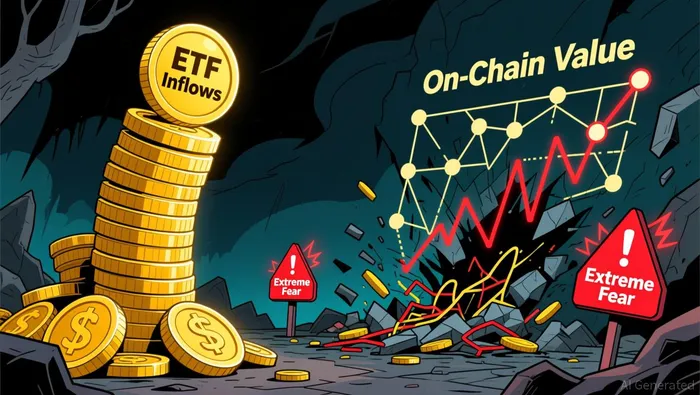
The sustainability of this setup is now in question. For the rotation to prove durable, the ETF inflows must continue to outpace the decline in on-chain quality. The current data shows a fragile balance where institutional money is flowing in, but the network's economic throughput is weakening. This creates a vulnerability; without a corresponding rise in stablecoin volume and fees, the rally lacks a foundation to support a sustained move higher.
Catalysts and Risks: The Path to Decline
The immediate risk is a reversal in the capital rotation that is currently propping up Ethereum. The primary catalyst for a new decline would be a resumption of significant outflows from Bitcoin ETFs. The $325 million in outflows on April 13 provided the initial bid for ETH funds. If that trend restarts, capital could flow back into BTC, pressuring ETH's relative rotation and removing a key support for the price.
A technical breakdown below key support would confirm the flow is insufficient. The price must hold above the $2,400 level to signal the current ETF-driven momentum can drive a breakout. A failure to do so, especially on a volume spike, would suggest the underlying on-chain weakness is outweighing institutional inflows. The recent surge in speculative transactions without a rise in economic value makes the network vulnerable to a sharp correction.
The prediction market offers a stark contrast to the fundamental setup. Markets are pricing near-certainty for a price above $2,300, with contracts showing 99¢ for $2,300 or above. This reflects the current price action and momentum, not an assessment of on-chain quality or ETF sustainability. The high probability of a price above $2,300 is a signal of speculative positioning, which can quickly reverse if the flow catalysts fade.