Deepvein Mining Faces Critical Adoption Test as Mining Giants Hesitate to Fund Robotics-First Infrastructure
Deepvein Mining is not just selling a new tool; it is building the first-principles infrastructure for a new paradigm in mineral discovery. The company's DeepSight Exploration system represents a fundamental shift from human-led expeditions to a robotics-first workflow, automating the entire exploration process from surveying to sampling. This is a classic move onto the early adoption phase of an exponential growth curve, where the company is positioning itself as the foundational layer for the next mining paradigm.
The technological promise is clear. By combining autonomous aerial swarms with ground-based quadruped robots and an AI-powered geological intelligence platform, Deepvein aims to accelerate discovery by 30 to 50 percent while reducing costs by approximately 40 percent. More importantly, it removes humans from the high-risk survey phases, directly addressing a core safety imperative in the industry. This end-to-end robotic solution moves beyond piecemeal automation, offering a unified platform that could dramatically compress exploration cycles in a sector where finding new, accessible deposits is becoming exponentially harder.
This move aligns with a powerful macro trend. The global mining robotics market, valued at $1.7 billion in 2026, is projected to grow at a 9.8% CAGR to $3.3 billion by 2033. This adoption curve is being driven by rising safety regulations, labor shortages, and the need to operate in more complex, remote environments as easily accessible deposits decline. Deepvein is entering this phase at the right time, constructing an infrastructure layer that fits squarely within the industry's accelerating push toward automation.
The bottom line is that Deepvein is not chasing a marginal efficiency gain. It is attempting to redefine the discovery workflow itself, placing the company at the inflection point of an S-curve where early adoption can lead to significant market capture. The coming years will test whether this robotics-first infrastructure can achieve the promised acceleration and cost reduction at scale, but the strategic positioning is clear: Deepvein is building the rails for the next mining paradigm.
The Infrastructure Layer: Hardware-Software Integration and First-Mover Leverage
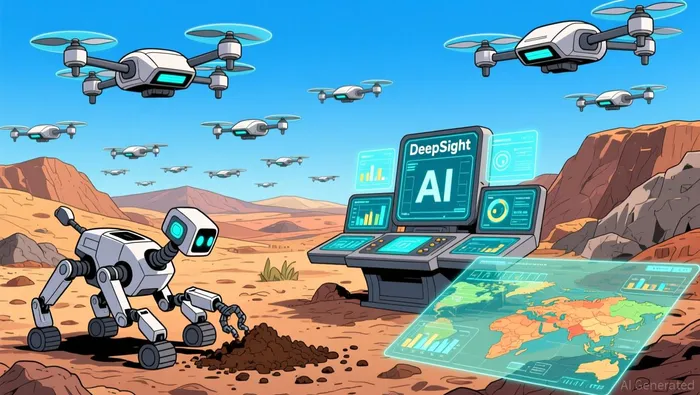
Deepvein's true strategic advantage lies in its ability to integrate disparate technologies into a single, closed-loop exploration system. The company is not just selling drones or robots; it is building the foundational software-hardware stack that defines the workflow. The DeepSight Exploration platform unifies autonomous aerial swarms for wide-area scanning with ground-based quadruped robots for precise sampling, all controlled by a central AI-driven geological intelligence system. This creates a real-time feedback loop where data from the sky is immediately processed to guide robots on the ground, which then collect new samples to refine the model. This integrated approach is what moves the company from a vendor of components to an infrastructure layer for the next mining paradigm.
This hardware-software integration is the core of its first-mover leverage. By designing the entire system from the ground up for this specific workflow, Deepvein avoids the common pitfalls of retrofitting existing industrial robots for exploration. The equipment is engineered for the harsh conditions of remote mining sites, with features like wind resistance and dust protection. More critically, the software platform is built on the premise of embodied intelligence, where machines don't just follow commands but perceive, adapt, and support decision-making. This vision of a "parallel world" for mining, spanning exploration to reclamation, positions Deepvein as the architect of the operating system for a fully autonomous mining future.
External validation of this advanced design is now coming. The company's Intelligent Geological Mapping and Geochemical Sampling Quadrupedal Robots have won a Gold Award at the 2026 NY Product Design Awards. This recognition signals that the industry is beginning to acknowledge the sophistication of Deepvein's engineering and its potential for industrial adoption. It adds credibility to the platform's ability to deliver on its promises of accelerated discovery and cost reduction.
The company's founder brings a unique operational foundation to this technical challenge, having been involved in the discovery of Asia's largest lithium deposit. This deep field experience ensures the technology is not developed in a vacuum but is grounded in the real-world pressures and constraints of mineral exploration. It provides an invaluable feedback loop, allowing Deepvein to refine its systems based on actual geological workflows. This blend of visionary engineering and hard-won field expertise creates a formidable barrier to entry, as replicating the integrated platform and its operational insights would require significant time and capital investment. For now, Deepvein is constructing the essential rails, and its integrated design is the first key to unlocking the exponential growth of the next mining S-curve.
Adoption Trajectory and Financial Impact Pathway
The unveiling of DeepSight Exploration in March 2026 marks the official launch of a new paradigm, but it also places Deepvein at the base of the adoption S-curve. The company is now in the critical phase of converting technological promise into commercial scale, a journey that hinges entirely on securing pilot contracts and demonstrating rapid adoption rates. The path forward is clear: move from validation to widespread deployment, scaling unit economics to capture the massive, sustained demand created by the green energy transition.
The primary adoption driver is the global push for critical minerals. The market for these resources is expanding exponentially, creating a large addressable market for accelerated discovery. Deepvein's platform is positioned to meet this demand by compressing exploration cycles by 30 to 50 percent and cutting costs by approximately 40 percent. For mining companies facing the dual pressures of declining accessible deposits and rising safety regulations, this efficiency gain is not a luxury but a necessity. The company's validation at its Namibia project site, where predicted copper zones aligned closely with on-site verification, provides early proof of concept. Yet, scaling requires moving beyond single-site validation to a portfolio of operational pilots that can refine the system and build industry credibility.
Success will be signaled by a rapid acceleration in adoption rates. The company must achieve a high velocity of pilot-to-commercial conversion to capitalize on the market's projected growth. The global mining robotics market, valued at $1.7 billion in 2026 and projected to grow at a 9.8% CAGR, provides the macro backdrop. Deepvein's integrated hardware-software stack offers a unique value proposition within this growth, but first-mover leverage must be converted into market share quickly. The key metrics to watch will be the number and value of signed pilot agreements, the speed of deployment across different geographies and deposit types, and the ability to reduce the cost of discovery per tonne of identified resource.
The financial impact pathway is therefore a function of adoption velocity. Rapid scaling allows the company to amortize its significant R&D and system integration costs over a larger revenue base, improving unit economics. It also builds a network effect, where more data from deployed systems further trains the AI platform, enhancing its predictive power and creating a virtuous cycle. Conversely, slow adoption would prolong the high-cost launch phase and risk ceding ground to competitors who may develop similar integrated solutions. For now, Deepvein is building the rails. The coming quarters will determine whether the company can achieve the exponential adoption rate needed to ride the next mining paradigm's S-curve to profitability.
Catalysts, Risks, and the Exponential Growth Threshold
The investment thesis for Deepvein Mining now hinges on a clear set of near-term milestones that will validate its position on the S-curve. The company has launched its platform; the next phase is proving its exponential value. The most critical catalyst is securing pilot contracts with major mining firms. These partnerships are the essential proof of concept that moves the narrative from a Silicon Valley showcase to an industry standard. Success here would signal a shift from promise to proven performance, demonstrating that the promised 30 to 50 percent acceleration in discovery timelines and 40 percent cost reduction are achievable in real-world operations.
A deeper validation will come from the expansion of the robotics platform's capabilities beyond initial surveying. The current system integrates aerial swarms and ground robots for sampling. The next infrastructure layer will be the autonomous execution of geological modeling and target verification. If Deepvein can demonstrate a closed-loop system where data from drones and robots is processed by its AI platform to autonomously refine exploration models and direct subsequent robotic actions, it would fundamentally redefine the workflow. This would move the company from a tool vendor to the operating system for autonomous exploration, deepening its moat and accelerating the adoption curve.
The primary risk that could flatten this adoption trajectory is the industry's inherent capital expenditure cycles. Mining companies are notoriously slow to adopt new exploration technologies, even when the efficiency gains are clear. The decision-making process for new equipment is often multi-year, tied to long-term project planning and budget cycles. This creates a potential lag between Deepvein's rapid technological deployment and the industry's slower capital allocation. The company's challenge is to build a compelling enough ROI case to overcome this inertia, proving that the time saved and risk reduced by its robotics-first approach justifies the upfront investment.
Another material risk is the competitive landscape. While Deepvein is a first-mover in an integrated exploration stack, the mining tech sector is rapidly innovating. Established players like Sandvik are advancing intelligent drills, and other firms are developing AI-powered analytics. Deepvein must maintain its technological lead in hardware-software integration to prevent its early advantage from eroding. The company's Gold Award for its quadrupedal robots is a positive signal, but sustained R&D investment is required to stay ahead.
For investors, the path forward is defined by these catalysts and risks. Watch for announcements of pilot agreements with tier-1 exploration firms, as these will be the first concrete indicators of market traction. Also monitor for any expansion of the platform's autonomous functions, which would signal deeper infrastructure integration. The bottom line is that Deepvein is building the rails for a new paradigm. The coming quarters will determine whether the company can achieve the exponential adoption rate needed to ride the next mining S-curve to profitability, or whether the industry's slow capital cycles will keep it on the early, high-cost phase of the curve.