Concentration Risk Looms as Tech Imbalance Supports the Rally, While AI Frenzy Appetite Stretches Into a Critical Week Ahead
The stock market continues to show resilience as it becomes increasingly immune to Middle East headlines and shifts focus back to fundamentals. So far, the earnings season has delivered mixed signals. Investors are no longer satisfied with companies simply beating expectations. With valuations already elevated and technical conditions stretched, the market now demands stronger surprises and clearer forward guidance. While overall earnings remain solid, the software sector still struggles to justify its position amid ongoing AI disruption. At the same time, concentration risk is building, as a handful of technology giants continue to lead the rally with aggressive spending. With major earnings approaching next week, the market is entering a critical phase where both technical positioning and earnings expectations could drive near term direction.
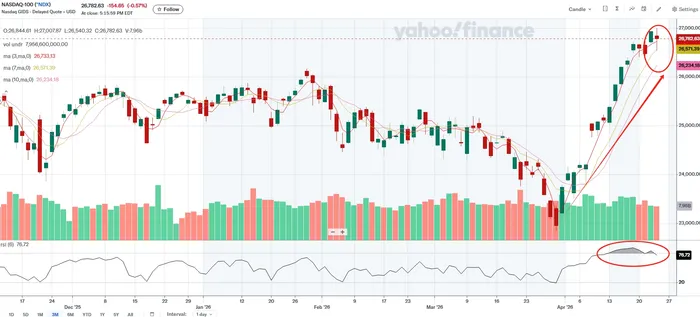
From a technical perspective, the broader market has cooled slightly following the recent sharp rally and is entering a consolidation phase as it awaits further earnings clarity. The Nasdaq 100 shows an RSI around 76, elevated but not yet extreme, with a bullish structure supported by MA3 above MA7 and MA10. However, short term momentum is beginning to slow as the faster moving averages lose acceleration, suggesting that speculative enthusiasm is starting to fade even as the AI narrative remains intact. The S&P 500 reflects a similar setup, with RSI near 72 and a flattening short term trend. As major earnings approach, investors are becoming more cautious about whether current valuations can stretch further without stronger fundamental support.
Looking ahead requires understanding what recent earnings have already revealed. The key takeaway from first quarter results is that beating expectations has become the baseline rather than the exception. The broader economy remains stable, but structural shifts across industries continue to shape investor behavior. Market participants are placing greater emphasis on forward guidance and are increasingly sensitive to any signs of slowing growth. Even minor disappointments or cautious outlooks can quickly trigger selling, reflecting a more demanding and selective market environment.
Taking Thursday as an example, the SaaS sector was hit hard again. IBM dropped 8%, ServiceNow fell 17% post earnings, which then triggered declines in Microsoft at 4%, Palantir at 7%, and both Shopify and Snowflake down around 6%. Investors reacted with concern, as some companies still failed to convince the market that AI can sustain or expand their positioning, raising broader worries about the entire industry, even among firms with deep partnerships with Anthropic or OpenAI.
For instance, IBM delivered a solid earnings beat with revenue up 9%, but reiterated guidance of around 5%, which signaled potential headwinds ahead and raised concerns that AI could be part of the pressure. In the case of ServiceNow, its "AI control tower" narrative suggested that Middle East tensions had impacted subscription revenue despite the earnings beat. This outcome implied that pricing power may be weakening, regardless of whether the cause is geopolitical or competitive. From an investor perspective, the market placed greater weight on these explanations, leading to a broad selloff across the software sector.
In contrast, the semiconductor segment continues to demonstrate strong momentum, supported by relentless spending from large technology companies. Texas Instruments recorded its largest daily gain (+19%) since 2000, driven by demand from data centers and industrial applications. Intel has surged double this month as rising CPU prices and strong AI driven demand lifted its outlook. These developments reinforce the view that hardware linked to AI infrastructure remains a primary beneficiary in the current cycle. However, this divergence within the technology sector is also a source of concern, as leadership becomes increasingly narrow.
A critical question is where this demand originates. The answer lies with hyperscalers, which continue to commit significant capital to AI infrastructure. Alphabet, Microsoft, Amazon, and Meta are set to report earnings next week, and their investment strategies will be closely scrutinized. Collectively, these companies have already committed roughly $650 billion in capital expenditure based on fourth quarter trends, implying a 70% increase in spending for 2025. This investment is fueling growth in the semiconductor ecosystem, with companies like TSMC already raising guidance. However, the scale of spending is also raising concerns about monetization. Investors are increasingly questioning whether revenue growth can keep pace with capital deployment, especially as returns on AI investments remain uncertain in the near term.
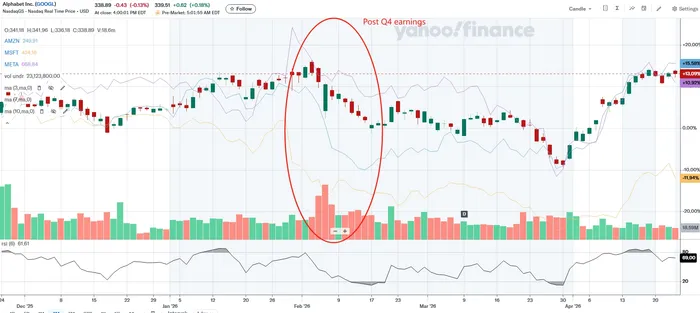
Recent history adds to this caution. On average, these major technology companies have declined about 5.7% in the session following earnings releases, with further downside often following as markets digest the balance between spending and growth. This pattern could repeat, particularly as expectations remain high and positioning is already stretched. While the long term AI narrative remains compelling, near term reactions may be driven more by concerns over cost efficiency and return on investment.
The current earnings season appears to be an extension of the previous quarter, characterized by heavy investment in AI infrastructure, ongoing capacity constraints, and strong performance from chip related companies. However, as large technology firms now serve as the foundation of the broader market, any pullback in these names could have an outsized impact on overall sentiment. With indices already near highs and investor expectations elevated, the risk of disappointment becomes more pronounced.
In conclusion, the market is entering a critical phase where concentration risk and elevated expectations intersect. Semiconductor and cloud related companies continue to support the rally, but the growing imbalance within the technology sector introduces vulnerability, especially as software weakness becomes more visible. With the broader market already stretched, reliance on a narrow group of leaders increases downside risk if sentiment shifts. The upcoming earnings from major technology firms will likely determine whether the rally can sustain its momentum or face a near term reset. Investors should remain selective, focusing on areas with clear demand visibility while being cautious of segments where expectations may have already run ahead of fundamentals.