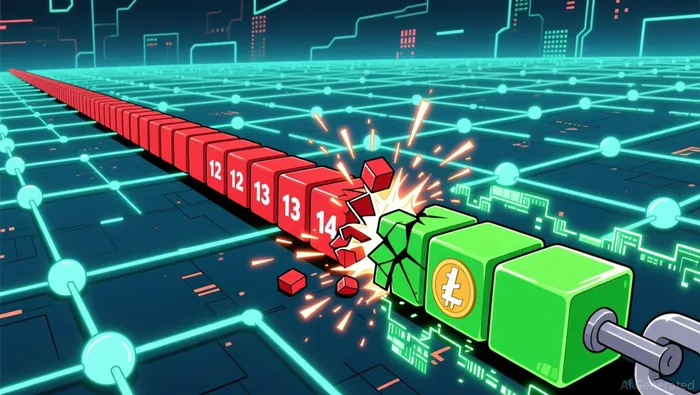
Litecoin's 13-Block Reorg: Flow Impact and Price Reaction
The market's immediate reaction was muted. Litecoin's price dipped to $56.02, a 0.97% drop, showing limited panic despite the technical disruption. This minor correction suggests the event was largely absorbed without triggering a broader selloff.
The network executed a 13-block chain reorganization to reverse invalid transactions processed by non-updated mining nodes. This was the direct technical response to a zero-day bug that allowed fraudulent MWEB transactions to be pegged out to third-party DEXs. The reorg was not a 51% attack, but a network correction to wipe invalid data before settlement.
Critically, the Litecoin team confirmed all valid transactions from the period remain safe and that the bug has been fully patched. The network is now operating normally, with the incident contained to the invalid chain segment.
The Mechanics: Exploit Flow and Network Defense
The attack exploited a zero-day vulnerability in the MWEB protocol. This flaw allowed a malformed transaction to pass validation on non-updated mining nodes, creating a window for fraudulent activity. The exploit specifically enabled coins to be pegged out to third-party decentralized exchange (DEX) platforms, effectively moving value off the Litecoin chain.
The network's defensive response was an automated 13-block chain reorganization. This mechanism discarded the invalid chain segment and wiped all affected transactions from the main ledger. The reorg was the protocol's corrective action to reverse the fraudulent activity before settlement.
The Litecoin team confirmed the bug has been fully patched. All valid transactions from the period remain intact, and the network is now operating normally. The incident highlights a persistent risk in proof-of-work systems: security depends on the majority of nodes running updated software.
The Aftermath: Financial Losses and Market Sentiment
The reported financial exposure was significant but likely overstated. Cross-chain bridge NEAR Intents had initially flagged approximately $600,000 in exposure, stating it would cover user losses. However, the network's confirmation that all invalid transactions were wiped during the 13-block reorg suggests the actual settled losses are materially lower. The incident highlights a key risk: protocol updates create temporary windows where non-updated nodes can be exploited, but the network's defensive mechanism contained the damage.
This event is not isolated. The vulnerability exploited is part of a recurring pattern in proof-of-work networks. As noted by Zcash founder Zooko Wilcox, there have been many rollback-and-double-spend attacks against Proof-of-Work-alone blockchains recently, including against Monero and Grin. Each attack underscores the persistent challenge of ensuring node coordination and software updates across a decentralized network, where a minority of outdated nodes can compromise the integrity of the chain.
The bottom line is that while the price impact was contained, the incident serves as a costly reminder. It demonstrates that even well-secured networks face operational risks from zero-day exploits and node fragmentation. For investors, the flow of funds through cross-chain bridges like NEAR Intents remains a critical vector for potential loss, but the network's ability to self-correct via a reorg provides a crucial safety net.