Microsoft and OpenAI's "Peaceful Breakup". AI Giants Move from Bound Growth to Settling Their Own Accounts
Microsoft drops OpenAI exclusivity to boost Azure margins, while OpenAI gains multi-cloud distribution to reduce dependency and expand enterprise reach.
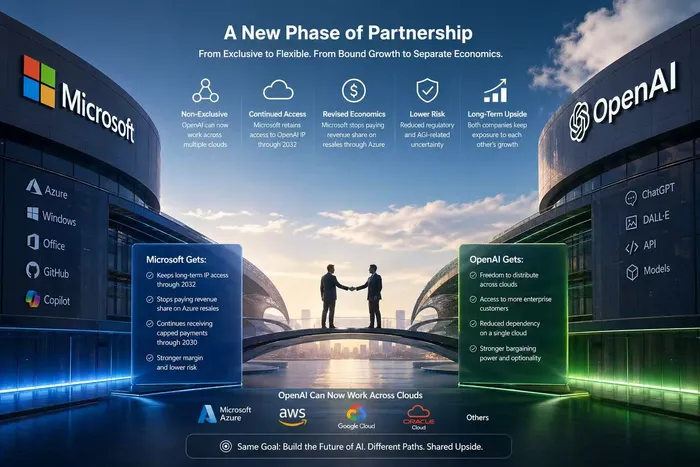
Microsoft and OpenAI have revised the terms of their partnership. Microsoft is giving up its exclusive right to sell OpenAI's models, and OpenAI is gaining more freedom to distribute its technology through other cloud platforms. At the same time, Microsoft will no longer pay OpenAI a resale revenue share on OpenAI products sold through Azure. The deal is not a breakup. It is a reset of rights, margins, and distribution power after both companies outgrew the original structure of their alliance.
Microsoft will no longer have an exclusive license to OpenAI's models and products, which means OpenAI can reach customers across AWS, Google Cloud, Oracle, and other non-Azure environments. Microsoft keeps important protections: OpenAI's revenue-share payments to Microsoft continue through 2030, Microsoft retains access to OpenAI IP through 2032, and Azure remains OpenAI's primary cloud partner. In plain terms, OpenAI gets wider distribution, while Microsoft keeps long-term access and improves the economics of its own Azure resale business.
OpenAI Is Trying to Become a Cross-Cloud AI Standard, Not a Microsoft-Attached Product
For OpenAI, ending exclusivity is a necessary step in its evolution from a frontier-model lab into a standalone AI infrastructure company. Microsoft was essential to OpenAI's rise: it provided capital, cloud infrastructure, enterprise distribution, and a path into products such as Copilot, Azure OpenAI Service, GitHub, and Office. Such an arrangement made sense when OpenAI needed scale more than independence. As OpenAI becomes a supplier of core AI capability for enterprises, developers, and software platforms, being tied too tightly to one cloud provider turns into a constraint rather than an advantage.
Strategic value now comes from OpenAI's ability to reach customers outside the Azure ecosystem. Many large enterprises are already deeply embedded in AWS, Google Cloud, Oracle, or hybrid-cloud architectures. If OpenAI wants its models to become a default layer of enterprise AI, it cannot afford to be perceived as a Microsoft-only product. In practical terms, the company is trying to position itself less like an application inside Microsoft's software stack and more like a standardized AI component that can be distributed across clouds, applications, and enterprise workflows.
AWS Changes OpenAI's Bargaining Position
Amazon is the most important external variable. Reuters reported that the revised pact opens the door for OpenAI to work with Microsoft's cloud rivals, including Amazon, Oracle, and Google. Amazon CEO Andy Jassy also said OpenAI models are expected to come to AWS soon, giving OpenAI potential access to one of the world's largest enterprise cloud customer bases.
Such access matters because OpenAI's core bottleneck is no longer only model quality. It is compute, power, distribution, enterprise trust, and capital. A company preparing for a more independent future cannot rely on a single cloud channel, especially when AI demand is expanding faster than available infrastructure. Multi-cloud access gives OpenAI more leverage, lowers dependency risk, and makes its future revenue base easier for investors to underwrite. A single-cloud AI company receives a different valuation narrative from a platform that can sell wherever enterprise customers already run their workloads.
Microsoft Gives Up Exclusivity, but It Gets Cleaner Profit Economics
Microsoft's side of the deal should not be read as a simple loss. The company gives up exclusive control, but it also removes a direct economic drag: it will no longer pay OpenAI a revenue share on OpenAI products resold through Microsoft's cloud. In an AI cycle where investors are increasingly focused on the return on massive data-center and GPU spending, that change matters. Azure OpenAI Service can become a cleaner margin story if more of the resale economics stay inside Microsoft.
Investor pressure over AI infrastructure spending has been building for a reason. The question is not whether AI demand exists; the harder issue is whether that demand can become durable profit rather than headline cloud growth. Microsoft's adjustment addresses this concern directly. It shifts part of the OpenAI relationship from "pay heavily to control the channel" toward "keep access, preserve upside, and improve unit economics." Microsoft still keeps a long-term license to OpenAI IP through 2032 and continues to participate in OpenAI's growth as a major shareholder. In other words, Microsoft is not exiting the OpenAI trade. It is making the trade more financially legible.
The AGI Clause Was a Legal and Commercial Overhang
Another important change is the treatment of AGI-related economics. The previous structure created uncertainty because key rights and payments could be affected by the achievement of artificial general intelligence, a concept that remains difficult to define and even harder to adjudicate in a commercial contract. The new arrangement makes OpenAI's revenue-share payments to Microsoft continue through 2030 regardless of technology progress, reducing the risk that a vague technical milestone could disrupt a major business relationship.
Removing that trigger is not just a legal cleanup. It signals that both companies want a more mature and financeable structure. OpenAI needs cleaner governance and more predictable obligations as it moves closer to public-market logic. Microsoft needs confidence that future access and economics will not be disrupted by a disputed AGI declaration. By reducing the role of that trigger, both sides remove one of the most sensitive sources of tension in the partnership.
Regulatory Pressure Makes a Looser Partnership More Valuable
Regulatory pressure is another reason the revision makes sense. Microsoft's relationship with OpenAI had become unusually dense: Microsoft invested in OpenAI, supplied cloud infrastructure, gained model access, integrated OpenAI technology into its own products, and helped distribute OpenAI services through Azure. Such a structure was always going to attract scrutiny because it could look like a dominant software and cloud platform controlling a critical AI gateway.
A non-exclusive structure is easier to defend. OpenAI can work with rival clouds, while Microsoft can argue that it is not blocking access to a key AI supplier. Microsoft does not lose its real advantage in that scenario. Its moat is not only OpenAI exclusivity; it is the combination of Azure, Office, Windows, GitHub, Copilot, enterprise procurement relationships, and developer distribution. Early AI competition was about access to the strongest model partner. The next phase is about embedding AI into workflows and converting usage into recurring, high-quality revenue.
The Trade Is No Longer About Model Access Alone
For investors, the key question is not whether Microsoft and OpenAI are "breaking up." A better question is which company improves its business model from here. OpenAI gains freedom: it can sell across cloud platforms, reduce infrastructure concentration risk, and expand into enterprise accounts that may never standardize on Azure. Microsoft gains clarity: it keeps long-term IP access, continues receiving capped revenue-share payments through 2030, removes the resale revenue-share burden, and lowers regulatory risk.
Practical indicators matter more than symbolic headlines now. Watch whether OpenAI's availability on AWS expands enterprise adoption. Watch whether Azure OpenAI Service shows better margin quality. Watch whether Microsoft Copilot usage and paid conversion continue improving. Watch whether AWS can use OpenAI models to strengthen its AI cloud narrative. Also watch Google Cloud, because broader OpenAI distribution could make the enterprise model market more competitive.