Musk vs Altman Goes to Court: What's Actually Going On?
Elon Musk demands $134 billion from OpenAI and Microsoft, challenging the AI giant's for-profit shift and threatening its $852 billion valuation.
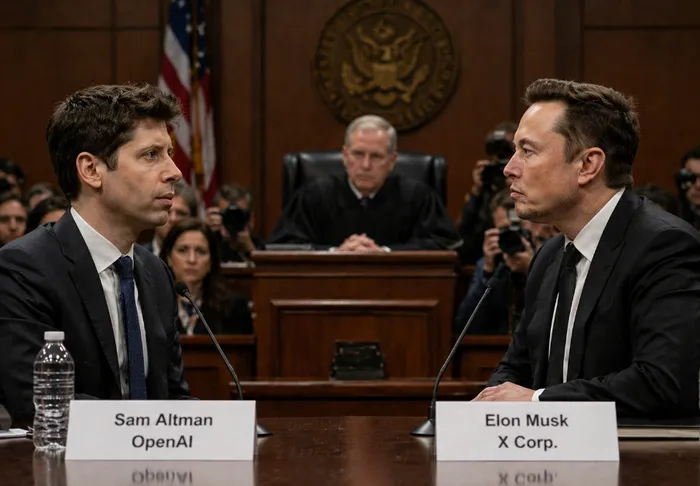
The federal courthouse in Oakland, California, has officially become the stage for the most explosive legal drama in the history of Silicon Valley. The trial of the century has begun: Elon Musk vs. Sam Altman and OpenAI.
Forget the complicated legal jargon for a second. This is a story about two former best friends, a massive amount of "betrayal" money, and the question of who gets to control the most powerful technology ever built.
The $852 Billion "Betrayal"
The biggest bone of contention is how OpenAI transformed from a tiny "save-the-world" lab into a global financial juggernaut. On March 31, 2026, OpenAI closed a historic funding round that officially pegged its valuation at $852 billion.
Imagine you and a friend start a non-profit "animal shelter." You donate millions because you love dogs. Then, a few years later, your friend kicks you out, closes the shelter, and builds a massive, high-end "pet hotel" that charges $1,000 a night. That is exactly what Musk claims happened. He says he gave $38 million in seed money to a charity, only for Altman to turn it into a Microsoft-backed "money-printing machine."
The $134 Billion "Give It Back" Demand
In a move that has shocked even veteran lawyers, Musk isn't just asking for his $38 million back. He is demanding that OpenAI and Microsoft "disgorge" up to $134 billion in wrongful gains.
Musk isn't saying "I want $134 billion in my bank account." He is saying, "You made this money by breaking your promise to stay a non-profit. Therefore, you don't get to keep it." His lawyers argue that OpenAI made about $109 billion and Microsoft made about $25 billion by unfairly using the technology Musk helped fund. Musk's ultimate flex? He wants this money returned to the OpenAI Charity, not to himself. He's essentially trying to bankrupt the "New OpenAI" to revive the "Old OpenAI."
How This Trial Actually Affects Your Life
You might think, "I don't own a billion-dollar company, so why should I care?" But the result of this fight will change your daily life in a big way. It's basically a battle to decide if the "brain of the future" will be free like the air we breathe, or something you have to pay for every month.
The Cost of Getting Smarter: If Altman wins, AI will likely stay "closed." This means every time you use a smart tool—like an AI doctor to check a cough or an AI tutor to help your kid with homework—you'll probably have to pay a subscription fee. It becomes a "pay-to-play" world where the richest people have the smartest AI.
A "for-profit" OpenAI is built to make money for its owners. Their goal is to make AI do your job faster and cheaper than you can. If Musk wins and forces the tech to be "open," more companies can build tools that help humans do their jobs better, rather than just replacing them to save a buck. If the tech becomes free and "open" for everyone (Musk's goal), you get amazing tools for free. But it also means the "bad guys" get the same powerful tech with no safety locks. It's a choice between a safe, expensive world and a free, wild-west world.
Conclusion
This trial is just a giant fight over who gets to be the gatekeeper. Whether it's Musk or Altman, someone is going to be in charge of the tech that runs our lives. We're just the audience in the front row, waiting to see if our future is going to be "expensive and safe" or "free and messy." Either way, the days of AI being a helpful little sidekick are over—it's now a business, and we're the customers. Grab your wallet, because one way or another, we're all paying for this.