The True Heat of AI Behind TSMC's Capex Surge
TSMC raises 2026 capital expenditure to $56 billion, betting heavily on AI demand while facing risks of massive asset depreciation if utilization drops.
In the 2026 AI gold rush, if Nvidia is the one selling shovels, Taiwan Semiconductor Manufacturing Co. (TSMC) is the foundry that monopolizes the world's raw iron supply. As 2nm and A16 processes reach full-scale deployment, TSMC is betting its balance sheet on an unprecedented capital gamble.
From "Astronomical" to "Industry Standard"
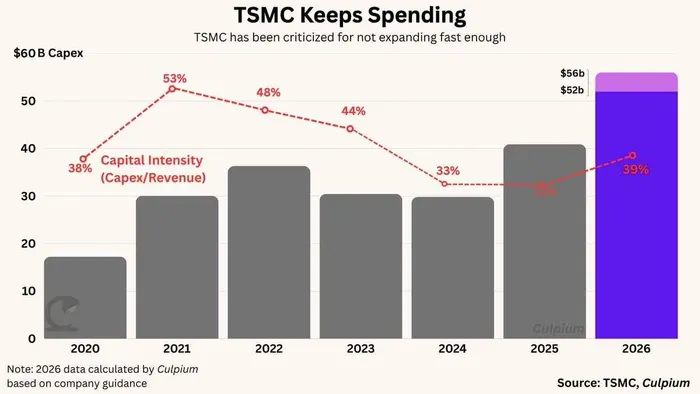
According to the latest WSJ AI & Business Newsletter, TSMC has officially raised its 2026 capital expenditure (Capex) guidance to a staggering $52 billion – $56 billion. This means TSMC is spending an average of $150 million every single day on equipment and fabrication plants.
This figure represents a 60% surge over its five-year average, far exceeding the $44 billion that Wall Street had initially anticipated. This extreme capital density is a direct reaction to the massive AI infrastructure build-outs by downstream giants like Meta, Google, and Microsoft, who are scrambling to secure the availability of computing capacity for a growing user base.
Despite the optimism, TSMC CEO C.C. Wei expressed a "sober anxiety" during the company's recent earnings call. He noted that because fabrication plants have exceptionally high fixed costs, even a slight dip in capacity utilization can severely bruise the bottom line. "If we didn't do it carefully, that would be a big disaster for TSMC for sure," Wei warned.
While the 66.25% gross margin of a 20-year high is currently buoyed by robust AI server demand, it masks a mediocre smartphone market. Financial data indicates that TSMC's stock has risen 25% year-to-date, reflecting a belief that TSMC's pricing power can offset these risks. However, as the Wall Street Journal notes, if companies like Amazon or Google overshoot their data-center build-outs, they can eventually find a use for that capacity; TSMC, however, faces a catastrophe of massive asset depreciation if its tools sit idle.
"Bug Armageddon" and the Meta Surge
A critical driver behind this insatiable demand is a phenomenon technologists are calling "Bug Armageddon." Anthropic's Mythos model recently detected a system vulnerability that had remained hidden for over 27 years. This milestone reveals a deeper cause of the compute shortage: AI is shifting from "content generation" to "foundational code reconstruction." As AI begins to rewrite decades of legacy software, the demand for high-end chips will shift from linear growth to exponential explosion.This structural shift means the industry is no longer just building chat-bots, but re-auditing the digital world's aging infrastructure.
Meanwhile, software giants are proving the value of this hardware. Emarketer expects Meta Platforms to generate $243.5 billion in net advertising revenue this year, exceeding even Google. This financial muscle, bolstered by the release of their Muse Spark AI model, allows these companies to keep footing the bill for TSMC's expensive AI makeover. TSMC's massive investment is, in effect, a physical hedge against the risk of total compute exhaustion as the industry attempts to fix and upgrade the world's aging software infrastructure.
The Physical Anchor of a Digital Revolution
TSMC's $56 billion gamble marks a shift where the constraints of innovation are no longer algorithmic, but physical. It has become the ultimate "truth serum" for the AI cycle. If this momentum holds, TSMC will be the cornerstone of a total digital reconstruction; if not, it will be the industry's most expensive cautionary tale.