SOX +40% Surge, Goldman Flags Bubble Risk
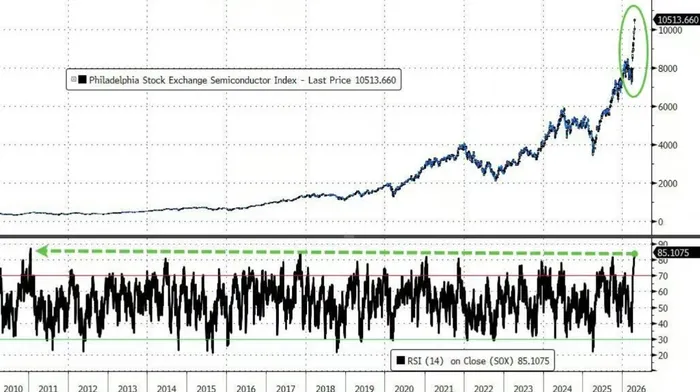
The Philadelphia Semiconductor Index (SOX) has surged nearly 40% in just one month—raising a critical question for investors: is it time to take profits?
Goldman Sachs’ head of hedge fund coverage, Tony Pasquariello, has issued a cautious warning. While geopolitical tensions in the Middle East remain unresolved, equity markets are surging aggressively.
The SOX index has delivered a 39% monthly gain, while its Relative Strength Index (RSI) has climbed to 85, signaling extremely overbought conditions.
📉 Valuation Stretch: Echoes of the Dot-Com Peak
More concerning is how far valuations have stretched.
SOX is currently trading nearly 50% above its 200-day moving average—a level last seen during the peak of the 2000 dot-com bubble.
From a historical perspective, this month’s return ranks among the strongest in the current cycle. The closest comparable period is February 2000, just weeks before the bubble burst.
Pasquariello emphasized that given the “temperature” of the rally, investors must seriously consider sector-specific peak risks, identifying this as one of the two most critical risks in today’s market.
🌍 Geopolitics: The Second Major Risk
The second key risk stems from geopolitical developments.
Pasquariello highlighted that oil prices continue to rise, with Goldman Sachs raising its Brent crude Q4 target from $80 to $90 per barrel.
Under Goldman’s updated assumptions:
Persian Gulf export normalization is now delayed from mid-May to end-June
Supply recovery will be slower than previously expected
The probability of a prolonged supply shock and higher oil prices has increased
Higher oil prices could trigger inflationary pressures, potentially forcing the Federal Reserve to pause rate cuts.
📊 Sentiment Overheating: A Warning for Returns
U.S. equity sentiment is also flashing warning signs.
Goldman’s sentiment indicator currently stands at +1.5 standard deviations, the highest level since December 2024.
Historical data shows that when the indicator falls within the 1.5 to 2 range:
S&P 500 returns over the next 2 weeks: -0.2%
Over the next 1 month: -0.4%
Goldman strategist Ben Snider notes that while low sentiment readings are more reliable buy signals, elevated readings typically signal below-average returns in the near term.
Over the past five years, this indicator exceeded 1.5 only three times:
Late 2024 → market pressure in early 2025 (DeepSeek, tariffs)
March 2024 → mild pullback in April
July 2023 → ~10% decline in subsequent months
Each correction had fundamental catalysts, but elevated speculative positioning amplified the downside impact.
🎯 Strategy: Don’t Chase, Don’t Short
Based on this framework, Pasquariello offers a clear tactical stance:
👉 Do not chase the rally 👉 Do not short the market
Instead, he recommends maintaining a “long delta / long volatility” positioning structure.
Specifically, he suggests focusing on:
S&P 500 3-month, 25-delta call options
Current implied volatility: ~13%
The rationale:
As markets rise, dealer gamma exposure tends to shorten, making this strategy an efficient way to retain upside participation while reducing overall risk exposure.
🧭 Conclusion: Bull Market, but Not a Free Ride
Pasquariello’s core view remains unchanged:
👉 This is still a bull market, with an upward primary trend.
However, he is equally clear:
“I would neither chase this market nor short it.”
In the current environment—where extreme momentum meets rising macro risk— the optimal approach is not directional aggression, but structured participation through long delta and long volatility exposure.
📌 The message is precise: This rally may continue—but the risk of sharp reversals is no longer negligible.