AI Boom Opens Opportunities in Power, Small Caps and Global Markets
Ross Mayfield warns that AI-driven market gains mask macro risks from energy prices and Fed policy, creating opportunities in power and small caps.
The U.S. stock market’s surge, powered by artificial intelligence and megacap technology firms, is obscuring mounting macroeconomic risks tied to energy prices and monetary policy, according to Ross Mayfield, Investment Strategist at Baird. “I don't think it's outweighed in terms of these companies' influence,” Mayfield said, emphasizing that the largest technology firms “touch that ecosystem at basically every level.”
In an interview with AInvest’s Capital & Power, Mayfield pointed to the dominant role of companies such as Alphabet, Amazon, Meta Platforms and Microsoft in driving index performance. Their leadership reflects both their position at the center of the AI build-out and the durability of their legacy businesses.
Coverage by Bloomberg News, Reuters and several other outlets has similarly highlighted how investment in AI infrastructure, from cloud computing to semiconductor capacity, has fueled earnings expectations and concentrated gains in a narrow group of firms. That concentration, however, raises structural concerns for investors.
Mayfield cautioned that many holders of broad index funds may underestimate their exposure. Investors who believe they own a diversified basket of companies “might think you own 500 equal weighted companies…that I don't think is offered…at this moment,” he said.
AI Momentum Underpins Valuations
The durability of current valuations depends heavily on continued confidence in AI. Mayfield argued that recent technological progress supports that optimism.
“To be a believer in these companies…you have to be a believer that AI is real,” he said, pointing to rapid advancements in model capabilities and enterprise adoption.
Reuters has reported that corporate spending on AI and data-center infrastructure continues to accelerate, with major technology firms committing billions to expand computing capacity. Despite the surge, Mayfield noted that valuations remain within historical norms. “They're 20s, 30s…It's fairly reasonable,” he said, referring to forward price-to-earnings multiples.
Energy Prices and Geopolitics Pose Risks
Beneath the surface, Mayfield sees significant macro risks, particularly tied to oil markets and the Iran war. “The market has just decided they're tired of the policy by tweet,” he said, warning that investors may be ignoring “the tail risk that we could still devolve into kind of a hot war in Iran.”
Tensions in the Middle East have disrupted the flow of oil through the Strait of Hormuz pushing crude prices above $100 a barrel. While the U.S. economy is less energy-intensive than in past decades, Mayfield said sustained high oil prices would still weigh on growth.
Sector-level performance already reflects some of that strain. Consumer discretionary stocks, he noted, have lagged as higher fuel costs erode household spending power, even as AI-related sectors continue to rally.
Federal Reserve Policy in Focus
Another key risk is the potential response from the Federal Reserve. Mayfield warned that policymakers could overreact to inflation driven by energy costs. “Hiking into an oil shock is by my lights a policy mistake,” he said, adding that tighter monetary policy could amplify economic slowdown risks.
The concern echoes commentary in The Wall Street Journal and Bloomberg News, where economists have cautioned that central banks face a difficult balancing act between controlling inflation and sustaining growth amid supply-driven price pressures.
Mayfield also identified the labor market as a critical vulnerability. While layoffs remain limited and unemployment claims low, hiring has been concentrated in a narrow set of sectors.
“Outside of that area, it is a very tough labor market,” he said, noting that consumer spending depends heavily on continued employment stability. “This is a consumer economy…if anything happens to the labor market, the rest of the stuff kind of falls apart,” he added.
Opportunities Beyond Megacaps
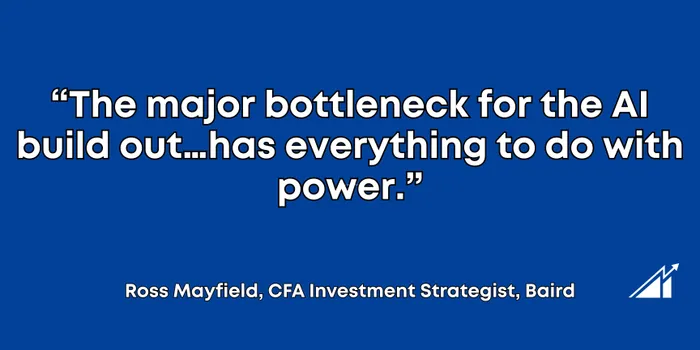
Despite the risks, Mayfield highlighted areas of opportunity tied to the AI expansion, particularly in infrastructure. “The major bottleneck for the AI build out…has everything to do with power,” he said, pointing to demand for electricity generation and grid capacity.
Bloomberg News has similarly reported that utilities and industrial firms are seeing increased demand tied to data-center construction and energy needs.
Mayfield also cited small-cap stocks and international markets as potential beneficiaries of a weaker dollar environment, as well as software companies that have lagged amid concerns about AI disruption.
“There are a lot of babies that have been thrown out with the bathwater,” he said, describing the sector as a rare value opportunity.