CurveBeam AI's China Deal: A $10M Catalyst to Scale Weight-Bearing CT Amid Execution Risk
The fundamental shift CurveBeam AI is enabling is a move from static, two-dimensional X-rays to dynamic, three-dimensional imaging under natural load. This isn't just a technical upgrade; it's a paradigm shift in how orthopedic conditions are diagnosed. The company pioneered weight-bearing CT (WBCT) systems, which capture sub-millimeter 3D images of joints while the patient stands. This functional perspective is critical for accurately diagnosing alignment issues like flat foot or hip dysplasia, where the joint's true state only appears under weight.
This technology has already demonstrated its clinical value. CurveBeam has installed more than 160 systems around the globe at leading orthopedic institutions. The feedback from physicians is telling: they report replacing the need for multiple separate scans, with one user noting the system provides "everything together in one minute." This early validation at top centers is the essential proof-of-concept needed to drive broader adoption.
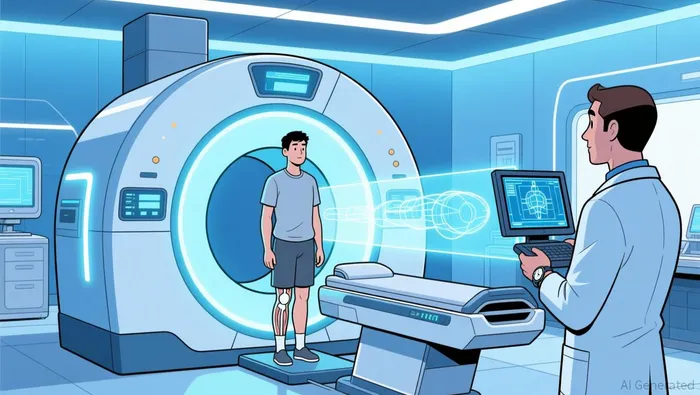
The recent ten-year exclusive deal with Shandong WeiYing is the strategic catalyst that could accelerate this adoption into an exponential curve. By securing exclusive access to the vast Chinese medical device market, including over 38,000 hospital sites, CurveBeam is positioning itself to scale rapidly. This partnership provides more than just distribution; it brings local manufacturing, regulatory support, and access to government procurement, removing key friction points for a new technology. For a company building the infrastructure of a new imaging paradigm, this is the kind of market access that can transform a niche product into a standard of care.
The China Catalyst: Exponential Growth on the S-Curve
The partnership with Shandong WeiYing is the engineered launchpad CurveBeam needs to propel its technology from a niche clinical tool to a mainstream standard. This is the classic infrastructure play: securing exclusive rights across a massive, high-barrier market to accelerate adoption along the S-curve. The deal's mechanics are designed to remove every friction point for a foreign innovator.
First, the exclusivity is comprehensive. CurveBeam gains exclusive rights for sales, distribution, manufacturing and regulatory approvals across China, Hong Kong, Macau, and Taiwan. This isn't a simple distribution agreement; it's a full-market entry permit. For a company building the rails for a new imaging paradigm, this control over the entire commercialization chain is essential for rapid scaling.
Second, the financial structure provides both immediate capital and a clear path to commercialization. The company will receive upfront payments, milestone-linked investments, and royalties on future sales. The initial 4 million dollar payment within 60 days offers near-term liquidity, while the remaining 6 million dollars tied to commercial and regulatory milestones creates a powerful incentive for both parties to execute. This staged investment de-risks the partnership and aligns long-term goals.
Most critically, local manufacturing and regulatory alignment are the keys to overcoming China's formidable entry barriers. By producing devices locally, CurveBeam gains eligibility for government-backed procurement schemes and mitigates tariff risks. The shared regulatory responsibility-CurveBeam handling US-manufactured units, the partner handling local ones-ensures compliance without sacrificing quality. This setup is the operational engine for exponential growth, transforming a complex, slow market into a scalable opportunity.
The bottom line is that this deal provides the capital, the market access, and the operational infrastructure needed to move from installing 160 systems to hundreds. It's the strategic catalyst that could turn CurveBeam's technological advantage into a dominant market position.
Integration with the Next Paradigm: Robotic Surgery
CurveBeam's regulatory expansion into Canada and Europe is more than a geographic win; it's a strategic positioning for the next major inflection point in orthopedics. The company's Enhanced HiRise system has received Health Canada approval and CE Marking, solidifying its presence in key markets and creating a foundation for deeper integration with emerging surgical technologies.
The most compelling synergy is with robotic-assisted joint replacement. This field demands extreme precision, and the gold standard for preoperative planning is a high-fidelity 3D model of the patient's anatomy. CurveBeam's weight-bearing CT provides exactly that. Studies confirm its imaging delivers equivalent 3D bone models to MDCT for joint replacement planning, but with the critical advantage of capturing the joint in its true, functional state under load. This is the kind of data that robotic systems need to execute complex cuts and implant placements with confidence.
This positions CurveBeam as a potential infrastructure layer for the next generation of AI-driven, robotic orthopedic procedures. As highlighted by surgeons like Dr. Chris O'Grady, the future involves using 3D images in proprietary software to virtually perform surgery before the patient arrives. For robotic systems, this pre-op planning phase is where CurveBeam's technology becomes essential input. The company is already building AI tools for bone separation and segmentation, which could further refine the models fed into robotic platforms.
The long-term strategic value is clear. By securing its place in the surgical workflow now, CurveBeam ensures its imaging data becomes a standard component of the robotic orthopedic pipeline. This isn't just about selling more scanners; it's about embedding the company's technology into the fundamental operating system of a high-growth surgical paradigm. The China deal accelerates market penetration, while this integration with robotic surgery secures a foothold in the next exponential phase of adoption.
Financial Reality and Key Risks
The financial picture for CurveBeam is that of a company in the high-investment phase of its growth S-curve. The stock trades at a market cap of ~$28.7 million with a trailing twelve-month earnings per share of -$0.04. This pre-profit status reflects the significant capital required to build the infrastructure for a new imaging paradigm. The recent China deal provides a crucial injection of capital, with an initial $4 million payment and a potential $10 million equity investment. Yet, the company must still navigate the path from these funds to sustained, scalable revenue.
The most critical risk is execution. The success of the ten-year exclusive China deal hinges entirely on the capabilities of the joint venture partner, Shandong WeiYing. While the partner is described as an established player in the Chinese orthopaedic device market, CurveBeam must now rely on them for local manufacturing, sales execution, and navigating complex regulatory pathways. Any shortfall in these areas could stall the entire growth engine, turning a strategic catalyst into a costly delay. The 24-month escrow on issued shares is a mechanism to align incentives, but it does not eliminate the operational risk.
Beyond execution, CurveBeam must prove its clinical ROI in a crowded field. The AI-driven medical imaging landscape is advancing rapidly, and competitors will seek to replicate or out-innovate. CurveBeam's value proposition-functional 3D imaging under load-must consistently demonstrate superior diagnostic accuracy and workflow efficiency to justify replacement of existing modalities. The early physician testimonials are promising, but widespread adoption depends on this clinical advantage translating into measurable cost savings and better patient outcomes that healthcare systems can quantify.
The bottom line is that CurveBeam is trading on future potential, not current financials. The China deal offers a clear path to exponential growth, but the company must execute flawlessly on manufacturing and sales while continuously validating its technology's unique value. Any stumble in this high-stakes execution phase could derail the entire S-curve.