Rio Tinto Delivers 8% Copper Output Gain as China's EV Surge Fuels Lithium Rally
The core pressure in Australia's mining sector is a stark divergence between commodity classes. Demand for energy transition metals is surging, while the fundamentals for traditional bulk commodities remain under strain. This split defines the current investment landscape.
The most dramatic move is in lithium. Prices have rallied 156.81% year-to-date, hitting a three-month high in late April. This isn't a fleeting spike; it's a sustained climb driven by concrete, long-term demand signals. The key catalyst is China's ambitious plan to double national EV charging capacity to 180 gigawatts by 2027. This infrastructure push, combined with soaring vehicle sales forecasts from companies like BYD, is creating a powerful, sustained demand tailwind for battery-grade lithium.
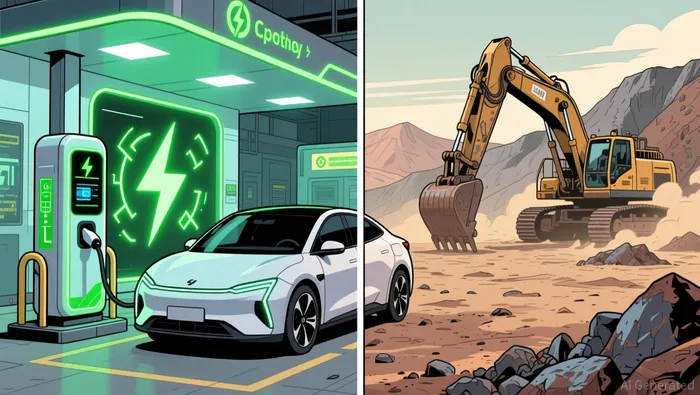
In contrast, the outlook for bulk commodities like iron ore and coal is more muted. The industry's response to this divergence is one of disciplined restraint. This isn't about abandoning growth, but about executing it with precision. As the sector enters 2026, projects that execute well will likely find support, while those that do not tend to fall away quickly. There is little tolerance for delay or cost overruns.
Evidence of this steady, reliable production is clear. Rio Tinto's 2025 results show a company focused on its core strengths. The miner achieved 8% growth in copper equivalent output for the year, driven by strong performance at Oyu Tolgoi and record bauxite production. This kind of disciplined execution-delivering on planned ramp-ups and maintaining operational excellence-is exactly what the current market rewards. It builds a resilient supply base for critical metals without overextending.
The bottom line is a sector in two parts. On one side, lithium and other transition metals face a supply-demand imbalance that is being met with cautious, incremental expansion. On the other, the broader bulk market operates under a new rulebook of restraint, where the ability to deliver predictable, cost-controlled output is the primary competitive advantage.
Financial and Operational Pressures
The sector's growth ambitions are being tested by a dual squeeze of rising costs and volatile markets. For Australia's ASX-listed miners, the primary financial risk has shifted to the top of the agenda. According to the latest risk forecast, financial risk has surged to the top, driven by a confluence of rising capital costs, inflationary pressures, and a tighter capital environment. This is particularly acute for early-stage and critical minerals projects, where financing constraints are now a direct brake on exploration and development. The result is a sector where simply having a good project is no longer enough; the ability to fund it efficiently is the first hurdle.
Commodity price risk remains a close second, highlighting the industry's vulnerability to swings in the global market. The PwC Global Mine report notes that higher costs and rising investment requirements are eating into profits for the world's top mining companies. This creates a precarious margin environment where revenue gains from strong prices can be quickly eroded by input cost inflation, leaving companies exposed to any downturn in commodity values.
The most critical bottleneck, however, is a gap between reserves and production. Australia holds a commanding lead in key transition metals, with 23% of global lithium reserves and significant shares in cobalt, manganese, and nickel. Yet, the sector's production rates are failing to keep pace with this resource wealth. This creates a structural bottleneck, where the physical capacity to deliver the metals needed for the energy transition lags behind both demand forecasts and the sector's own reserve base. The consequence is a market where supply is constrained, but the expansion of that supply is itself hampered by the very financial and operational pressures now top of mind for executives.
The bottom line is a sector navigating a complex trade-off. It must secure the capital to develop its vast resource base while managing the volatility of the markets it serves. The failure to align public and private stakeholders to attract investment, as noted in the PwC report, risks turning Australia's reserve leadership into a long-term liability rather than an immediate competitive advantage.
The Diversifying Economic Counterbalance
While the mining sector faces its own pressures, a broader economic shift is providing a crucial buffer. Non-mining business investment is set to reach record levels by the 2026/27 fiscal year, driven by a wave of spending on technology, data centers, and renewable energy. This diversification is actively reducing Australia's economic reliance on its resource sectors, adding a layer of resilience that can help smooth out sector-specific downturns.
The drivers behind this investment surge are multifaceted. Monetary policy easing, with the Reserve Bank of Australia cutting rates starting in early 2026, has lowered borrowing costs and lifted business confidence. This is coupled with a tight labor market and real wage growth, which together support firm stability and expansion plans. The focus is particularly strong in digital infrastructure and clean energy, where analysts estimate a pipeline of projects worth around $170 billion needs to be developed annually to meet climate commitments.
This strategic pivot is already reshaping the economy's capital expenditure profile. Investment in technology and energy is expanding beyond the traditional mining-led growth model, making non-mining sectors a key engine for economic activity. In practice, this means the Australian economy is building a more balanced foundation, where growth is supported by a wider range of industries.
Yet, this diversification exists alongside a stark market reality. The Australian Securities Exchange remains one of the world's most commodity-sensitive equity markets, with mining companies holding a dominant position. This concentration is evident in the recent performance of the S&P/ASX 200 Index, which advanced to record highs last week. The gain was primarily driven by a 0.6% rise in the mining sector, which amplified the broader market's 0.3% move. This dynamic highlights the ongoing dependence of the equity market on mining fortunes, even as the underlying economy diversifies.
The bottom line is a dual narrative. On one hand, the economy is building a more resilient, diversified base through record non-mining investment. On the other, the financial markets remain tightly tethered to the mining cycle, where the performance of a few giants can dictate the path of the entire index. This creates a buffer for the real economy but does not yet translate into a fully decoupled market.
Catalysts and Risks to Watch
The sector's current balance hinges on a few forward-looking events. The sustainability of lithium's rally is the most immediate test. Prices have climbed 156.81% year-to-date, but this momentum faces headwinds. On the supply side, the long-awaited first shipment from the Simandou iron ore project in Guinea signals a potential new source of bulk material that could ease pressure on related markets. More critically, policy shifts pose a direct threat to lithium flows. Zimbabwe's recent suspension of lithium exports, a key African producer, introduces a new layer of supply uncertainty that could disrupt the market if not quickly resolved. For now, the demand tailwind from China's EV charging build-out remains powerful, but any policy reversal or unexpected supply surge could quickly deflate the current price premium.
The broader mining cycle, however, is governed by a stricter discipline. The industry's "restraint" environment means project execution is now the sole path to support. As noted, projects that execute well will likely find support, while those that do not tend to fall away quickly. This is a zero-tolerance zone for delays or cost overruns. Rio Tinto's recent results, which highlighted record quarterly iron ore production and the successful Simandou milestone, exemplify the kind of disciplined delivery that will be rewarded. Any stumble from major players on timelines or budgets will be heavily penalized in the market, making operational excellence the non-negotiable currency of 2026.
Finally, the sector's resilience is contingent on the broader economy. Record non-mining investment is providing a crucial counterbalance, with spending on tech and renewables set to hit record levels by 2026/27. This diversification buffers the economy against a mining downturn. Yet, a broader economic slowdown remains a material risk. It could pressure commodity prices across the board and test whether this new investment wave is robust enough to fully offset a drop in mining revenue. The financial system's top risk, financial risk, underscores this vulnerability-tighter capital conditions could squeeze all sectors. The bottom line is that the sector's commodity balance is not static. It will be determined by whether lithium demand holds, whether projects deliver on time, and whether the economy's new growth engines are strong enough to carry the load if the mining cycle falters.