Baxter Tops Turnover Rankings as Stock Plunges 5.8% Ahead of Grim Earnings
Market Snapshot
Shares of Baxter International Inc. (BAX) experienced a sharp decline on April 29, 2026, closing down 5.80% as investors digested the company’s recent operational challenges ahead of critical financial disclosures. The sell-off was accompanied by a significant surge in trading activity, with the stock recording a turnover of $0.26 billion, marking a 49.67% increase from the previous session. This elevated volume placed Baxter at the top of the daily market rankings by turnover, indicating heightened institutional and retail interest as the market positioned itself for the upcoming earnings report. The substantial drop in share price, coupled with the record trading volume, reflects a clear shift in sentiment, with market participants reacting to the looming release of first-quarter 2026 results and the broader macroeconomic pressures affecting the medical devices and supplies sector.
Key Drivers
Baxter International is preparing to release its first-quarter 2026 earnings on April 30, after market close, a catalyst that has significantly influenced today’s trading dynamics. Analysts have set conservative expectations for the quarter, forecasting revenue of $2.62 billion and earnings per share (EPS) of $0.31. These figures represent a notable contraction compared to prior periods, with EPS estimates implying a year-over-year decline of approximately 43.6%. The market’s negative reaction today suggests that investors are pricing in the likelihood of a difficult quarter, consistent with management’s own warnings that Q1 2026 will likely be the most challenging of the year. The anticipation of weak financials has overshadowed any potential positive sentiment from the broader healthcare sector, where peers have shown mixed results.
A primary headwind weighing on Baxter’s performance is the continued operational pressure within its Infusion Therapies & Technologies (ITT) segment, part of the Medical Products & Therapies division. The company faces unfavorable comparisons due to a one-time distributor build in the prior year, which artificially inflated previous quarters. Furthermore, Baxter is grappling with near-term margin pressure stemming from higher-cost inventory. The ongoing shipment and installation hold on the Novum IQ large-volume pump has further disrupted sales channels, leading customers to adopt a cautious, wait-and-see approach amid uncertainty regarding the resolution timeline. These structural issues are expected to constrain top-line performance and limit operating leverage in the near term.
Profitability metrics have also deteriorated significantly, adding to investor concerns. In the fourth quarter of 2025, Baxter’s adjusted gross margin declined by 900 basis points to 35.5%, while the operating margin fell 340 basis points to 11.8% year-over-year. The company reported a diluted EPS of -$0.67 over the trailing twelve months, highlighting current unprofitability. Although analysts predict a return to profitability in fiscal 2025 with a forecasted EPS of $2.35, the immediate data points to substantial margin compression. This erosion of margins reflects the cost pressures and inefficiencies associated with the ongoing turnaround efforts, raising questions about the speed and efficacy of management’s corrective actions.
Looking ahead, Baxter’s guidance for 2026 indicates flat to 1% total sales growth, with the company explicitly warning of a particularly challenging first quarter before anticipated improvements later in the year. CEO Andrew Hider has acknowledged these challenges but emphasized a strategic focus on innovation and operational improvements, citing several planned product launches. However, the market appears skeptical of these long-term promises in the face of immediate headwinds. The divergence between the company’s optimistic long-term narrative and the harsh reality of current operational disruptions has led to a repricing of the stock, with the average analyst price target of $22.12 standing in stark contrast to the current share price of $18.02.
The broader context of the medical devices and supplies sector adds another layer of complexity to Baxter’s performance. While the sector has seen an average share price increase of 10.8% over the last month, Baxter has risen 14% during the same period, suggesting a prior accumulation of gains that may now be being taken. Peer companies have reported mixed results; for instance, Abbott Laboratories saw revenues up 7.8% but traded down 4.7%, while Neogen’s revenues decreased 4.4% despite beating estimates, leading to an 8.9% drop in its stock. This sector-wide volatility indicates that investors are rigorously scrutinizing growth sustainability and margin integrity, factors that Baxter currently struggles to demonstrate convincingly.
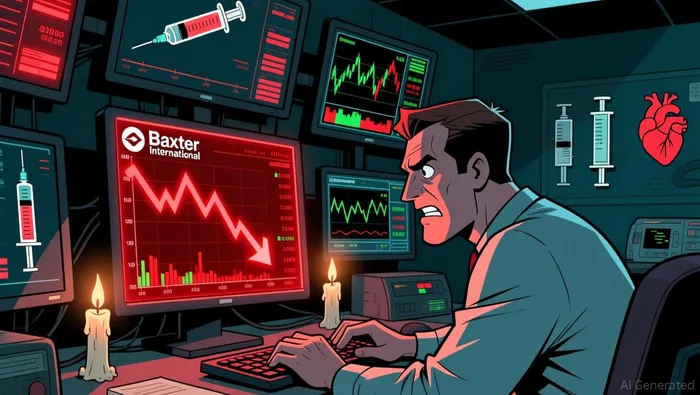
Ultimately, the combination of expected earnings misses, structural operational hurdles, and margin compression has driven the significant decline in Baxter’s stock today. The record turnover suggests that a large volume of shares changed hands as investors reassessed the company’s valuation in light of its near-term outlook. With the earnings report scheduled for tomorrow, the market is likely to remain highly sensitive to any details regarding the Novum IQ pump resolution, inventory management strategies, and specific guidance for the remainder of 2026. The stock’s performance today serves as a clear signal that investors demand tangible evidence of operational stabilization before committing to a recovery thesis.