The Past 160 Threshold in the Sand: Japan's Shrinking Intervention Toolkit Amid JPY/USD Volatility

The Japanese Yen has been the undisputed heavyweight champion of currency market drama this week.
After weeks of grinding higher and repeatedly testing the psychological—and now heavily defended—160.00 threshold, the USD/JPY pair experienced a violent pullback, currently hovering around the 156 mark.
While the initial drop bore the unmistakable fingerprints of the Ministry of Finance (MoF) stepping out of the shadows, the reality of managing this currency pair is becoming increasingly complex. Tokyo is fighting a multi-front war against structural interest rate differentials, geopolitical headwinds, and a very strict, fast-approaching regulatory ceiling.
Here is a breakdown of the forces currently whipping the Yen, and why the MoF's strategy is a high-stakes race against the clock.
The Fundamental Friction: Yields, Oil, and Geopolitics
At its core, the USD/JPY dynamic remains a classic rate-differential trade. As long as the Federal Reserve keeps US interest rates structurally higher than the Bank of Japan's (BoJ) ultra-accommodative stance, the carry trade dynamics fundamentally favor a stronger Dollar. Intervention can shock the system and alter the trajectory of the move, but it cannot dissolve the underlying math.
However, recent intraday volatility—which saw the pair test lows near 155.00—wasn't entirely engineered in Tokyo. The Greenback softened broadly across the board following recent Axios reports indicating that Washington and Tehran are inching closer to a preliminary agreement.
The Iran Factor: A proposed 30-day negotiation framework aimed at ending hostilities and potentially reopening transit through the Strait of Hormuz has injected a dose of risk-on sentiment, briefly cooling the Dollar.
The Energy Achilles Heel: Japan's heavy reliance on imported energy means ongoing Middle East disruptions are inherently bearish for the Yen. Any credible de-escalation in the Strait of Hormuz is a net positive for Japan's trade balance, but until oil shipments normalize, this remains a heavy anchor on the JPY.
The Regulatory Straightjacket: IMF WP/09/211
The most fascinating—and arguably most restrictive—element of the current USD/JPY saga is the bureaucratic red tape binding the Ministry of Finance.
Japan relies on a "free floating" currency designation for its standing in international financial frameworks. However, maintaining this classification comes with strict operational limits defined under IMF Working Paper WP/09/211.
The rules of engagement are explicit:
- A "free floating" currency can sustain a maximum of three intervention instances within any rolling six-month period.
- Each "instance" can span a maximum of three consecutive business days.
Japan has a math problem. The MoF has already consumed two of its three permitted instances.
Instance One: A coordinated cluster of interventions executed across a Thursday, Friday, and Monday. Because they were consecutive business days, they counted as a single instance, delivering maximum shock-and-awe for the cost of one "strike."
Instance Two: The recent standalone round. By stepping in for a single day, the MoF burned a full instance for a fraction of the firepower.
If the MoF steps in again, they initiate their final instance before November. If they intervene for one day and stop, their budget is effectively blown for the year, risking their free-floating classification if they attempt further defenses. As markets recognize this predictability, the mechanical impact of each intervention diminishes; the element of surprise is largely spent.
Technical Outlook: A Bearish Cap with Structural Support
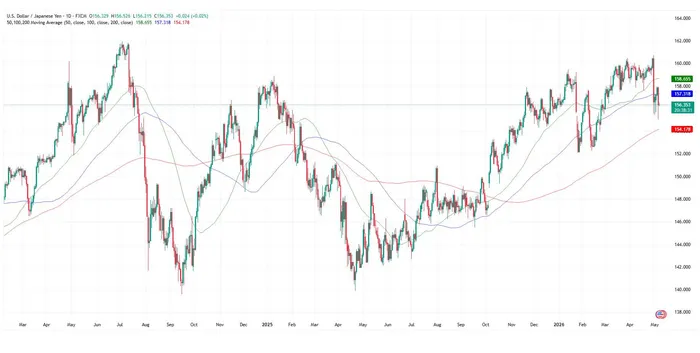
Looking at the daily chart, USD/JPY has developed a near-term bearish tone, though it remains within a broader bullish structure.
- Resistance: Upside momentum remains strictly capped by a formidable resistance confluence. The 100-day SMA (157.36) serves as the immediate tactical pivot, followed by the 50-day SMA (158.69). A sustained daily close above this zone is required to neutralize the prevailing bearish bias.
- Support: While the 155.50 horizontal level offers a temporary psychological cushion, the primary focus is shifting toward the 200-day SMA at 154.24. This remains the defining structural floor; a decisive breach here would likely trigger a broader capitulation toward the 152.00 handle.
- Momentum: The RSI (38) currently hovers in neutral-bearish territory, notably shy of oversold conditions, suggesting further runway for downside extension. This is reinforced by a negative MACD alignment, indicating that selling pressure is still being actively absorbed by the market.
- Trend Strength: With the ADX at 23, the current move is characterized by moderate trend strength. However, the alignment of major moving averages above the spot price suggests the path of least resistance remains lower.
- Analyst Rating: According to Goldman Sachs Analysts, Japan still has the firepower to intervene around 30 times in currency markets at last week(Apr 27-May 1)'s scale, though officials are expected to conserve its reserves and step in at more effective moments.
The Bottom Line: A Two-Way Risk Environment
The market is currently trapped between an immovable object and an unstoppable force. The fundamental drivers—persistent yield differentials and divergent central bank policy—continue to naturally buoy the USD/JPY. Conversely, the closer the pair drifts back toward that 160.00 "line in the sand," the higher the probability of official action, keeping speculative Yen-shorts on high alert.
Traders should keep a close eye on upcoming Japanese Labor Cash Earnings and US Initial Jobless Claims. But ultimately, the MoF is managing a descent, not reversing a trend. With only one intervention instance left in the chamber, Tokyo will have to make its next shot count.