The Correction May Be Near as the AI Fueled Rally Needs a Cooldown While Systemic Risks Build Around Hyperscalers
The stock market is entering an increasingly bullish phase as investors become more immune to the U.S.-Iran conflict and continue chasing the AI driven rally. Both the S&P 500 and Nasdaq 100 are on track for a sixth consecutive weekly gain. However, extremely stretched technical conditions and relentless spending from major technology companies may now be placing a cap on further upside. The current environment suggests momentum remains powerful, but speculative positioning could soon begin to unwind. Here is what investors should watch closely.
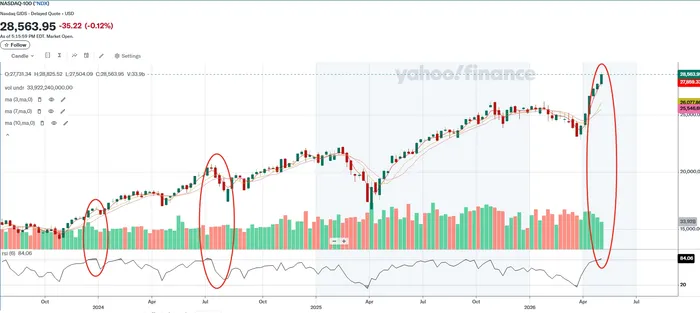
From a technical perspective, bullish momentum has pushed the market into a breakout phase with little sign of slowing. The Nasdaq 100 RSI is now around 86, while the S&P 500 stands near 76. These levels remain elevated, though not yet at the most extreme readings. Every pullback continues to attract dip buying, driving indices toward fresh highs and reflecting strong confidence in the current AI narrative.
However, a broader weekly view shows that sentiment is becoming increasingly overheated. The Nasdaq 100 weekly RSI has climbed to 84, the highest level since July 2024. At that time, the index reached a short term peak before falling roughly 15% over the following four weeks to establish a new base. A similar setup occurred in February 2024, when the index experienced a 1.5% pullback within a week before quickly stabilizing. These historical comparisons suggest that investors should not assume the rally can continue uninterrupted. No market rises indefinitely, and when price action becomes excessively one sided, it often signals that speculative behavior is building beneath the surface. This does not necessarily mean the bullish cycle is over, but it does suggest caution is warranted as consolidation has yet to fully develop following the recent surge.
Looking deeper, the rally has become increasingly concentrated within the semiconductor industry. Sandisk and Intel have surged more than 460% and 200% this year respectively, while Arm, AMD, and Marvell shares have nearly doubled as demand for memory chips, CPUs, ASICs, and AI infrastructure continues accelerating. Strong guidance and expanding margins have further fueled enthusiasm. Much of this momentum can be traced back to hyperscalers. Alphabet, Microsoft, Amazon, and Meta collectively announced plans to spend roughly 725 billion dollars this year following their latest earnings reports, representing a 68% year over year increase and more than 100 billion dollars above prior projections.
The growth cycle behind this trend is straightforward. Enterprises are rapidly adopting OpenAI and Claude based solutions, while AI startups continue racing to secure computing power. This has pushed companies toward cloud platforms such as Azure, Google Cloud, and AWS for deployment. Surging demand and capacity shortages have forced hyperscalers to accelerate purchases of chips and data center infrastructure. As AI adoption expands exponentially, cloud providers are committing to larger contracts with semiconductor firms, strengthening pricing power and boosting order visibility across the supply chain. Alphabet appears particularly well positioned, benefiting from both Gemini AI and its expanding cloud ecosystem, giving the company a unique strategic premium.
Still, the pace of spending is beginning to raise concerns. Hyperscalers are burning cash rapidly to build infrastructure, while cloud revenue growth is not accelerating at the same speed. Microsoft Azure reported roughly 40% growth against a 61% increase in capital expenditures. AWS grew 28% while capital spending jumped 51%, even resulting in negative free cash flow during the first quarter due to aggressive AI investments. Google Cloud remains more impressive, delivering 63% growth while doubling capex, but the broader trend remains clear. To sustain these massive investment cycles, major technology companies increasingly rely on debt issuance while delaying meaningful shareholder returns.
This creates a hidden vulnerability. Hyperscalers sit at the top of the AI ecosystem, and the broader rally depends heavily on their willingness to continue spending aggressively. As long as confidence remains intact, the cycle can sustain itself. But if macro conditions deteriorate, financing costs rise further, or investors begin questioning monetization timelines, sentiment could shift quickly. Semiconductor stocks may become especially vulnerable because many are already priced for near perfect outcomes. In many ways, hyperscalers now function as the financial engine supporting the entire AI supply chain. If cracks begin to emerge among these leaders, the broader technology complex could feel the impact rapidly.
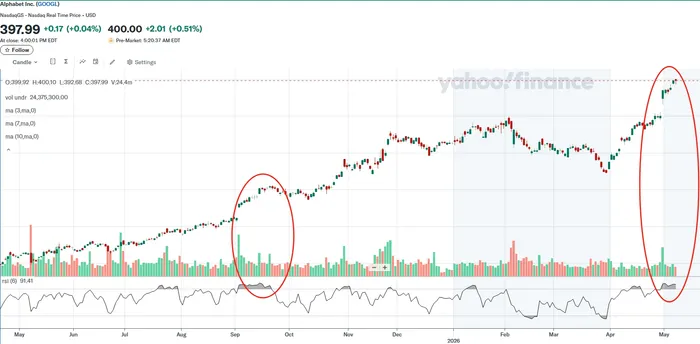
Technical conditions among major technology names are also becoming more concerning. Alphabet, which has benefited strongly from Gemini and cloud momentum, now carries an RSI of 91, the highest level since September 2025. Historically, such readings have often preceded periods of downward consolidation. Microsoft has already entered a consolidation phase while struggling near key resistance levels, and Amazon's short term momentum is beginning to slow as its faster moving averages flatten. If pressure builds across these leaders, broader market headwinds could intensify quickly.
In conclusion, the current rally remains fundamentally supported by AI demand and aggressive infrastructure expansion, but concentration risk is becoming increasingly difficult to ignore. Semiconductor companies and hyperscalers now account for much of the market's momentum, leaving the broader rally dependent on a narrow group of leaders. While the long term AI narrative remains powerful, technical conditions are stretched and spending commitments are accelerating faster than monetization. That imbalance increases the likelihood of a near term cooldown or consolidation phase. Investors should not confuse a potential correction with the end of the bullish cycle. Instead, it may represent a necessary reset that allows the market to stabilize before the next leg higher. Monitoring hyperscaler spending trends, cloud revenue growth, and technical momentum across major technology names will be critical in determining whether the current rally can sustain itself or whether speculative excess is finally beginning to unwind.