Abaxx's Regulatory Win Is Priced In-The Real Question Is Whether Q1 Earnings Can Justify the Valuation Gap
The CFTC registration is done. The Energy Risk award is in the rearview mirror. For Abaxx, these were binary events-either the regulatory gate opened or it didn't, either the industry recognized the play or it didn't. Both have now resolved in the company's favor, and the stock has already priced that in.
The market's expectation has shifted. Announcements that would have moved the needle months ago are now background noise. What matters now is whether Abaxx can convert growing trading activity into the revenue and profitability that the market is silently demanding.
Consider the metrics that define this transition. The CFTC Foreign Board of Trade registration opened Abaxx's markets to U.S.-based futures firms-a significant expansion, but one that is now in the past tense. The Energy Risk Newcomer award recognized Abaxx Exchange's role in developing new futures contracts, but this is a lagging indicator-it honors what the market has already begun to accept.
Then there's volume. The exchange hit a new weekly record of 54,740 contracts in mid-March, and April monthly volume exceeded total Q1 2026 volume by 8%. These are meaningful traction signals. But volume without corresponding revenue and profitability is just noise-exactly the kind of "growth without monetization" story that has punished similar names in the past.
This is the expectation arbitrage setup. The regulatory risk is cleared. The industry validation is secured. The volume is climbing. The market now expects execution-not more announcements, but the conversion of trading activity into financial performance. The question isn't whether Abaxx can announce milestones. It's whether Q1 earnings can justify the valuation gap between where the stock trades and where it would need to be if execution actually materialized.
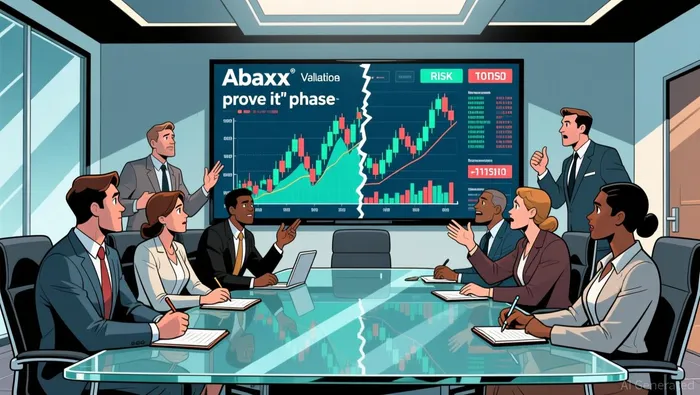
The Valuation Problem: Why Abaxx Still Looks Expensive
Abaxx trades at a striking discount to its intrinsic value-CA$58 versus a DCF fair value of CA$153.61, or roughly 62% below what the cash flow model suggests the company is worth CA$58 versus a DCF fair value of CA$153.61. Yet this discount masks a more fundamental problem: the valuation multiples are absurd relative to actual financial performance, creating an expectation gap that Q1 earnings must bridge.
The numbers tell a jarring story. Abaxx's price-to-book ratio sits at 24.79x, nearly seven times the peer average of 3.4x 24.79x versus peer average 3.4x. The price-to-sales ratio is even more extreme at 1,967.66x-meaning investors are paying roughly twenty times the company's entire annual revenue for each dollar of sales. These aren't modest premiums; they're valuations reserved for companies delivering exponential growth and expanding margins, not ones posting negative returns on equity of -73.49% and negative returns on invested capital of -48.40% ROE -73.49% and ROIC -48.40%.
The PE ratio is equally telling-at -16.83, it reflects a company that is fundamentally unprofitable PE Ratio of -16.83. This isn't a temporary setback; the negative earnings have been persistent, with the company posting negative PE ratios in every recent quarter. The market is pricing Abaxx as if future profitability is guaranteed and imminent, but the current financials show none of that materializing.
So what is the market actually pricing in? The gap between CA$58 and CA$153.61 represents a 95% upside that assumes execution on the volume growth story-converting trading activity into revenue and, critically, into profitability. The 54,740-contract weekly record and April's monthly volume exceeding total Q1 volume by 8% are meaningful, but they're still just volume 54,740 contracts. Without corresponding margin expansion and revenue conversion, these numbers don't translate into the cash flows that justify the DCF valuation.
This is the expectation arbitrage in its purest form. The regulatory and industry validation risks are cleared, but the financial performance hasn't caught up. Q1 earnings, due May 15, 2026, must now demonstrate that the volume traction is converting into something closer to the multiples the market is already assigning. If revenue growth is strong but margins remain negative or deteriorate, the valuation gap won't close-it will widen. The stock is priced for perfection, and anything less than a "beat and raise" scenario could trigger a sharp reversion.
Q1 2026 Earnings: The First Real Test
The May 15, 2026 earnings report is the first real check on whether Abaxx's growth story is translating to financial performance. This is the key inflection point; if Abaxx cannot show meaningful revenue growth and a credible path to profitability, the valuation gap will widen dramatically.
The timing matters. The webcast scheduled for May 19 will be the first financial check-in since CFTC registration-the first time management will walk through the numbers with investors after the regulatory gate opened. That makes this quarter uniquely important. It's the moment of truth between the promise of market access and the reality of financial execution.
Here's what to watch. Revenue trajectory is the obvious starting point-the market needs to see the volume traction converting to top-line growth. But the more critical metrics are customer acquisition costs and the path to positive operating margins. Abaxx has been building infrastructure and gaining regulatory clearance, but those are cost centers. The question is whether the company is moving toward a model where each new customer or contract contributes meaningfully to the bottom line.
The valuation problem from Section 2 hangs over this entire exercise. With a price-to-sales ratio of 1,967x and negative returns on equity and invested capital, the market has already priced in exponential future growth ROE -73.49% and ROIC -48.40%. If Q1 shows revenue growth but no margin improvement-or worse, widening losses-the gap between CA$58 and the DCF fair value of CA$153.61 won't close; it will become untenable CA$58 versus a DCF fair value of CA$153.61.
This is expectation arbitrage at its most binary. The regulatory and industry validation risks are cleared. The volume is climbing. Now the financials must catch up. A "beat and raise" scenario-strong revenue growth with clear margin trajectory-could start to bridge the gap. But anything less than execution on the conversion story risks a sharp reversion. The stock is priced for perfection, and Q1 is the first real test of whether that's justified.
Catalysts and Risks: What Moves the Stock Next
The binary regulatory risks are behind Abaxx. What remains is far less certain: execution. The stock has entered a 'prove it' phase where future catalysts depend entirely on the company's ability to convert trading activity into financial performance. The risk/reward profile has shifted from regulatory binary to execution uncertainty-and the May 15 earnings report is the first real test of that new reality.
Upside catalysts now cluster around three themes: product expansion, liquidity inflows, and financial conversion. The Enwex wind futures launched earlier this month extend Abaxx's weather suite across Europe's major renewable markets, and the company has been steadily adding contracts-16 commodity futures benchmarks now trade on the exchange 16 commodity futures benchmarks. New LNG curve products and the first OTC LNG cargo trade indexed to Abaxx prices first OTC LNG cargo trade signal product-market fit in complex underwriting areas. Meanwhile, CFTC registration opens Abaxx's markets to U.S.-based futures firms-a liquidity tailwind that could accelerate volume growth if American firms actually increase participation. If any of these catalysts translate into revenue-positive quarters, the valuation premium starts to look less like fantasy and more like forward pricing.
Downside risks are equally execution-dependent. The most immediate is the failure to convert volume into revenue-Abaxx has posted record weekly trading volumes 54,740 contracts, but volume without margin expansion is just noise. Continued negative margins and widening losses would validate the skeptics who see the current valuation as disconnected from financial reality. Commodity market weakness poses another threat: if energy and carbon prices stay range-bound or decline, hedging demand could soften, directly impacting exchange activity. The company's negative returns on equity and invested capital