TLT Holds Range as Market Prices In Higher-for-Longer Reality
The April inflation data delivered a clear message: the market's expectations were too low. The core event was a double miss on the whisper numbers, resetting the forward view for the Federal Reserve and financial markets.
Headline consumer prices rose at a 3.8% year-over-year pace, just 0.1 percentage points above the consensus forecast. On the surface, that seems like a minor beat. But the real story was in the details and the context. The report showed inflation pressures were broadening, with energy prices jumping 3.8% and shelter costs ticking up. This wasn't a one-off; the annual rate was the highest since May 2023 and up half a point from March. For the market, the expectation was for a slight slowdown, not a stabilization. The print confirmed that disinflation is still a work in progress.
The bigger surprise came from the producer side. The producer price index surged 1.4% in April, its largest monthly gain since early 2022. That was a massive miss against the 0.5% forecast. The core PPI also accelerated sharply, rising 1% versus a 0.4% estimate. This data pointed directly to a pipeline of future consumer inflation, as wholesale costs are a key input for businesses. The market had priced in a cooling in the supply chain, but the PPI showed the opposite.
This expectation gap had immediate consequences. The hotter-than-expected data pushed the probability of a Fed rate hike by December to 36%, up from about 16% a week prior. The market is now pricing in a more hawkish stance, as the data suggests the Fed may need to hold rates higher for longer or even consider a hike to combat persistent inflation. The reaction in bond markets-yields rising to multi-month highs-was the direct translation of this reset. In reality, the market had hoped for a clearer path to cuts; the print showed that path is now much more uncertain.
The Market's Expectation Gap: Yields Spike, Then Stocks Dip
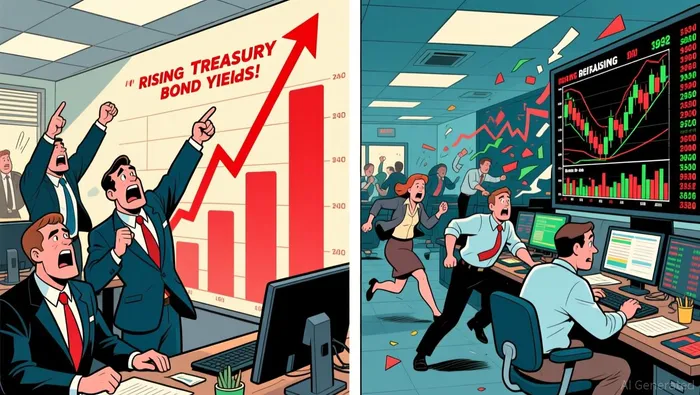
The market's initial reaction to the inflation data was a classic expectation gap play. Treasury yields jumped to 10-month highs, with the 10-year yield edging up toward the key 4.5% level and the 30-year yield rising back above the key psychological level of 5%. This spike was the direct translation of the reset in Fed policy expectations, as the hotter-than-forecast Producer Price Index pushed the probability of a rate hike by December to 36%. In theory, this should have been a bearish signal for stocks, and it was.
Yet the market's behavior was nuanced. While the longer-dated yields surged on the inflation shock, the 2-year Treasury yield fell slightly, down a basis point to 3.98%. That move is critical. It signals that the dominant priced-in narrative remains a Fed hold, not a hike. The market is absorbing the inflationary pressure but still sees the central bank as constrained from raising rates immediately. The expectation gap here is between the hotter data and the still-anchored near-term policy view.
This dynamic played out clearly in the equity markets. Despite the spike in long-term yields, U.S. stock indexes slipped following the PPI report, with the Dow Jones Industrial Average down 0.5%. The move shows the equity market's sensitivity to the inflationary pressure, particularly the risk of margin compression if businesses cannot pass on higher wholesale costs. As one strategist noted, "If PPI continues to run hotter than CPI data, you could see some margin compression in companies that are not able to pass those costs along."
The bottom line is a market caught between two realities. The data reset expectations for a future hike, spiking long-term yields. But the 2-year yield's behavior confirms the Fed hold is still the priced-in baseline. For now, that creates a volatile setup where stocks are pressured by inflation fears, but not yet by the prospect of an imminent rate increase. The expectation gap is wide, and the market is trying to price in a more hawkish future while holding onto the present policy status quo.
The Bond Market's Forward Look: What's Priced In?
The recent spike in yields is a clear repricing event, but the bond market's positioning suggests it's not the start of a new, sustained trend. The evidence points to a volatile but contained move within a defined range.
The iShares 20+ Year Treasury Bond ETF (TLT) shows this dynamic. Over the past 20 days, the fund is down 1.58%. More importantly, it has fallen 4.46% over the past 120 days. That longer-term downtrend is the real story. The recent yield spike is a sharp acceleration within an existing bearish momentum, not a clean break from a prior trend.
This is the market's current "priced-in" reality. The spike to 10-month highs for the 10-year and 30-year yields is a test of key psychological levels. As one strategist noted, yields around 4.25% to 4.75% are viewed as "normal" in this new environment. The market is not pricing in a collapse; it's pricing in a higher, more volatile baseline. The expectation gap has shifted from "disinflation is coming" to "higher-for-longer is the new normal."
The positioning data supports this range-bound view. TLT's turnover rate is moderate at 5%, and its intraday volatility is contained. The market is digesting the inflation shock, but not panicking. The recent price action is a repricing of risk, not a wholesale reassessment of the long-term trajectory. For now, the market has reset its expectations for Fed policy and inflation, but it has not yet priced in a break from the current range.
The Expectation Arbitrage Play: Catalysts and Risks
The market has reset its expectations for inflation and Fed policy, but the current range-bound view is fragile. The next moves will hinge on a few key catalysts that could either confirm the new "higher-for-longer" reality or force another expectation gap.
The immediate test is the May consumer price index report, which will be the first to include the full impact of the Iran war on energy prices. The April data showed energy costs jumping 3.8% and the 12-month gain for gasoline at 28.4%. If the May CPI shows these pressures persisting or accelerating, it will validate the market's new baseline and likely keep yields elevated. A surprise slowdown, however, could signal that the recent spike was an overreaction, potentially triggering a pullback in long-term yields.
Beyond data, the Fed's communication is the ultimate driver. The central bank's stance is the priced-in baseline, but its messaging can reset expectations. The recent data has already increased the probability of a rate hike by December to 36%. Any shift in the Fed's tone-toward more hawkish language or a clearer signal that it is not yet ready to cut-would reinforce the higher-for-longer view. Conversely, dovish comments could challenge the market's new reality, creating a volatile arbitrage opportunity.
A critical metric to watch is the market's long-term inflation expectations, derived from Treasury Inflation-Protected Securities (TIPS). The breakeven rate of inflation, calculated as the difference between nominal Treasury yields and TIPS yields, is a direct gauge of what investors are pricing in for the future. If this rate holds steady or rises, it confirms that the market believes persistent inflation is baked in. A decline would signal a loss of confidence in the new baseline, potentially leading to a sustained rally in bonds.
The bottom line is that the market is poised for the next catalyst. The recent repricing has established a new range, but it is not a permanent equilibrium. The May CPI, Fed commentary, and the TIPS breakeven rate will determine whether this range is sustained or broken. For the expectation arbitrageur, the setup is clear: watch these three levers, as the next gap between priced-in reality and incoming data will dictate the next major move.