Tennessee's Prediction Market Felony Hits a Federal Fault Line
Tennessee's governor Bill Lee signed two bills in the same legislative session: SB 2136, which bans sweepstakes casinos (the "dual-currency" platforms that let users play casino-style games by purchasing virtual currency, using a legal loophole to sidestep gambling law), and SB 1992, which creates a new Class E felony for prediction market manipulation.
That pairing makes for a neat headline. The structural reality underneath is more interesting.
What actually changed
SB 1992 makes it a felony for anyone who "engages in conduct intended to influence the outcome of an event" while they or someone else holds a position on a prediction-market contract tied to that event. The bill defines a "prediction-market" broadly: any platform where people trade contracts that pay out based on real-world outcomes.
That's deliberately wide. It could apply to Kalshi, the CFTC-regulated exchange where you trade contracts on inflation numbers and election results. It could apply to Polymarket, the offshore platform where people bet on everything from political outcomes to celebrity feuds. It could, in theory, apply to something narrower, like a local sports pool, though the language doesn't draw those lines.
The sweepstakes casino ban is a separate fight, part of a national trend. Six states outlawed sweepstakes casinos in 2025 alone. Tennessee joins them by classifying the dual-currency model as illegal gambling and imposing fines up to $15,000. Operators have already been pulling back. That story is well-worn, and I won't rehash it here.
The prediction market felony is the part that hasn't been tried before - and where the legal fault lines are already visible.
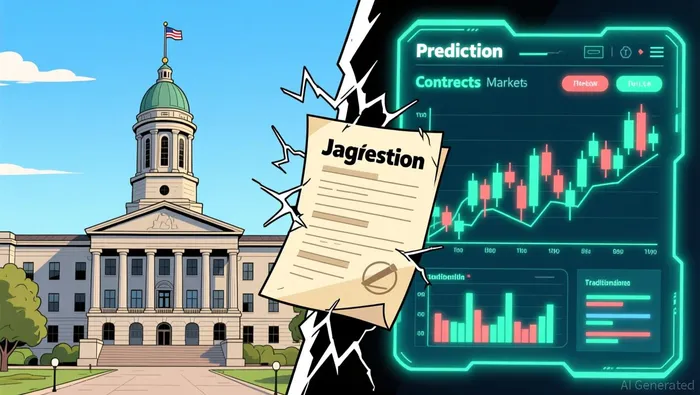
The jurisdictional collision
Here's what most coverage of the Tennessee bill misses: a federal appellate court ruled three months ago that the CFTC has exclusive jurisdiction over the kind of event contracts that prediction markets trade.
Kalshi, the regulated prediction-market operator, argued that its contracts qualify as "swaps" under the Commodity Exchange Act, the same law that gives the CFTC authority over interest-rate and weather derivatives. In February 2026, a federal district court in Tennessee granted Kalshi a preliminary injunction against state regulators. Then in April, the Third Circuit Court of Appeals affirmed that ruling. The CFTC itself filed a separate statement in February reaffirming its exclusive authority.
Tennessee's new felony law was signed in late May, after those rulings. So the question isn't just whether the state meant well. It's whether the law can survive a preemption challenge.
If event contracts are swaps - and a federal appellate court says they likely are - then states can't create parallel criminal regimes for manipulating those markets. That's the whole point of federal preemption: one regulator sets the rules, not fifty.
Why Tennessee did it anyway
The instinct behind the law is understandable. Prediction markets threaten to cannibalize revenue from state-legal sports betting. Eleven states introduced prediction-market legislation this cycle, and the industry has estimated roughly $600 million in lost sports-betting tax revenue tied to platforms like Kalshi and Polymarket. States that carved out regulated sports-betting markets are watching their tax base get competed around by products that, legally, might not be sports betting at all.
But Tennessee's approach is unusual. Most states have tried either outright bans - Minnesota, which enacted the first state-level prediction market ban in May 2026, immediately triggered CFTC legal action - or taxes, like a proposed 14.25% excise tax on prediction-market operators' fees. Tennessee chose criminalization. Making manipulation a felony sounds like enforcement. It actually reads like a warning shot fired into a space the CFTC says it owns.
That distinction matters. If Tennessee had taxed prediction-market operators, it would be a revenue grab competing with federal jurisdiction. By criminalizing manipulation, it's trying something different: defining the activity as inherently corrupt, not just untaxed. The legislative theory seems to be that even if the CFTC gets to regulate markets, the state gets to prosecute the people who rig them.
I'm not convinced that theory holds. Market manipulation on a swap platform is, in existing law, a CFTC enforcement matter. States don't get to run their own version of the CFTC's anti-fraud regime for products the federal government claims exclusively. Tennessee's felony might be an interesting political statement. Whether it's a functional law is another question entirely.
The Polymarket wildcard
There's a second layer that makes Tennessee's law even more awkward in practice.
Kalshi is the regulated operator. It sits inside the CFTC framework, argues its case in federal court, and has won preliminary victories. Polymarket, by contrast, operates offshore. The CFTC forced it to pay a civil penalty and wind down U.S. offerings back in 2022, but the platform has continued serving American users through various workarounds. Multiple states have sent cease-and-desist letters to Polymarket's U.S.-facing operations.
Tennessee's felony language doesn't distinguish between regulated and offshore platforms. It covers any "prediction-market." So in theory, the law could target a Polymarket user in Nashville who tries to influence an event outcome. In practice, prosecuting someone for a felony based on behavior connected to an offshore platform the CFTC hasn't fully shut down is a bridge the state probably doesn't want to walk.
What to watch
The Tennessee prediction-market felony is real law now. But it's real law sitting inside a federal preemption dispute that hasn't been tested with this specific statute. My read: if Kalshi or another operator challenges the law - and there's every reason they would - a court will have to decide whether Tennessee's criminal regime is preempted by the CEA's grant of exclusive CFTC authority.
The Third Circuit's language was broad enough that Tennessee's position looks vulnerable. But federal courts don't always read preemption as expansively as regulators hope. It's possible a court carves out room for state criminal law even when it blocks state regulatory schemes.
What would change my view? A Kalshi motion to enjoin enforcement of the Tennessee felony, followed by a ruling that squarely addresses preemption. Until then, the law sits as a signal: states are losing patience with the prediction-market category, and they're willing to test the boundary between state criminal law and federal financial regulation to prove it.
That boundary test is the story. The sweepstakes ban is just the headline they printed on the same page.