AllianceBernstein Global High Income: $0.18 NII Supports a 7.6% Yield, but Mark-to-Market Losses Still Threaten AWF's Risk-Adjusted Return
AWF's $0.18 NII helped income, but mark-to-market losses still weighed on total return
The latest report gives income-focused investors one clear positive: $0.18 per share of net investment income for the quarter ended March 31, 2026. But the same release also reported a $(0.28) per share realized and unrealized loss. In a closed-end fund, that split matters. Cash income can support distributions today, while mark-to-market losses reduce the asset base that supports future payouts.
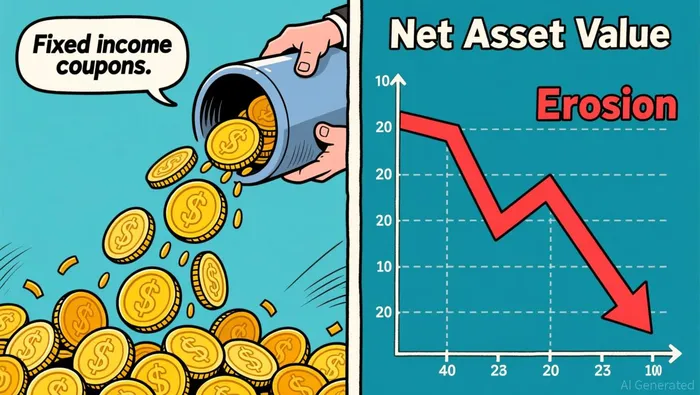
That tension is visible in the fund's balance-sheet numbers. Net assets fell to $963.4 million from $985.2 million at year-end, and NAV per share declined to $11.17 from $11.43. The income stream held up, but capital erosion remains the bigger concern because it can weaken future payout capacity and deepen discount pressure if sentiment softens.
The practical takeaway is straightforward: AWF still looks usable for investors seeking current cash flow and willing to tolerate NAV volatility. It looks less compelling for investors whose main goal is strong risk-adjusted return.
Portfolio construction explains why income held up even as the quarter turned negative
The income support is not hard to trace. AWF still holds 53.52% non-investment-grade corporates. That heavy lower-rated credit exposure helps explain why the fund can keep generating spread and coupon cash even when market repricing hurts the P&L. The April portfolio also included Treasury exposure and a broad mix of sectors, so the fund is not leaning into a single credit pocket.
Why cash income can stay firm while market value weakens
For investors, the key point is mechanical: distribution support comes from coupon income and other portfolio cash flow, not from realized gains. A bond can keep paying even as its fair value moves with rates, credit spreads, or sentiment. That is why AWF can still show a workable income profile in a quarter when realized and unrealized losses dragged on total return.
Bernstein describes the strategy as a global multi-sector approach across fixed income, using a process that combines quantitative and fundamental research. In practice, that means the fund can keep looking for pockets of attractive cash yield across sectors and geographies. Holdings such as DISH DBS Corp. 5.75%, 12/01/28; DaVita 4.625%, 06/01/30; and American Airlines 5.75%, 04/20/29 illustrate where some of that income exposure sits across media, healthcare, and transportation.
That is also the main risk. A high-coupon sleeve can support distributions for a while, but it does not prevent NAV from repricing if spreads widen or rates move against the book. The quarter is best read as a split outcome: the cash stream remained functional, while the market-value side still needed better spread and duration control.
For AWF, the discount matters more than the headline distribution rate
At $10.32 versus an $11.38 NAV, AWF trades at a 9.39% discount. That is wider than the 5.73% 52-week average discount, but still within the range the market has previously tolerated, with shares trading above the $9.85 52-week low. For a closed-end fund, the discount is often the real decision point: investors are not just buying a yield stream, they are buying NAV exposure at a price that can either converge toward or diverge further from net assets.
Why discount movement matters as much as the yield
A 7.60155000% distribution rate sounds attractive until you separate cash income from total return. AWF offers two potential sources of return:
- distribution yield based on the market price
- discount repair if sentiment improves
The second matters because it can add to income rather than replace it. If the discount narrows from -9.39% toward the -5.73% 52-week average, that would imply meaningful price appreciation even if NAV stayed flat. The risk is the reverse: if the discount stays depressed or widens further, the headline yield may not be enough to protect risk-adjusted return.
That is why AWF fits better as a satellite income position than a core holding. Investors can take advantage of the cash flow and possible discount repair without letting the position dominate the portfolio's overall volatility.
What would need to happen for AWF to work from here
From here, AWF works only if the market starts rewarding the current discount faster than it penalizes the fund's realized and unrealized loss.
Bulls can argue the setup is still alive because the cash stream has held up, with net investment income supporting the payout while the shares remain below NAV. Bears will counter that a high-yield book heavy in non-investment-grade corporates can keep producing income even as mark-to-market pressure reduces the asset base. That is the real fork in the road: discount repair improves the risk-adjusted return case, while persistent NAV drag turns the headline yield into compensation for holding a more volatile asset.