Galloper Gold Raised $2.2M-But the Real Signal Is There Was No Broker in the Deal
The raise solves the near-term cash question, but it does not settle demand
Galloper does not look financially strained. It closed its non-brokered private placement for $2,226,996 in gross proceeds, issuing 16,891,633 flow-through common shares at $0.12 and 2,000,000 common shares at $0.10. The proceeds should be enough to fund the 2026 exploration program at Glover Island and support working capital. That removes the most urgent financing risk, but it does not by itself signal strong market demand.
The finder's fee complicates a clean insider-led narrative
If this had been a quiet, purely insider-backed raise, the fee line might have been small or absent. Instead, Galloper paid $71,890 in finder's fees to BMO Nesbitt Burns Inc., Canaccord Genuity Corp., and Ventum Financial Corp. That suggests intermediaries helped bring the deal together. It does not, on its own, prove competitive bidding, institutional accumulation, or broad outside conviction.
"Strategic support" is still unproven without details
Management said the deal had the commitment and support of our strategic investor and other key investors. Investors can lean on that, but it is not proof of alignment by itself. Without named buyers, disclosed lock-up terms beyond standard statutory holds, or disclosed insider cash participation, the statement remains more promotional than evidentiary. Options may align upside, but they are not cash at risk.
So the core question is simple: who put money down at $0.10 to $0.12? Until Galloper answers that, the financing looks useful rather than definitive.
The real catalyst is what Galloper does with the proceeds
The funding window is open. What matters now is how Galloper uses it.
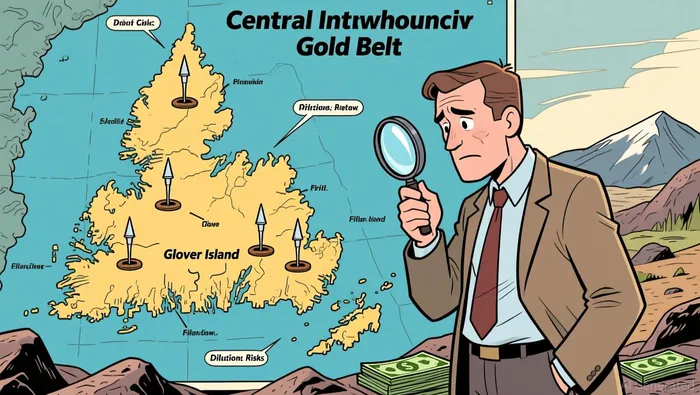
The cash gives the company room to move on its 2026 exploration program at Glover Island and for general working capital purposes. In practical terms, that means more drilling, geochemistry, geological interpretation, and potentially a stronger technical picture over time. Galloper's portfolio centers on Glover Island and Mint Pond projects in the Central Newfoundland Gold Belt, so the next release should show whether those prospects are being better defined or merely kept alive.
What the spending needs to prove
In junior exploration, a financing usually only rerates the stock if it leads to better geology. Bulls will argue that a funded program is the first real step toward de-risking. If Galloper can put boots on the ground at Glover Island and Mint Pond, the market can start underwriting a story instead of just debating one. Management also said it looks forward to communicating details and results in the near future, which makes the next technical disclosure the obvious near-term catalyst.
Bears have a fair counter. A drill program is not a resource, and it is not a mine. It is an expense engine that can dilute existing holders before it creates value. If the next update is mostly promotional, or it highlights intermittent high-grade intercepts without solid geological context, the market may view the raise as equity consumption rather than progress.
The timing window matters only if management uses it
The securities sold in the raise are subject to statutory hold periods and applicable CSE restrictions. That matters for two reasons.
First, it reduces the risk of immediate resale pressure from new placement buyers.
Second, it gives management a window to deliver something before the market focuses again on liquidity. That window is only valuable if the company uses it to put out a disclosure the market can trade on. If Galloper waits until the last possible moment, or issues something weak, the hold period will look less like a cushion and more like delayed selling risk.
For now, this is a financing to watch, not one to worship. The stock only works if the next disclosure shows the ground is worth the dilution.
What would actually strengthen the investment case
In a micro-cap like Galloper, lagged institutional-tracking metrics are of limited use. By the time those holdings show up, the move may already be priced. A more useful signal is simpler: named buyers, insider cash participation, and management putting its own money into the same story.
Signals that would improve confidence
- A named strategic investor. Management said the raise had the support of our strategic investor and other key investors. If the next disclosure names that investor, the story becomes more concrete.
- Insider cash commitment. The clean test is whether executives and directors are buying from their own pockets. So far, the only disclosed equity commitment tied to insiders is incentive stock options. Options can align upside, but they are not the same as cash at risk.
- A funded program that turns into geology. The cash is earmarked for the 2026 exploration program at Glover Island, and the company also has Mint Pond in its portfolio. That is the mechanism that could eventually justify the raise.
What still keeps the story opaque
- No buyers are identified.
- No lock-up terms beyond standard statutory holds are disclosed.
- The finder's fees suggest intermediaries were involved, but that is not the same as proving outside demand.
What would change the view over the next 1 to 3 months
- Management still cannot identify the strategic investor after the financing closes.
- The next technical update is weak, vague, or delayed.
- Drilling does not start, or the company cannot connect activity to Glover Island and Mint Pond.
- The only "alignment" remains incentive stock options rather than real cash commitment from insiders or strategic capital.
My stance remains neutral to cautious. This is a show-me setup. Until Galloper delivers a disclosure tied to Glover Island or Mint Pond that identifies the strategic backer and shows real skin in the game, the financing alone is not enough to buy.