Don't Worry About the AI Bubble, at Least for Now, and Get Ready to Buy the Dip Again as a Healthy Pullback Nears
With AI enthusiasm continuing to spread and pushing markets relentlessly higher, some investors have begun questioning whether the current environment resembles the Dot-com bubble, given the enormous capital commitments and still developing monetization path. Chip and AI infrastructure companies continue to deliver exceptional earnings growth and powerful share price appreciation. At the same time, AI startups such as OpenAI and Anthropic command rich valuations ahead of potential IPO, while big tech is spending hundreds of billions of dollars on data centers to stay competitive in the AI race. Despite those concerns, investors should remain constructive on the AI boom for now. Technical conditions suggest additional upside remains possible, even as a healthy pullback or consolidation phase approaches. More importantly, the conditions associated with a true bubble collapse have yet to emerge.
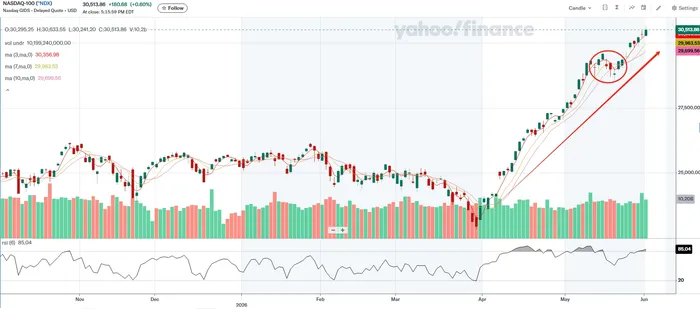
The Nasdaq 100 has surged roughly 33% since the end of March, reaching fresh highs almost daily as semiconductor stocks continue leading the advance. The technical structure remains strong, with MA3 above MA7 and MA10, while investors consistently step in to buy every dip. That behavior reflects strong confidence in the current AI narrative and suggests momentum remains firmly intact. However, the persistent buying pressure has also pushed RSI back toward 85, a level not seen since May 11. The last time momentum reached similar territory, the index experienced a nearly 3% correction within three trading sessions. That does not necessarily imply a major downturn is imminent, but it does suggest that a short term pause or consolidation could be approaching.
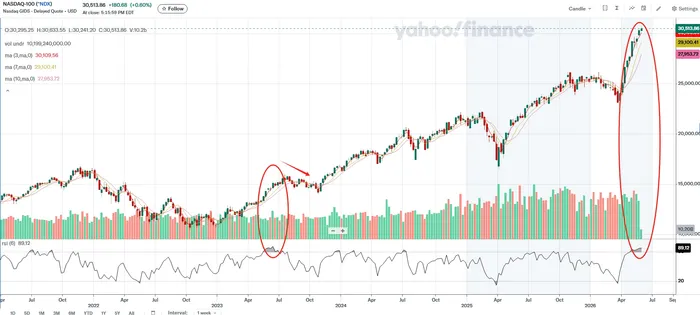
The weekly chart reinforces that view. Weekly RSI has climbed to 89, the highest reading since June 12, 2023. During that period, the Nasdaq 100 declined roughly 1.3% over the following week before entering a broader consolidation phase. More importantly, the current reading marks six consecutive weeks with RSI above 80, approaching the eight week stretch recorded between mid May and late June of 2023. Following that period, the index spent nearly three months consolidating before eventually breaking out to new highs. History does not always repeat precisely, but it often rhymes. Current conditions suggest the market may need time to digest gains before the next leg higher rather than signaling the end of the bullish cycle.
What makes the present environment different is the extraordinary concentration of enthusiasm surrounding AI related stocks. Investor optimism continues to build around chips, software, infrastructure providers, and cloud platforms. Yet many individual names are beginning to display signs of speculative excess. Arm recently reached record highs with RSI above 90 as investors embraced its partnership opportunities with Nvidia. IBM and Snowflake both traded with RSI readings above 95 amid excitement surrounding AI and quantum computing initiatives. Dell climbed to an RSI of 97 thanks to strong demand for AI servers tied to Nvidia deployments. Meanwhile, Micron and Sandisk maintain RSI levels above 80 after delivering triple digit returns this year.
These examples illustrate how aggressively capital has flowed into the AI ecosystem. The concentration of positioning increases the risk of short term volatility because crowded trades often become vulnerable to profit taking. If one highly valued segment begins correcting, it can create a chain reaction throughout the broader AI complex. That possibility should not be ignored. However, investors should distinguish between a speculative cooldown and a true bubble collapse.
A pullback appears increasingly likely, but that should be viewed as a healthy development rather than a warning that the AI story is ending. Extreme technical conditions often cause institutional investors to become more cautious, even when fundamentals remain solid. The issue becomes risk versus reward rather than business deterioration. Historically, major bear markets or corrections exceeding 20% are rarely caused by overbought indicators alone. Instead, they occur when confidence erodes over time and fundamentals begin deteriorating, eventually triggering widespread panic selling.
That is not what the market is facing today. The demand backdrop supporting AI remains exceptionally strong. Enterprises continue accelerating adoption of AI applications for both training and inference workloads. Those trends require massive computing resources, creating ongoing demand for advanced semiconductors, networking equipment, memory solutions, and data center capacity. Supply remains constrained across several key areas, which continues supporting pricing power and revenue growth throughout the value chain.
The bigger challenge may actually come from liquidity and valuation rather than demand itself. As share prices continue rising, expectations become increasingly difficult to satisfy. Elevated valuations can amplify market swings and make investors more sensitive to disappointments. The longer technical extremes persist, the greater the likelihood of a squeeze within the most crowded positions. That process can feel uncomfortable, but it is often necessary to create the conditions for the next sustainable advance.
Such a reset could occur over a matter of days, similar to the 3% decline experienced during the May 14 through May 19 period (depnd on MAs trend) , or it could unfold through a longer one to two month consolidation. Either scenario would be normal within a powerful bull market. Investors should avoid interpreting every pullback as evidence that the AI boom has failed. Markets frequently require periods of digestion before resuming higher.
In conclusion, the AI trade is becoming increasingly crowded, and technical conditions suggest a healthy correction may be approaching. However, the ingredients associated with a true bubble burst remain absent. Demand for AI infrastructure continues accelerating, corporate spending remains robust, and the long term investment case is still strengthening. Short term volatility should be expected, but it should not be confused with structural weakness. For now, any meaningful pullback is more likely to represent an opportunity to accumulate quality AI related assets rather than a signal that the broader cycle has come to an end. The AI story remains a long term investment theme, not merely a speculative trade.