The Tariff That Isn't, and the Political Weapon It Pretends to Be
Brazil's president woke up yesterday to news that the United States is proposing a 25% tariff on Brazilian imports. His response was to call his main election rival a traitor to the homeland.
The odd thing is not the drama. The odd thing is that the tariff doesn't actually do that much.
Here's what happened. The USTR - the United States Trade Representative, the agency that administers Trump's tariff playbook - published a Section 301 proposal on June 1. Section 301 is a trade law that lets the US impose tariffs on countries it decides are cheating. The proposal levies 25% on Brazilian goods, citing things like deforestation and digital trade practices. On paper, that sounds like an economic declaration of war.
In practice, the proposal contains more than 1,600 product-level exemptions. Beef is exempt. Coffee is exempt. Cacao is exempt. Aircraft and aircraft parts are exempt. These are Brazil's biggest export categories. The tariff looks like a 25% hammer until you read the appendix, at which point it looks more like a carefully aimed spotlight that was designed to cast shade without causing structural damage.
That's the mechanism. Now the politics.
Three weeks before the tariff announcement, Senator Flávio Bolsonaro met with President Trump at the White House. Flávio is the eldest son of Jair Bolsonaro, the former president who is currently serving time for election-related crimes. He's also the man polling closest to President Lula da Silva ahead of Brazil's October election. The meeting was a political courtesy for Flávio and a photo op for Trump. It was also, as it turns out, a gift for Lula.
Lula didn't need to be subtle. He blamed Flávio directly, saying the senator had requested American interference in Brazil's election. He called Flávio an idiot and a traitor. Brazilian media described it as Lula seizing an opening to reinforce claims that the Bolsonaro family acted against Brazil's national interest.
The timeline is too neat to ignore. Lula met Trump at the White House on May 7 for a three-hour session. They agreed to a 30-day deadline for ministers to resolve tariff issues. Thirty days later, the USTR publishes its proposal. The political calendar and the trade calendar landed on the same day.
The basic point is not whether Flávio asked Trump for favors or whether the tariff is economically punishing. The basic point is that both sides needed this to happen.
Trump gets a visible trade action - Section 301 proposals are a core feature of his second-term brand, regardless of how many exemptions gut the economic bite. He can tell his base that Brazil is being held accountable. He also gets to keep his relationship with Lula intact because the actual pain is manageable. The exemptions look like diplomatic workmanship, which is useful for the same base that demands tough trade.
Lula gets something even better. He gets a narrative. In a tight election where polls show him barely ahead of Flávio, having a moment where his rival meets a foreign president and then that foreign government announces tariffs on your country is a political gift. He doesn't need the tariff to actually crush the Brazilian economy. He needs it to be visible enough to point at, and soft enough that he can survive it.
This is basically political theater disguised as trade policy. Or trade policy disguised as political theater. It doesn't matter which way you read it - both leaders get the headline they want.
The history here helps. Trump first threatened Brazil with 50% tariffs back in July 2025, explicitly framing them as retaliation for the prosecution of Jair Bolsonaro. That was pure personal grievance masquerading as trade enforcement. The US subsequently dialed things back. Beef, coffee, and cacao were removed from the 50% tariff scope in late 2025. The current 25% proposal continues that pattern: a big number that shrinks considerably once you read the exemptions.
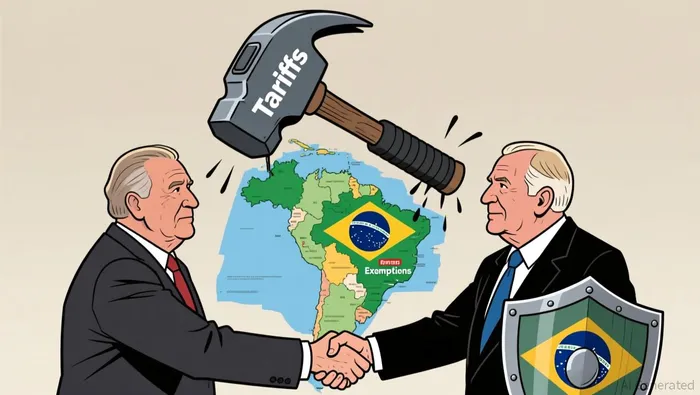
The structure reminds you of the old playbook. The threat does the work. The actual implementation is designed to be survivable. That's not a bug - it's the feature. A tariff that actually destroyed a trading partner's key exports would require Lula to negotiate in desperation. A tariff that looks scary but exempts the stuff that matters gives Lula room to play the sovereignty card while Flávio plays the personal-relationship card, and Trump plays to both audiences.
For an ordinary investor watching Brazil, the question isn't whether the tariff hurts. The question is which side wins the October election and what trade policy that actually looks like after November. If Lula wins and continues his current approach, the pattern suggests more of the same: big threats, big exemptions, manageable economic pain. If Flávio wins and brings the Bolsonaro brand back to the presidency, the personal dynamic with Trump becomes harder to model, which is its own kind of risk.
The simplest model is this: the tariff is a political instrument. The 1,600 exemptions are the part where the political becomes economic again. They're the quiet acknowledgment that the US needs Brazil as a trading partner even while the headline demands punishment. Who bears the actual risk? The smaller Brazilian exporters who didn't make the exemption list. Who captures the upside? Lula, with a campaign ad ready to go; Trump, with a tough-trade headline; and Flávio, with a White House photo and a plausible argument that he has the ear of the most powerful man in the world.
The structural implication is that when trade policy serves as election strategy, the economic damage gets calibrated to the political need. The tariff isn't meant to break Brazil. It's meant to give Brazil's president something to point at while he tries to win an election. That's not normal trade. It's diplomacy in costume.