VYM vs HDV: The Yield Gap Is Not the Real Question
The first thing you notice is the yield gap. HDV sits around 2.9%. VYM is closer to 2.2%. On paper, HDV looks like the better income grab - you get more cash per share, and if dividends are what you're here for, that's the number that should win.
But yield is the easiest trick in the business. The question isn't how much each fund pays today. It's what those payouts are built on, and which ones survive when the environment shifts.
Let's look at what's actually producing the income.
What each fund holds tells you more than what each fund yields
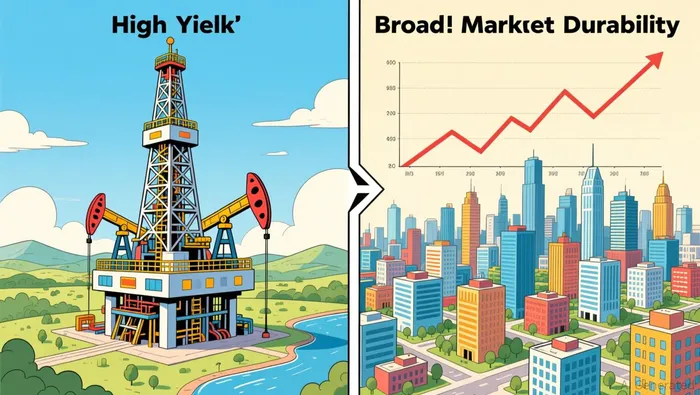
HDV tracks the Morningstar Dividend Yield Focus Index and funnels heavily into sectors that happen to pay a lot - because that's literally how the index is constructed. It picks high yielders. As of early 2026, consumer staples sits at roughly 27% of the portfolio. Energy and healthcare round out the top three. Exxon Mobil alone is about 10% of the fund; Chevron adds another 7%. Together, those two oil majors represent a third of what's driving HDV's headline number.
That concentration is what earns the yield - and what makes it vulnerable. Energy dividends look great when oil is stable and cash flows are strong. They look very different when prices cycle down and companies have to choose between maintaining the payout and protecting the balance sheet. It's not that energy dividends are unreliable. It's that their reliability is tied to commodity prices, not to a structural cash-flow engine you can predict. You're betting the cycle stays kind.
VYM, by contrast, tracks the FTSE High Dividend Yield Index and weights by market cap, which naturally spreads the exposure. Financials make up about 22% - with JPMorgan Chase as the second-largest holding. Technology runs second at the sector level, with Broadcom sitting at roughly 8% of the fund, a position that wouldn't appear in HDV at all. Healthcare and financials provide stable income; the tech tilt gives you exposure to companies whose dividends are funded by growing cash flows rather than mature, cash-rich balance sheets.
The yield is lower, but the payout engines are different. You're not just buying dividends - you're buying the businesses that produce them.
Which dividend is more durable?
Here's where the income investor's instinct should kick in. When you need income to fund actual life - groceries, utilities, that mortgage payment - you don't want your payout tied to whatever oil is doing. You want dividends that come from businesses whose cash flows are structural, not situational.
HDV's concentration in staples and energy means two things: first, the yield is genuinely earned from real portfolio cash flows, not accounting tricks. That's a good thing - it's not supplementing distributions with return of capital. Second, when the cycle turns, those are the dividends under the most pressure. Energy companies that look like dividend castles in good years become the first ones on the chopping block when revenue drops.
VYM's financial exposure introduces a different risk - interest rate sensitivity. When rates fall, bank net interest margins compress and that pressure can flow through to dividend growth. But VYM's broader construction means that risk is diversified. A rate hit to JPMorgan doesn't take down the whole income stream the way an energy downturn can take down HDV's top three holdings.
The expense ratio doesn't decide this
HDV charges 0.08%. VYM is around 0.04%. The fee difference is real - but at these magnitudes, it's a rounding error over any reasonable holding period. Don't let the expense ratio distract you from the structural question. A quarter-basis-point advantage doesn't matter when the real issue is whether your dividends keep coming.
So which one actually pays you?
If you need income now and believe the commodity cycle stays cooperative, HDV's higher yield is real money in your pocket. There's nothing dishonest about it. The dividends are legitimate, the companies are large and established, and BlackRock's iShares platform is institutional-grade.
But if you're building an income architecture that needs to keep paying across cycles - not just this cycle - VYM's broader base is the more defensible structure. You trade some current yield for a payout profile that isn't dependent on oil staying expensive or consumers staying generous.
The honest answer is that these two ETFs aren't really competing for the same role. HDV is a concentrated income play. VYM is a diversified income play. If your portfolio runs thin on financials and technology exposure, VYM fills a gap. If you already own plenty of broad-market dividend stocks and want a targeted high-yield slice, HDV adds a different texture.
What would change the call?
For HDV: a sustained drop in energy prices below $60 a barrel, or a recession that hits consumer staples spending. Either scenario would test whether that 2.9% yield holds or whether coverage gets squeezed.
For VYM: a prolonged low-rate environment that crushes financial margins, or a tech slowdown that pulls Broadcom-style payers down. The risk is softer - but it's there.
The bottom line for the income investor: don't pick the fund with the higher number. Pick the one whose underlying businesses you can trust to keep paying when things get uncomfortable. The yield gap is about 70 basis points. The difference in what that yield depends on is much larger.
We're here to collect income, not to chase yields that vanish the moment the cycle turns.