Philippines Arrests Its Own SEC Director - And That Is the Point
The Philippines has spent years priced as a governance discount. Foreign direct investment fell 31% year-over-year through February 2026. Short-term foreign funds exited in January. The PSE index languished around 5,912. The story has been simple: you get a corruption premium whether you like it or not, and there is no reason to expect it to change.
Then the National Bureau of Investigation - with the SEC cooperating, not fighting - arrested one of its own top directors in an entrapment operation over alleged corporate extortion. The news broke June 3. The headline looks like another corruption scandal. That is exactly why you should pay attention.
The market is still pricing the old story: a system too entrenched to self-correct. But an enforcer arresting his own regulator while a reform-minded chair runs the show is a different data point than a rogue official caught in isolation.
The proof point is institutional, not individual
Chairperson Francis Edralin Lim, appointed in June 2025, has been building toward this moment. He is not a politician - he's a corporate law specialist and former PSE chief, brought in specifically to clean house. Since taking office, his moves have run in one direction:
- He imposed a hard 9-year term limit on independent directors, closing loopholes that let the same names sit on boards indefinitely. Listed companies fought it. He held the line.
- He cut SEC document fees by 50%, removing a long-standing friction point for small and mid-sized businesses.
- He introduced a "deemed approved" system for registration applications, so companies stop waiting months for a stamp that used to be both slow and expensive - two conditions that feed rent-seeking.
These are not press releases. Each one removes a vector for extortion. When a regulator controls the timeline for approval, someone always asks what it costs to speed things up. You shorten the timeline and standardize the process, and the rent-seeking shrinks. That is the mechanism.
Now a top SEC director has been caught trying to do the very thing Lim's reforms are designed to prevent - and the institution itself cooperated with the arrest. That is the detail that matters. It is one thing for an external agency to take down a corrupt official. It is another for the agency under reform to participate.
Why the tape does not care yet
The PSE closed at 5,912 on June 2, the day before the arrest news broke. There is no rerating because the market has no habit of pricing one enforcement action. It takes sustained signal. Lim has been at it for 12 months, and the reform arc is becoming visible, but institutional credibility compounds slowly.
More importantly, the broader macro headwinds are loud right now - oil price volatility, peso weakness, the ongoing political turbulence from the flood-control corruption scandal that led to Senator Jinggoy Estrada's arrest this month. These are real, and they are enough noise to bury a governance inflection in the daily tape.
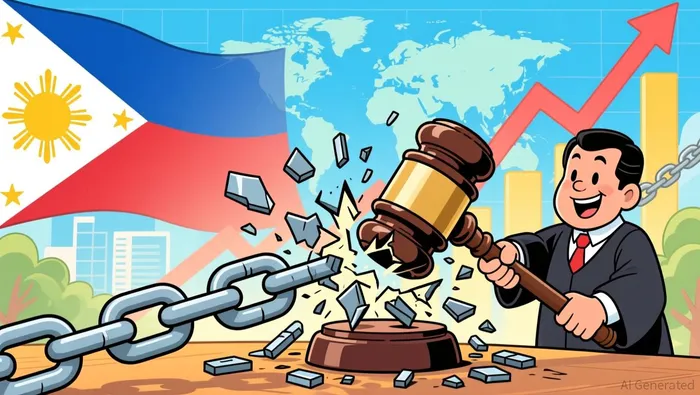
This isn't about excitement. It's about whether the structural cost of doing business in the Philippines - the corruption discount embedded in every valuation - starts to compress. You can't build a DCF model around institutional integrity. But you can watch whether foreign capital stops leaving.
The financial bridge
Here is what you track:
- FDI inflows. They fell 31% year-over-year through February 2026. That is the number. If Lim's reforms hold, that trend should stabilize and reverse within two quarters. Investors do not put permanent capital in jurisdictions where the regulator extorts them. An SEC director caught doing exactly that, and removed with institutional cooperation, is the kind of signal that changes risk models - eventually.
- Foreign fund positioning. Short-term foreign money exited in January 2026. The PSE has disputed the scale of the market's losses from corruption - saying P185 billion lost rather than the P1.7 trillion the SEC initially claimed - but the directional truth remains. Foreign money leaves when governance risk rises. You watch for it to stop.
- The reform calendar. Lim has proposed even stricter boardroom governance rules. The 9-year term limit is already in effect. The next inflection is whether these rules survive the pushback from the conglomerates that benefit from the old system.
The risk
I can be wrong. One arrest does not rewrite a system. The Philippines has a long history of anti-corruption announcements that evaporate by the next fiscal quarter. The flood-control graft scandal is still unfolding - 18 suspects named, a senator in custody - and that is a reminder that institutional rot runs deeper than one agency's cleaning effort.
The thesis breaks if Lim's reform agenda stalls, or if the SEC director's arrest proves to be a politically motivated outlier rather than the first of a pattern. If subsequent quarters show FDI continuing to fall and foreign funds continuing to exit, then this is just noise on the old story, not the beginning of a new one.
But if you are positioned in Philippine equities, or thinking about it, the question over the next 12 months is not whether the country will be perfectly clean. The question is whether the market's worst-case assumption - permanent decay - starts to look stale. An enforcer turning on his own, under a chair who has spent a year systematically removing the plumbing that makes extortion possible, is a setup worth watching. The cash flows of the companies on that exchange do not change today. But the risk premium applied to every single one of them might.
Tripwire: if the reform calendar freezes, or if the next six months produce another wave of regulator arrests without corresponding policy enforcement, the inflection thesis is broken. Discipline over ego.