Raizen's $12.6 Billion Restructuring Is a Creditor Rescue, Not a Shareholder Win
Brazilian sugar and ethanol producer Raízen has reached a debt restructuring agreement covering $12.6 billion (~R$65 billion) with a majority of creditors. The company announced the initial deal in March 2026 and presented its final plan on June 3. S&P Global ratings Raízen CCC+. Fitch has it at B. The preferred shares trade on Brazil's B3 exchange at R$0.38 - down more than 80% from the company's 2021 IPO price.
The headline number is the restructuring size. The real story is the mechanism: 45% of the restructured debt will be converted into equity. Existing shareholders - including co-owners Cosan (44% stake) and Shell (44% stake) - will be diluted into a much smaller piece of the reorganized company. The plan also calls for separating Raízen's bioenergy and fuel-distribution units and injecting fresh capital.
This is a creditor rescue. For equity holders, it is a dilution event.
The mechanism that matters
Under the plan presented to creditors, nearly half of the company's debt becomes equity. Here is what that means in practice: creditors who would otherwise have to negotiate haircuts or extended maturities instead become new shareholders, claiming 45% of the post-restructuring ownership pool. Existing shareholders' stakes are compressed proportionally. If Cosan and Shell each held 44% before, that percentage shrinks into a smaller fraction after the swap.
Raízen needs 98% creditor approval for the plan to bind all participants. The company says it has informal majority support as of early June. That is a pass but not a guarantee - holdout creditors can block the deal if the threshold isn't met.
The debt that broke the capital structure
As of June 30, 2025, Raízen carried R$63.7 billion in total debt. Fitch projected net leverage near 4.0x for fiscal 2026. S&P's December 2025 update projected leverage climbing to 4.5x by end of fiscal 2026, after peaking at 5.6x in September 2025. Annual interest obligations were running roughly R$9.3 billion at those leverage levels.
That is what triggered the crisis. Raízen reported a R$15.6 billion net loss in the third quarter of the 2025/26 crop year, driven by a R$11.1 billion non-cash impairment triggered by the rating downgrades. The company also posted a R$2.3 billion net loss in the prior quarter. Sugar and ethanol prices were volatile, and the capital structure - loaded with debt at rising Brazilian interest rates - became unsustainable. Fitch projected R$9.3 billion of annual interest payments at 4.5x–5.0x leverage; that kind of fixed cost leaves no room for operational misses.
The business underneath
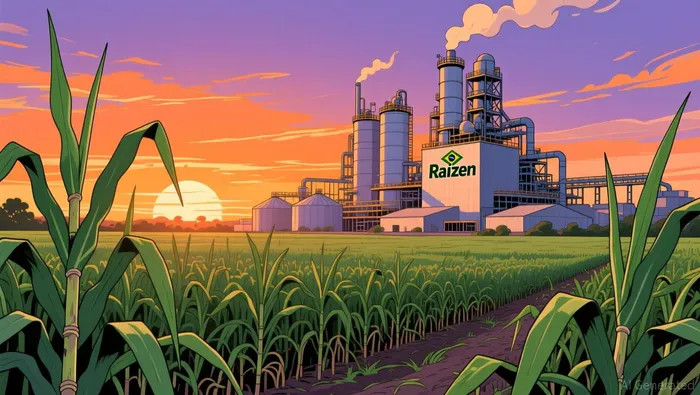
Raízen is Brazil's largest sugar and ethanol producer and one of the country's top energy companies by revenue. The joint venture was formed in 2011 when Cosan's sugar mills merged with Shell's fuel distribution network. The company produces over 3 million cubic meters of ethanol annually, operates one of Brazil's largest mill complexes, and achieved commercial-scale second-generation ethanol production in 2024–2025 - a cleaner-burning biofuel with lower lifecycle emissions.
The assets are real and hard to replace. Brazil's ethanol infrastructure is deeply entrenched, the sugarcane supply chain is concentrated, and Raízen's mill network spans the country's most productive growing regions. This is not a paper company with no floor.
But the business has been destroying value under the weight of its own leverage. The restructuring is the only path to survival.
The Cosan exposure
For US-based investors, the exposure runs through Cosan (NYSE: CSAN), which owns 44% of Raízen. Cosan's ADR trades at roughly $2.79, down 27.5% from the start of 2026. S&P downgraded Cosan to BB- in March, citing Raízen's debt crisis as a direct drag on its credit profile.
Cosan's Q1 2026 results showed a net loss of R$1.6 billion, partly driven by non-cash impairment charges tied to Raízen's deterioration. Cosan has been reducing its own debt - cutting expanded gross debt by R$6.5 billion and extending average maturity to 6.1 years - but the Raízen exposure remains the single largest overhang.
If the debt-to-equity swap goes through, Cosan's effective stake in Raízen shrinks. The parent company's exposure to the JV doesn't disappear; it just becomes a thinner slice of a restructured entity. That matters for anyone modeling Cosan's standalone value.
The valuation gap
Raízen's market capitalization sits at approximately R$4 billion against an enterprise value of roughly R$65 billion. The gap between market cap and enterprise value is the debt - the very debt being restructured. If the plan succeeds, the enterprise value drops materially as debt converts to equity and fresh capital is injected. But the market cap won't rise proportionally because the share count effectively expands.
The preferred stock at R$0.38 is not a cigar butt. A cigar butt trades below the asset value of an intact equity claim. Here, the equity claim itself is being redefined. Until the restructuring closes and the new capital structure is known, there is no provable per-share asset value to anchor a valuation.
What happens next
The plan requires 98% creditor approval. If it passes, Raízen emerges as a split company - bioenergy on one side, fuel distribution on the other - with a lighter debt load and new creditor-shareholders holding 45% of the reorganized equity. If it fails, the company enters judicial recovery, and the dilution gets worse.
For existing Raízen shareholders, the outcome is binary but asymmetric: either a diluted stake in a cleaner entity, or a near-total write-off. For Cosan holders, the restructuring removes the credit overhang but compresses the value of the Raízen stake.
Investment thesis
This is not a turnaround play for equity holders. It is a restructuring where creditors get equity and shareholders get diluted. The underlying assets - Brazil's largest ethanol and sugar operation - are valuable and operationally real. But the equity slice belonging to current shareholders is shrinking faster than the business can recover.
The issue is not whether Raízen's mills are worth something. The issue is whether the post-swap equity claim - however diluted - can compound from a clean balance sheet. If the restructuring closes and the reorganized entity trades at a discount to its asset base with manageable leverage, that is the moment to reassess. Until then, the gate hasn't cleared.
Rating: Avoid. The restructuring serves creditors, not shareholders. There is no entry point that offers margin of safety for RAIZ4 or CSAN until the new capital structure emerges and a post-restructuring valuation can be modeled.