Argentina's crypto enforcement gap - and who actually polices digital money
The headline is almost too absurd to use as the spine of an article: Argentina's anti-corruption investigators are stuck because their free-trial blockchain forensics software has expired and they haven't renewed it. They were tracing about $4.8 million in LIBRA token funds. Without the tool, they can't.
The deeper story isn't the expired subscription. It's what the gap reveals about who actually gets to enforce rules in a world where money moves on-chain.
The LIBRA scandal, briefly
If you've been offline, here's the short version. In February 2025, Argentine President Javier Milei posted about a cryptocurrency called $LIBRA on X, describing it as a private project to fund small businesses. The token's price spiked, then collapsed. Entities tied to the token's creator pulled roughly $99 million in liquidity.
Argentina's Congress launched a probe. The securities regulator passed rules banning exchanges from listing tokens like LIBRA. And then things got complicated - because the investigating body, UFECI, the national anti-corruption agency, simply didn't have the tools to follow the money.
The expired license
In early June, reports emerged that UFECI's crypto-tracking software - which they'd been using on a free trial - had lapsed. The agency still needs a paid subscription. Politicians are now urging budget support. The probe is stalled.
Here's where the contrast matters. Circle, the US-based issuer of the USDC stablecoin, froze nearly $58 million in USDC wallets linked to the LIBRA team after an Argentine federal court issued a temporary restraining order. Circle could act because USDC is a permissioned token - the issuer controls the underlying contracts and can freeze addresses at the protocol level. An emerging-market government agency can't do that with on-chain funds on its own.
Circle has enforcement power baked into its product design. UFECI has an expired free trial.
What this is actually about
Argentina is a useful stress test for something I keep thinking about: when a country embraces crypto - whether ideologically, through regulation, or because inflation has already made people permissionless-payment-curious - does its state apparatus actually gain the capacity to police it?
In this case, the answer is a qualified no. Argentina legislated crypto rules within months of the LIBRA collapse. It passed Article 37, which forbids exchanges from listing tokens similar to LIBRA. But the investigative plumbing wasn't built. Blockchain forensics - the discipline of tracing, analyzing, and documenting on-chain transactions to produce legally admissible evidence - requires paid software platforms, trained analysts, and sustained budgets. UFECI had none of it, and now the investigation is frozen over a licensing issue.
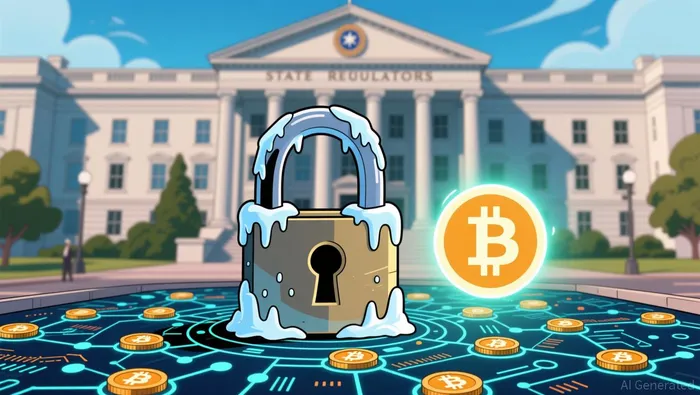
The irony isn't lost on anyone who follows frontier-market crypto adoption. Argentina has some of the highest per-capita crypto engagement in the world, driven by a currency that has lost most of its value over the past decade. People use stablecoins to preserve purchasing power. And yet the state's ability to investigate crypto-enabled financial crime rests on whether it can afford the next quarterly subscription fee.
Who actually sits between digital money and the user
The LIBRA case shows the asymmetry. A Delaware-registered stablecoin issuer responded to a foreign court order and locked $58 million in digital assets. The sovereign state that was directly harmed by the same scheme couldn't trace $4.8 million of it because the software was free for a while, and now it isn't.
This isn't unique to Argentina - though it's unusually visible there. Most emerging-market regulators don't have enterprise-grade blockchain intelligence platforms. They don't have teams of analysts who can follow cross-chain fund flows. And in many cases, they can't directly access or freeze on-chain assets unless a centralized intermediary - an exchange or a stablecoin issuer - cooperates.
That means the real enforcement power in crypto doesn't sit where people assume it does. It sits with the entities that control permissioned layers: stablecoin issuers, exchanges, custodians. Circle, Tether, Binance - they're the ones who can freeze, delist, or report. The state's role is increasingly to ask nicely, via court order or regulatory pressure, and hope the intermediary complies.
In the US, this dynamic has been a political fault line. Stablecoin issuers have been pushed to align with US sanctions and AML frameworks, partly because their survival depends on maintaining access to the dollar. In Europe, MiCA is building similar obligations into the regulatory fabric. Argentina just found out the hard way what happens when your enforcement machinery isn't connected to those rails.
What comes next
The LIBRA investigation isn't over. In March 2026, new forensic evidence surfaced linking messages between Milei and the token's promoters around the time of launch, and opposition lawmakers revived the probe after reports of a draft $5 million promotion deal. So there's still material to investigate. The question is whether UFECI gets funded, or whether the case continues to depend on outside actors doing the tracing.
I'm more interested in the structural question: as more countries adopt crypto regulation without building parallel investigative capacity, who fills the gap? The answer, for now, is whoever controls the choke points in the settlement layer. If you want to understand who really governs digital money in 2026, don't start with the legislation. Start with who can hit the freeze button.
Argentina's expired software license is an embarrassing detail. But it's an honest one.