Raizen's $12.6 Billion Restructuring Is a Hostile Takeover in Accounting Clothing
Raizen creditors are asking for 90% of the company in exchange for forgiving 45% of its debt. The headline calls it a debt restructuring. The economic reality is that bondholders and banks are using the balance sheet as a lever to take control of a Shell–Cosan joint venture.
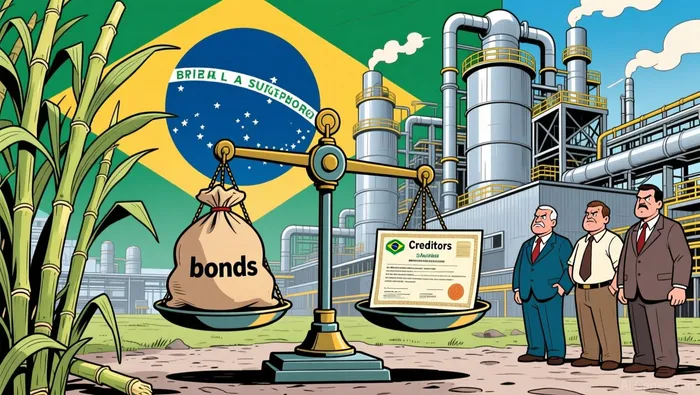
The competitor wire says Raizen has "reached" a $12.6 billion deal with majority creditors. That language implies closure. It isn't closed. Creditors began evaluating the latest proposal in early June. They haven't voted. The real story isn't whether the deal clears - it's who owns the company after it does.
The machine, stripped down
Raizen is the world's largest sugar-cane ethanol producer and a major Brazilian fuel distributor. It was built as a 50/50 joint venture between Shell and Cosan, a Brazilian conglomerate controlled by sugar-baron Rubens Ometto, who chairs Raizen's board. Shell brought fuel distribution networks; Cosan brought sugar mills and ethanol plants. It was supposed to be a clean partnership.
By the end of 2025, Raizen's net debt had climbed to R$55.3 billion - roughly $11 billion. The company posted a R$15.6 billion loss in the third quarter of its 2025/26 fiscal year, driven by an R$11.1 billion impairment charge. Fitch had downgraded its debt to C, which is essentially the rating equivalent of "probably not getting paid back." The debt package under negotiation covers international bonds, local debentures, agribusiness receivable certificates, and rural credit notes - R$65 billion total, or about $12.6 to $13 billion depending on when you check the exchange rate.
The basic point is not that Raizen has too much debt. The basic point is that the people who lent the money are now doing what distressed creditors always do: turning their claims into ownership. The question is how much.
Creditors want 90%. That's the number that matters.
The draft plan, first unveiled in March, included converting 45% of restructured debt into equity at R$0.25 per share. Creditors responded by asking for 90% of the company in exchange for that 45% haircut. They also demanded R$8 billion in fresh capital from shareholders and the removal of Rubens Ometto as chairman.
That is not a normal restructuring ask. In a typical workout, creditors want enough equity to have a seat at the table and downside protection. Asking for 90% means creditors are trying to flip ownership. They're not just protecting their downside - they're trying to become the company.
Raizen filed for extrajudicial reorganization in March, which is Brazil's out-of-court restructuring process, and separately obtained Chapter 15 relief in New York to protect against creditor actions in U.S. courts. The company needed approval from more than 50% of senior unsecured creditors to bind the plan. By mid-April, only 47% of unsecured creditors had signed on. The numbers haven't been binding.
The shareholder split is the hidden story
Here's where the plumbing gets interesting. Creditors demanded fresh capital from the owners. Shell agreed to inject R$3.5 billion - roughly $699 million, though earlier reports floated figures up to $765 million. Cosan, controlled by Ometto, did not match the contribution. One way or another, Cosan is also exploring splitting its own business.
When one side of a 50/50 joint venture writes the check and the other doesn't, the side that writes the check gets diluted. Shell's injection was always going to come with strings. The string is control. Shell made an early bid for Raizen with a larger check than Cosan, reportedly with no business split - meaning Shell wanted the whole company, not just half.
Creditors know this. They used it. By demanding Ometto's removal and refusing to cut a deal without serious shareholder skin in the game, they positioned themselves as the arbiter between the two owners. Shell and creditors are not exactly on the same team, but they're aligned on one thing: Cosan and Ometto lose their grip.
The alternative proposal Raizen sent in late April, and the final plan that creditors began evaluating in early June, represent the company's attempt to thread this needle. The R$0.25-per-share conversion price stayed in place. Shell's capital commitment stayed. Aguassanta, a Brazilian holding company linked to Cosan's broader empire, was floated as a possible additional capital source.
So what kind of financial machine is this?
This is an old structure in a new costume. In the 2000s, emerging-market distressed debt was a straightforward trade: buy the bonds cheap, wait for the restructuring, get equity. The difference now is that the creditors are organized enough to demand the terms in advance rather than discovering them after the fact.
The 90% equity ask is not sustainable - no shareholder writes real money into a company where bondholders get 90% of the result. But it was never meant to be accepted. It was meant to set the ceiling for the negotiation. The real deal will land somewhere between "creditors get a majority" and "creditors get a very large minority with board seats and protection." That's what the June proposals are arguing about.
The business split angle - separating Raizen's bioenergy unit from its fuel distribution unit - matters because it changes the asset pool creditors can reach. Fuel distribution is a lower-risk, cash-flowing business. Bioenergy is the growth story but also where the losses live. Which assets go into which bucket determines which creditors get paid from which engine.
The conclusion isn't whether the deal closes. It's who Raizen becomes.
The structural implication is clear. Cosan and Ometto are going to lose control of something they built. Shell is going to end up with more influence and probably more of the company than it started with. Creditors are going to get a large equity block and governance rights they didn't have before. The exact percentages are still being haggled over as of early June.
The simplest model is this: a 50/50 joint venture where one partner puts up capital and the other doesn't becomes, by necessity, a one-partner company. The creditors are just the ones holding the pen while the new ownership gets written.
The real question for anyone watching from the outside is whether the post-restructuring Raizen - whatever its final capital structure - is actually worth the equity that will be created. The impairment charges, the debt load, and the fact that the company needed this much capital at this much dilution to survive suggest the answer is uncertain. The machine is solvable. The economics are the part that's still being tested.